Sneak peek at Boeing/Saab T-X candidate (snout only):



Credit: Saklatvala collection
A 201 Sqn Sunderland GR5 – taken on this very day (16 Sept) in 1956.

An air-to-air right side view of a 50th Tactical Fighter Wing F-16A Fighting Falcon aircraft in formation with a 36th Tactical Fighter Wing F-15D Eagle aircraft during a dissimilar aircraft combat tactics exercise.
The 1980s was the last decade to witness air-to-air combat on a large scale, and the fighters of this age were impressively capable machines. Advances in radar, missile and man-machine interface technology produced extremely potent machines that were far easier to fly and fight in than their 1960s forebears. In the past, enemy aircraft had been safe hiding in the clutter of ground returns, but by the mid-80s many fighters had a look-down/shoot down capability making the sky a far more dangerous place.
In producing a top ten, I don’t hesitate to add all the normal disclaimers: each aircraft has strengths and weaknesses at different heights, speeds and in different situations; pilot quality and tactics are more important than hardware. The ordering one to ten has involved consideration, but is ultimately arbitrary. Aircraft considered that failed to make the grade included the Kfir C2, which deserves an honourable mention, but was pipped to the number ten slot by the Sea Harrier. The RAF’s Phantom FGR.2s were also capable machines, despite the airframe being passed its prime. The RAF’s Tornado F.Mk 2/3 were flying in late 1985 but were grossly immature- lacking as they were a functional radar or even the provision for chaff and flares. Though at a push the Tornado ADV and F-14 interceptors can be described as ‘fighters’, the MiG-31 seems a trifle too specialised to be featured but was certainly an impressive machine that is worth a mention. Upgraded MiG-21s would have given half the aircraft on this list a run for their money in the ‘merge’, but were too poorly equipped to make selection.
Here are the ten most potent fighters of 1985:
10. BAe Sea Harrier FRS.Mk 1

The Sea Harrier is the oddest aircraft on this list: its top speed was half that of the other aircraft, it could only carry half the amount of missiles and its radar had half the detection range. Yet, it managed to perform well in the air-to-air mission in the Falklands War of 1982. Its virtues were its high thrust-to-weight ratio and that it was small and smokeless, but the main reasons for its success were its highly-trained pilots and the excellent AIM-9L missile. It could also operate in weather conditions that would have kept any other carrier fighters on or under the deck. The Harrier family pioneered the use of vectored thrust for abrupt decelerations and unexpected manoeuvres in the dogfight, though these have not been used in actual air combat.
Keep this blog alive!
To keep this blog going- allowing us to create new articles- we need donations. We’re trying to do something different with Hush-Kit: give aviation fans something that is both entertaining, surprising and well-informed. Please do help us and click on the donate button above – you can really make a difference (suggested donation £10). You will keep us impartial and without advertisers – and allow us to carry on being naughty. Once you’ve done that we hope you enjoy 10 Incredible Soviet fighter Aircraft that never entered service. A big thank you to all of our readers.
See the top ten jump-jets here
9. Dassault Mirage F1

The Dassault Mirage F1 proved itself a formidable fighter in the Iran-Iraq War: one jet alone got a dozen kills. In this long bloody war, the F1 also downed several F-14s, making it the first type to bring down the mighty Tomcat. In service with the South African Air Force it was fitted with a helmet-cueing system and the respected Kukri air-to-air missile.
8. Saab JA37 Viggen

Though not the highest performance airframe, the JA37 was one of the world’s best-equipped fighters in 1985. At this time the Viggen had just received a secure datalink allowing the sharing of encrypted information. This innovation, years ahead of other nations gave the fighter an enormous edge in situational awareness. Its electronic warfare equipment was also world-class. The Skyflash, that armed the JA37, was the best medium range missile in the world. The Viggen’s agility was inferior to the new generation of Soviet, US and French fighters.
Click here for the Top Ten Swedish aircraft.
7. Dassault-Breguet Mirage 2000C

Described by many that have flown it as a perfect machine, the ultimate Mirage was an absolute thoroughbred. Fast, agile and easy to fly, it was a well-balanced design. The fly-by-wire system cured most of the worst vices associated with the delta wing. In 1985 the Mirage was fitted with the unimpressive Thomson-CSF RDM (Radar Doppler Multifunction) which had a limited look down/shoot capability and the Matra Super 530F semi-active radar guided missile. Though a capable fighter- the design was not close to the formidable machine it would become later in its life.
Top Ten French aircraft here
6. General Dynamics F-16C

The F-16 did not have a beyond-visual-range weapon until the Sparrow-capable Block 25 of mid-1984; but in 1985, it was still an immature model riddled with software problems. Despite this, the F-16C was an extremely agile, long-ranged aircraft and a worthy opponent for any fighter in the world in the close-range dogfight. Like the F-15, the F-16s first saw combat with the Israeli air force; a Syrian Mi-8 and MiG-21 were shot down in 1981. In the 1982 Lebanon War, Israel claimed 44 kills for the F-16 for no losses (a large number of the aircraft destroyed were Syrian MiG-21 and ‘23s).
Top Ten fighter aircraft at the outbreak of World War II here
Get to see more articles like this by donating (buttons above and below on this page). Many thanks.
5. Mikoyan MiG-29

The MiG-29 of 1985 would have been able to destroy most F-16s at arm’s length, armed as it was with medium range R-27 missiles (most F-16s had nothing more potent than short-ranged Sidewinders). Opponents that got closer to the MiG-29 would face an almost unbeatable fighter armed with the world’s best short range air-to-air missile, with an unprecedented off-boreshot capability cued by a helmet ‘look, shoot’ system (something the West would not have until the 1990s). Its manoeuvrability was breath-taking due to extremely powerful and tolerant engines, and advanced aerodynamics. Its weaknesses were short-range, poor man-machine interface and smoky engines. Remarkably, early MiG-29s did not include a fly-by-wire system.
4. McDonnell Douglas F/A-18A Hornet

In 1985 the F/A-18 had the most user-friendly cockpit in the world, the best multi-mode radar and the best low-speed manoeuvrability of any western fighter. Unlike the F-16, it had a mature Sparrow capability. The F/A-18 set new standards for a multirole fighter that Europe and Russia could only follow. Its weaknesses lay in its disappointing range and its poor performance at high speed and high altitude.
Click here to see how things have changed in 2015 (Top Fighters of 2015).
3. Grumman F-14A Tomcat

The F-14 flew with both the US Navy and the Islamic Republic of Iran Air Force. The F-14’s most notable weapon was the ultra-long range AIM-54 Phoenix missile, capable of destroying hostile aircraft 100 miles away (at least in theory). The main problem with the F-14A was its unreliable Pratt & Whitney TF30 engines, which were prone to stalling, and were insufficiently powerful to get the most out the airframe. The F-14, designed as a fleet air defence interceptor was also not as agile as the F-15 or Su-27. The F-14 proved devastatingly effective in the Iran/Iraq War. By 1985, the most successful F-14 pilot, Jalil Zandi of the IRIAF, had downed seven Iraqi aircraft including Mirage F1s, Su-22s, MiG-21s and MiG-23s. The F-14 was the elite fighter of the IRIAF and it is claimed that it destroyed 160 enemy aircraft including 58 MiG-23s, 23 MiG-21s, nine MiG-25s, 33 Dassault Mirage F1s, 23 Su-17s and five Tu-22s.
Check out the ten worst carrier aircraft here.
2. Sukhoi Su-27

After a problematic development, the Su-27 began entering service with the VVS in 1985. In kinematic terms, the Su-27 was the best fighter of 1985, with superior manoeuvrability to the F-15, especially at lower speeds. Its manoeuvrability was unbeatable, and combined as it was with the same helmet/R-73 missile combination as the MiG-29, it would have proved almost invincible in the close-range dogfight.It had an impressive range, though at maximum weights it was not a particularly agile aircraft. It also had a large weapon load, normally consisting of six R-27 medium-ranged missiles and two R-73s, backed up by a 30-mm cannon. Another system it shared with the MiG-29 was a combined infra-red search and track/laser range finder sensor. At this time IRSTs were out of vogue with western air forces and offered Soviet fighters an advantage in ‘silent’ passive detection. In 1985 the Su-27 was just bedding into frontline service and just misses the top spot through a lack of maturity.
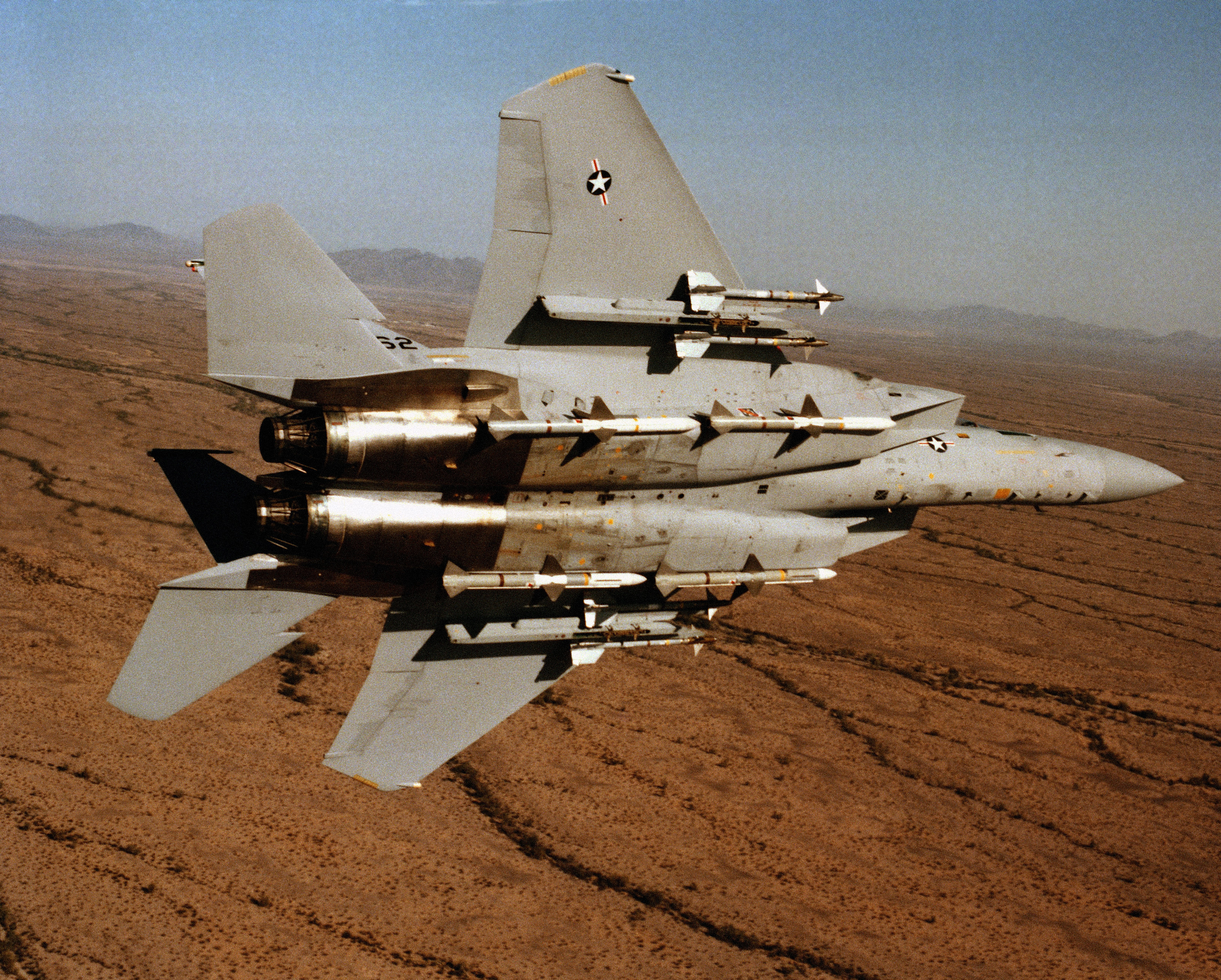
An air-to-air underside view of an F-15 Eagle aircraft from the 555th Tactical Fighter Training Squadron, 405th Tactical Training Wing, Luke Air Force Base, Arizona, banking to the left. The aircraft is equipped with four AIM-9 Sidewinder missiles on the wing pylons and four fuselage-mounted AIM-7 Sparrow missiles.
The earlier F-15A, though excellent in many ways, suffered from an immature radar and disappointing endurance. The F-15C, which entered service in 1979 rectified these problems and demonstrated McDonnell Douglas’ mastery of fighter design. The Eagle’s air superiority was achieved through a mixture of unprecedented manoeuvrability and acceleration, and advanced avionics, making it the benchmark of 1980s fighters. The F-15 was an uncompromised air superiority fighter, designed to excel in both within- and beyond visual range engagements. For the first time, USAF had a fighter with a thrust-to-weight ratio that exceeded unity at combat weight. The brute force of its large APG-63 radar gave it excellent detection range and a hearty resilience to electronic countermeasures. The aircraft was fast, and armed with up to eight air-to-air missiles and a M61 rotary cannon with 940 rounds. The first production Multistage Improvement Program (MSIP) F-15C was produced in 1985, which carried an upgraded central computer, the Programmable Armament Control Set, allowing for advanced versions of the AIM-7, AIM-9, as well as provision for the forthcoming AIM-120A missiles. In 1985 the Su-27 was still finding its legs, but the F-15 was combat proven; Israeli F-15s had scored multiple kills with no reported losses.
Want to see more stories like this: Follow my vapour trail on Twitter: @Hush_kit
Thank you for reading Hush-Kit. Our site is absolutely free and we have no advertisements. If you’ve enjoyed an article you can donate here. At the moment our contributors do not receive any payment but we’re hoping to reward them for their fascinating stories in the future.
Have a look at 10 worst British military aircraft, Su-35 versus Typhoon, 10 Best fighters of World War II , top WVR and BVR fighters of today, an interview with a Super Hornet pilot and a Pacifist’s Guide to Warplanes. Was the Spitfire overrated? Want something more bizarre? The Top Ten fictional aircraft is a fascinating read, as is The Strange Story and The Planet Satellite. The Fashion Versus Aircraft Camo is also a real cracker. Those interested in the Cold Way should read A pilot’s guide to flying and fighting in the Lightning. Those feeling less belligerent may enjoy A pilot’s farewell to the Airbus A340. Looking for something more humorous? Have a look at this F-35 satire and ‘Werner Herzog’s Guide to pusher bi-planes or the Ten most boring aircraft. In the mood for something more offensive? Try the NSFW 10 best looking American airplanes, or the same but for Canadians.
Follow my vapour trail on Twitter: @Hush_kit
 In a 2007 interview with former General Wesley Clark, he described how Rumsfeld told him (on the 20th September 2001), “We’re going to take out seven countries in five years, starting with Iraq, and then Syria, Lebanon, Libya, Somalia, Sudan and, finishing off, Iran.” The reasons for these vast, and potentially catastrophic, actions were vague, however Rumsfeld noted that the US had a strong military, ‘“I guess if the only tool you have is a hammer, every problem has to look like a nail.”
The danger of finding problems that fit your tool is known as the ‘Law of the instrument’ or ‘Maslow’s hammer’. This idea was expressed in 1964 by the American philosopher Abraham Kaplan as: “Give a small boy a hammer, and he will find that everything he encounters needs pounding.”
As we have mentioned before, military plans and military inventories are not independent bodies. The aircraft your air force chooses, will, to a large extent dictate how you can use your air force. The ramifications of armed unmanned aircraft have been well-explored (such as in the excellent Wired for War by P. W. Singer), the consequences of stealth aircraft less so.
In attempting to justify the F-35, some have hinted at breakthrough technologies onboard the aircraft that are classified and enormously impressive. While all F-35 claims can be taken with a grain of salt (remember the Lockheed Martin boast of superior kinematics to any 4th generation fighter?) it seems likely that one of these technologies is electromagnetic-pulse based.
This development has entered the White world in several recent projects, notably the Boeing Counter-electronics High-powered Advanced Missile Project (CHAMP). These weapons use microwave radiation to fry enemy electronics, crippling computers or even knocking the power system out for an entire building (it should also be noted that missiles contain electronics). Other possible candidates for ‘technology-X’ on the F-35 include extremely aggressive electronic attack modes to disable enemy radars, including computer virus insertion. If this were the case, it would combine with the F-35’s low-observability to produce an ‘asymmetric fighter’ capable of Black ops. As with unmanned aircraft, this could led to small scale military operations without the bother of international accountability. The F-35, which will inevitably serve in smaller numbers than now anticipated, will not be well suited to 21st century offensive warfare’s central mission of close air support. Though it may well excel in the other important modern role: intelligence, surveillance and reconnaissance (ISR). The F-35 to was conceived excel in Desert Storm-style warfare, it was to be used in blitzkrieg (later, and with added emphasis on the psychological, known by the revealingly repulsive term ‘shock and awe’) operations.
Israel is expected to receive its first F-35s in 2016. The Israeli air force has a long history of surprise air attacks on enemies or potential enemies outside of declared wars— at the risk of losing aircraft, and thus deniability and national prestige. If the F-35 performs as advertised (to use a cliche that has long attached itself to the programme) then it would by the ideal aircraft for Israel to threaten or attack Iran.
For other F-35 users, especially in NATO, the type’s usage- with its emphasis on off-base, centralised maintenance and sealed box components — will make it further apparent that their air forces are little more than ancillary wings of USAF. Whereas today it would be hard to conduct prolonged military operations without US consent (considering the large amount of US technology used by all NATO nations), in the days of the F-35 it would be impossible.
Follow my vapour trail on Twitter: @Hush_kit


Jim Smith had significant technical roles in the development of the UK’s leading military aviation programmes. From ASRAAM and Nimrod, to the JSF and Eurofighter Typhoon. We asked his opinion on what we can learn from the Northrop N-102 Fang design of the 1950s.
“This is a fascinating little design. From the drawings and other information provided, the intent was to develop a Mach 2 capable ‘high-altitude’ day fighter, with armament featuring guns and unguided rockets. A single engine was to be used, and either the J79 or Sapphire is mentioned.
Looking at other designs which might have been contemporaries, the aircraft wing area is in between that of the MiG-21 (which has about 20% less) and the Mirage III (which has about 20% more). The wing area is about 50% more than the Starfighter, and all these aircraft are powered by broadly similar thrust engines in the 10,000 lb class.
The Fang has a very compact fuselage design, and, in most of the illustrations provided, a rather small and close-coupled butterfly tail. The engine is underslung in a pod, and overall the aircraft appears small and relatively simple in design and construction.

So at first glance, what might one expect from this little aircraft ? Well, turning performance should be much better than the Starfighter, and the relatively thin delta wing, coupled with high power to weight ratio and reasonable wing area should provide pretty good acceleration and climb performance.

From a weapons system perspective, the combination of guns and unguided rockets as the armament choice does reflect the description of a ‘day fighter’. Although radar is mentioned, the space available appears quite small, and while this might aid an intercept, the emphasis appears to be strongly on WVR air combat. That might represent a bit of a missed opportunity compared to some of the rival aircraft. As drawn, the packaging of the front of the aircraft does look very tight, probably to minimise weight and frontal area.
From a configuration perspective, the biggest concern is probably the placement of the butterfly tail and its relatively small size. Roll-yaw coupling (sometimes called inertia coupling) can be a problem for aircraft with low roll inertia compared to pitch and yaw inertias.
The concentration of mass along the fuselage, and the short span can lead to violent departures from controlled flight if, for example, a roll manoeuvre results in an upset in pitch or yaw. Problems of this sort are exacerbated when low aerodynamic damping exists, due perhaps to high altitude and insufficient stability, particularly in yaw.

Typical solutions to this problem include large fin area, sometimes supplemented by ventral fins – compare late-mark versions of almost any early supersonic fighter aircraft with the initial prototype, and you will see the impact. For the Fang, the problem is likely to be compounded by the probability that the relatively small fins will be less effective at higher incidences due to blanketing by the airflow around the fuselage and wing.
Consequently, I much prefer the tailed-delta version of the aircraft shown in one of the illustrations. The taller tail fin, coupled with the low-set tailplane offer the prospect of a much more controllable aircraft, both in relatively low-speed manoeuvring air combat, and high altitude supersonic flight.
From a propulsion perspective, an aircraft aimed at a Mach 2 requirement should have some form of variable shock intake, and the configuration looks suitable for a Mirage-like shock cone intake. Without such an intake Mach 1.6 to 1.8 is probably the maximum that could be achieved.

With the addition of a bigger radar, a shock-cone intake, and the carriage of the early Sidewinder (or similar) missile, the US could have had a very decent MiG-21! Mind you, I think it wouldn’t be long before more fuel, external tanks, and refuelling probe might have been required.
I do think the Fang was a bit of a lost opportunity. My very first reaction to the design was, rather mischievously, to note that a developed Fang would make a very decent competitor for the Tejas …”
 Northrop proposed the Fang for an early 1953 USAF need for a high-altitude day fighter, though this vacancy was eventually won by the F-104 Starfighter, this design is a fascinating insight into the thinking of Northrop. Though the aircraft never flew it is fair to make a few guesses based on the aircraft’s general configuration. With a far lower loading than the F-104 its sharply swept delta and v-tail would have probably imbued the aircraft with a high instantaneous turn rate, and generally greater agility than the F-104. Northrop would return to the v-tail for the unsuccessful rival to the Raptor, the YF-23. If sufficiently powered (the Sapphire and J-79 were both considered) the Fang would have enjoyed swift acceleration. A novel aspect studied was the ability to readily change not just engine unit, but engine type, to allow for mission optimisation.
For armament, twin packs of 20- and 30-mm cannon were considered as were wing-root mounted 2-inch rockets, conventional and nuclear weapons.
The Fang was far smaller than F-104, with a greater emphasis on manoeuvrability, design priorities that would later lead to the superb F-5 family.
Want to see more stories like this: Follow my vapour trail on Twitter: @Hush_kit
Have a look at How to kill a Raptor, An Idiot’s Guide to Chinese Flankers, the 10 worst British military aircraft, The 10 worst French aircraft, Su-35 versus Typhoon, 10 Best fighters of World War II , top WVR and BVR fighters of today, an interview with a Super Hornet pilot and a Pacifist’s Guide to Warplanes. Was the Spitfire overrated? Want something more bizarre? The Top Ten fictional aircraft is a fascinating read, as is The Strange Story and The Planet Satellite. The Fashion Versus Aircraft Camo is also a real cracker. Those interested in the Cold Way should read A pilot’s guide to flying and fighting in the Lightning. Those feeling less belligerent may enjoy A pilot’s farewell to the Airbus A340. Looking for something more humorous? Have a look at this F-35 satire and ‘Werner Herzog’s Guide to pusher bi-planes or the Ten most boring aircraft. In the mood for something more offensive? Try the NSFW 10 best looking American airplanes, or the same but for Canadians. 

The Lightning was designed to defend mainland Britain against jet bombers. The point defence role required speed and climb rate over endurance, and the Lightning was certainly successful in these respects.
English Electric Lightning. Three words which sit so beautifully together (ignoring the tautology of ‘electric’ lightning). The charged air of English skies ripped apart by riveted lunacy. The Lightning was quite mad: a greedy machine set on eating fuel and turning it into speed. Unlike anything else its two Avon engines were stacked one on top of the other making it stand monstrously tall on the ground.

The unique stacked engines created less drag than side- by-side engines. If one was to fail the thrust would still be on the centreline (in theory this was safer, though would put a lot of strain on the surviving engine).
The Lightning would scorn today’s tedious drones controlled by gamers in porta-cabins. The Lightning was the anti-thesis of the UAV- it was essentially a manned missile, tricksy and twitchy – and it killed more of its own pilots than it did enemies (it actually did not see combat). When it entered service in 1959 it could outfly and outfight any of its peers, but failure to adequately upgrade the Lightning made it obsolete, while its performance was still unbeaten. Its astonishing maximum climb rate of 50,000 feet a minute was not equaled by a Western fighter until the F-15 entered service in 1976. While other fighters were getting Pulse Dopplers and radar-guided missiles, the Lightning was stuck with an antiquated radar and a missile armament of only two equally old-fashioned missiles (the contemporary F-4 Phantom II could carry eight). When it was retired it 1988, the Lightning still did not have the ability to carry chaff or flares (essential for survival) or a radar warning receiver (which alert the pilot to the presence of hostile radars).


The Lightning was Britain’s first, and only, Mach 2 fighter. Flying the Lightning was the most sought after position in the RAF, it was a delightfully exhilarating and agile aircraft for those brave enough to fly it! Image: Michael Hall.
Lightning at a glance
Nicknames: The Frightening
Who used it? The air forces of Kuwait, Saudi Arabia and Great Britain. Today the private
company Thunder City provides civilians the chance to fly in a Lightning.
First flight? 1957
How many were built: 337
Any good? Its phenomenal performance was marred by its poor endurance and weapons systems. As a point defence intercepter it was excellent. An early assessment against the US F-106 left the Lightning pilot with the impression that he had the best fighter in the world. By the late 1960s, it was behind the technology curve.
Rivals? There was no direct equivalent to the Lightning.

The first U-2 was designed and built a mere eight months after the contract was signed (today a military aircraft takes around twenty years to enter service). The project was led by the great Kelly Johnson and developed in such great secrecy that even Congress was unaware of it.
For almost sixty years U-2s have penetrated the inhospitable darkness of the stratosphere to snoop on America’s least favourite nations. From their first mission over the USSR in 1956, the soviets were aware of the presence of these CIA-operated intruders, but were powerless to destroy them; fighters of the 1950s simply could not catch an enemy flying at 70,000 ft.

Gary Powers and a U-2. At the crash site of his aircraft, soviet investigators found a packet of Kent cigarettes, a .22 pistol and a suicide pill. When Powers returned from his imprisonment in a spy swap in 1962, the CIA sent a female agent to secretly test if he had been turned by the soviets; Powers and his investigator fell in love and got married.
Things changed on May Day 1960 when a U-2 was shot down by a soviet surface-to-air missile. The CIA pilot Gary Powers was captured and sentenced to three years in prison followed by seven years of hard labour (of which he served only two). The US cover story that it was a weather plane that had flown off course was never believed by the soviets- the U-2 had fallen to the ground almost intact, allowing its secret equipment to be studied at leisure. The shoot-down was a diplomatic disaster for the Americans (spying overflights were technically an act of war), one that Premier Khrushchev exploited for maximum effect when he stormed out of a planned summit meeting in protest. This was also the first time that the general public had heard of this highly classified project. The U-2 was not safe over the USSR, but was still a useful reconnaissance tool. It would not be long till the U-2 would spark another Cold War imbroglio, this time one that brought the world calamitously close to a nuclear war; in 1962 U-2s photographed preparation for the installation of a soviet missile base in Cuba, triggering the Cuban missile crisis.Since then the U-2 has spied in almost every continent, identified war graves and carried out research for NASA.
This ghostly aircraft may end its life rather lonely, as in 2015 work began on developing an unmanned version.
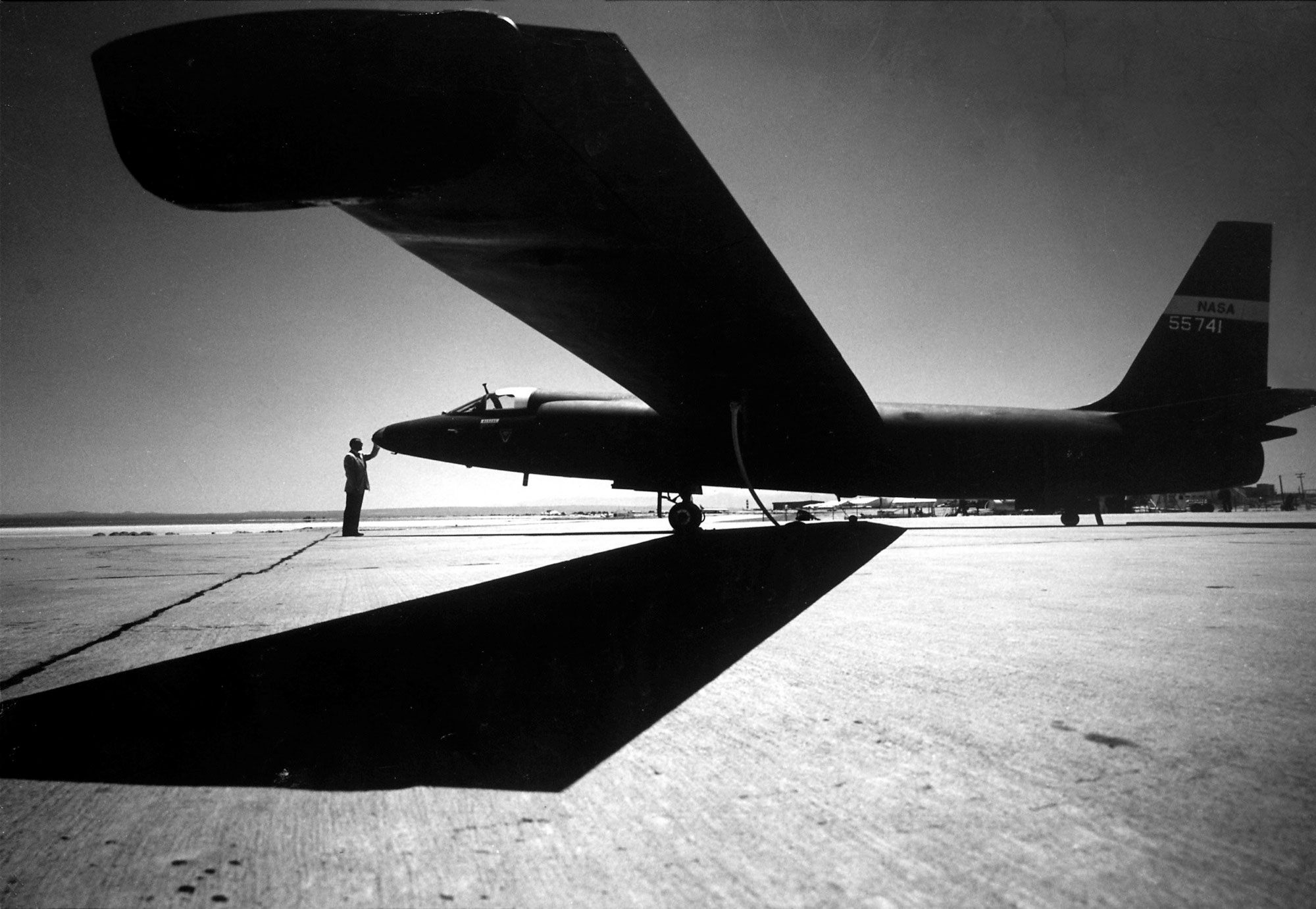
All of the U-2 family have extremely thin broad wings. These ‘high aspect’ wings are like those of sailplane, the huge wing area is needed to cruise in the very thin air of the lower stratosphere. Like many official stories about the U-2, the NASA markings are baloney and were only applied to conceal the aircraft’s real role.

The CIA secretly supplied U-2s to the Taiwanese air force (RoCAF) to spy on mainland China. The aircraft were flown by the 35th Squadron, known as the Black Cats. Of the nineteen aircraft flown by the RoCAF, eleven were lost, five of these being shot down over China.
U-2 at a glance
Nicknames: Gray Ghost, Shady Lady, Angel, and Dragon Lady
What so special about it? It can fly very high and has special cameras and
sensors for spying. Later versions have a data-link for transmitting this
intelligence back to base.
Who used it? The CIA, USAF. RAF, RoCAF, NASA
First flight? 1955
How many were built: 86
Any good? In high threat places it had a nasty habit of getting shot down, but
must be pretty good as it has had a very long service life.
Rivals? The English Electric Canberra PR.9 could fly pretty high too (a licence-
built Canberra was also used by USAF for reconnaissance). The Myasishchev M-
17 Stratosphera (NATO codename ‘Mystic’) was the closest thing to a soviet
equivalent (that we know of), one of the M-17’s missions was to shoot down US
reconnaissance balloons.
In popular culture: the Irish rock band U2’s name may have been influenced by
the U-2.
Have a peek at other material: There’s a whole feast of fantastic British, French, Swedish, Australian, Japanese , Belgian, German and Latin American aeroplanes. Want something more bizarre? The Top Ten fictional aircraft is a fascinating read as is the Top Ten cancelled fighters.
Read an interview with a Super Hornet pilot here.
Follow my vapour trail on Twitter: @Hush_kit

Military aircraft take too long to develop, cost too much to manufacture and are consequently available to air arms in insufficiently small numbers. Here’s how to avoid the current mess.
1. Prioritise development
For a frontline aircraft, here is the order of priority:
Sensors/software: average development time 18 years to maturity
New guided munitions/development/integration: average development time 17 years to maturity
Engines: average development time 15 years to maturity
Airframe: average development time 10 years to maturity
Strangely, the reality is almost the opposite with an aircraft starting life in the wind tunnel, despite aerodynamics being the most predictable facet of modern aircraft development.
2. At least two of the following components must be already available off-the-shelf: sensors/engines/airframe (note that former two can be replaced in upgrades).
3. Invest a large amount in a short development time. However terrifying this figure may be, it is guaranteed to be less than the 25 years it currently takes a frontline aircraft to go from concept to operational service. 10 years is not unreasonable. Do not let the requirement be altered during development.
4. Three simple metrics should dominate the design process: power-to-weight/reliability/range, however wonderful the weapons systems promise to be they will benefit from these inherent advantages.
5. Plan who will pay for upgrades in the future.
6. Small factories (of the lowest possible tech) close to all component assemblies (to make this work it must be made clear that the cost savings outweigh the political advantages of multi-state collaboration).
7. The A variant will have insufficient fuel, electrical and processing power for upgrade, this is normal, but plan how it will be rectified in the B or C model.
SAVE HUSH-KIT. Hush-Kit needs donations to continue, sadly we’re well behind our targets, please donate using the buttons above or below. Many thanks. I really hope Hush-Kit can continue as it’s been a fascinating experience to research and write this ridiculously labour-intensive blog.

Can you identify this? No cheating please.
