How did the United States, which invented the first fixed wing powered aircraft, fall so distantly behind the Europeans in military aviation by the end of World War I? The US got a slow start for several reasons, including a general apathy for the war and a lack of institutional will. An underrated villain, though, was the problematic application of intellectual property protection, a problem that the United States defence establishment continues to struggle with.
Intellectual property protection and national security have long been intertwined. For as long as espionage has existed, spies and agents have tried to steal and copy foreign technology. Early modern kings used patent protection to provide monopolies for important supporters, as well as to reward efforts at innovation in military technology.
When the development of military equipment (and especially naval equipment) became cost-prohibitive for private companies at the beginning of the 20th century, the government stepped in to support research and production. This came with a price (detailed in Katherine Epstein’s wonderful book Torpedo), which usually included ownership of the patents and trade secrets associated with the resulting technologies.
Modern military aviation began just as industrialisation began to overtake war. The successful first flight of the Wright Flyer in December 1903 was a magnificent engineering achievement, especially given the limited resources available to the Wrights. The brothers moved aggressively to counter anyone who used anything approaching their system of guidance, which they interpreted broadly to mean anything that changed wing surface in order to affect manoeuvrability (for more, see Lawrence Goldstone’s Birdmen). The Wrights hoped that the United States government would come through with a big cash payment for rights to the machine, and in fact refused to even demonstrate the flight in front of large audiences out of fear of theft.
Unsurprisingly, this made it difficult for other inventors to build upon their achievements. Almost any aircraft could run afoul of the “wing change” claim, even though the particular ‘wing warping’ technique used by the Wrights was not replicated in many other aircraft of the era. In 1909, the Wrights sued Glenn Curtiss for patent infringement following the developing of his own aircraft, which used lever-controlled aileron to manage manoeuvrability. The legitimacy of the Wright’s claim remains in some dispute, and the suit played out across a host of legal venues in several different countries, but never resulted in a significant finding for the Wrights.
Glenn Curtiss on his V8 motorcycle
The Wright’s obsession with litigation, combined with the unfortunate death of Wilbur, slowed innovation within the firm and made it ever more important to profit from already existing intellectual property. At least one history describes them as “patent trolls,” but this term usually connotes a genuine grifter, not an over-zealous inventor. Wright Co. suffered, but so did the rest of American aviation as inventors hesitated to develop new technologies out of fear of debilitating lawsuits from the Wrights. Some pre-emptively avoided the problem by paying off Wright Co. ahead of time, but the threat of lawsuits generated bad blood and deterred sharing.
Sadly, this site will pause operations in June if it does not hit its funding targets. If you’ve enjoyed an article you can donate here.
SPAD S.XIII in livery of Capt. Eddie Rickenbacker, 94th Aero Squadron.
As a result, despite having a huge economy and a vast industrial base, the United States found itself breathtakingly behind European standards as the war began. Rather than build its own aircraft, it relied on European producers, straining industries already working at near maximum capacity. US pilots would enter the war flying foreign aircraft, with the US aviation industry far behind its competitors.
The patent fight wasn’t the only reason for US unpreparedness for World War I. The Army had not devoted sufficient attention to aviation in the years before the war, leaving responsibility with the Signal Corps, which was under-resourced and struggled to develop a strong procurement plan or any theories of offensive and defensive warfare. Unlike in Europe, the executive did little to push the Army into developing a more aggressive aviation strategy. Moreover, the US aviation industry struggled even to produce European models under license, as US production methods were not well-suited to the craftsmanlike approach of the early aircraft production.
Eventually, the prospect of war in Europe drew the conflict into clearer focus. The United States government pressed the major aircraft manufacturers (including Wright and Curtiss) to enter a ‘patent pool’ which would ensure access to critical inventions but ensure the payment of a reasonable fee. Not coincidentally, this gave the government a stronger hand in negotiations with manufacturers, driving down overall prices. Most historians (but not all) concur that the dispute dramatically slowed the development of US aviation, both in
the military and civilian sectors. Eventually, clearing the tangles enabled the United States to develop a thriving, multifaceted aviation industry that would serve the country well in the Second World War.
Theoretically, strong patent and trade secret protection encourages innovation by giving inventors incentive, as well as a mechanism to protect any information that they share with other inventors. But the system sometimes breaks down. Inventors, reluctant to give up exclusive rights in the civilian market, balk at selling out to the government. Department of Defense officials can be overzealous in their pursuit of the data, trade secrets, and patents necessary to maintain the production of military equipment after the original producer has lost interest. And governments sometimes use intellectual property law as a cudgel to hammer small businesses, or to undercut unwanted competition. The turn of the 19th century saw tremendous changes in the legal context of the production of military technology, and the turn of the 20th century seems to have seen something very similar.
Make this happen! Support the crowdfunded Hush-Kit Book of Warplanes by pre-ordering your copy of our book here
From the cocaine, blood and flying scarves of World War One dogfighting to the dark arts of modern air combat, here is an enthralling ode to these brutally exciting killing machines.
The Hush-Kit Book of Warplanes is a beautifully designed, highly visual, collection of the best articles from the fascinating world of military aviation –hand-picked from the highly acclaimed Hush-kit online magazine (and mixed with a heavy punch of new exclusive material). It is packed with a feast of material, ranging from interviews with fighter pilots (including the English Electric Lightning, stealthy F-35B and Mach 3 MiG-25 ‘Foxbat’), to wicked satire, expert historical analysis, top 10s and all manner of things aeronautical, from the site described as
“the thinking-man’s Top Gear… but for planes”.
The solid well-researched information about aeroplanes is brilliantly combined with an irreverent attitude and real insight into the dangerous romantic world of combat aircraft.
FEATURING
Interviews with pilots of the F-14 Tomcat, Mirage, Typhoon, MiG-25, MiG-27, English Electric Lighting, Harrier, F-15, B-52 and many more.
Engaging Top (and bottom) 10s including: Greatest fighter aircraft of World War II, Worst British aircraft, Worst Soviet aircraft and many more insanely specific ones.
Expert analysis of weapons, tactics and technology.
A look into art and culture’s love affair with the aeroplane.
Bizarre moments in aviation history.
Fascinating insights into exceptionally obscure warplanes.
In flight picture of VZ608 [Credit: NAM Archive, via Rolls-Royce]
I want to support air museums during lockdown by raising awareness of their many treasures. With this in mind I have contacted several museums and asked them to share the story of their favourite exhibit (if you are part of an air museum and wish to take part please contact me here or by Twitter or Facebook). Let’s start with Newark Air Museum and their exceptional Gloster Meteor. Over to Museum Trustee, Howard Heeley.
“I have always liked how Newark Air Museum [NAM] has acquired airframes associated with aircraft development and testing. My favourite aircraft in the collection that illustrates this policy is Gloster Meteor VZ608.
VZ608 was constructed as a standard FR.9 and saw squadron service with 208 Squadron, before being transferred to the Gloster Aircraft Company for conversion to testing duties.
The extended reheat nacelle is visible in this picture of VZ608 [Credit: NAM Archive]
In early 1951 VZ608 was transferred to Rolls-Royce at Hucknall, Nottinghamshire. Here its engine nacelles were extended and modified to house a reheat system; a fifteen-month test programme saw VZ608 undertake both static and flight trials of the system. In early 1954, VZ608 was modified again, with an elementary thrust reverser being fitted to the port jet pipe.
In the early 1950s work was also underway at Hucknall on the V-TOL [Vertical Take Off and Landing] concept, using an experimental test-rig to investigate control and stability factors affecting V-TOL flight. Eventually this led to their designing the TMR [Thrust Measuring Rig], which affectionately became known as the ‘Flying Bedstead’. Two TMRs were constructed and these undertook a range of tethered and free flights whilst at Hucknall.
Meteor F8 WH443 that we acquired from Falfield, Gloucs to replace VZ608 [Credit: NAM Archive]
Rolls-Royce also ran a parallel development programme to the TMR, which saw the development of the RB.108 vertical lift engine for use in the Short SC.1 Research Aircraft, which had been developed by Short Brothers & Harland Limited in Queens Island, Belfast. At the time an advantage of the RB.108 design was that it was able to generate nearly 10 pounds of thrust per pound of engine weight, a significantly better performance that other existing engines.
VZ608 languishes in the Rolls-Royce Hucknall Fire Section [Credit: NAM Archive]1
VZ608 was selected for modification to undertake the initial flight trials of the RB.108. Fitment trials with the engine began in 1955 with the RB.108 positioned in the fuselage aft of the cockpit, replacing the main fuel tank. Underwing fuel tanks were added to extend endurance but in this configuration VZ608 was limited to 30 minutes flying. The orientation of the engine could be altered in flight to simulate vertical flight, with a replica of the Short SC.1 air scoop fitted to accurately simulate SC.1 aerodynamics.
TMR [Thrust Measuring Rig] -the ‘Flying Bedstead’ [Credit: NAM Archive]
Correspondence and Log Book entries in the NAM Archive from test-pilot Alan Bavin confirm the details of the first running of the RB.108 lift engine as follows. “Following on from our interesting meeting the other day and our discussions about my old Meteor VZ608, I am enclosing a copy of my log book page which records the very first running of the RB.108 lift engine in flight. As you see, it took place on 23rd October 1956. Prior to that, I completed windmilling tests on 14th September with the bare engine and further similar tests with the lower spoiler [we called it a coal scuttle] the engine windmilled backwards”
VZ608 entries from Alan Bavin’s Log Book [Credit: NAM Archive]
He continued, “The early engine, once lit and running in a low idle condition, had to be inched up to flight idle by a manually operated bleed valve. It also had no Acceleration Control Unit [ACU] which necessitated very careful throttle handling. Flight idling was at 14,000 rpm and top speed was 17,500 rpm. Later engines would automatically run up to flight idle after light up and the ACU would allow for extremely rapid throttle handling both up and down the range. I think the intake you have on VZ608 at the moment is the one used on the SC.1”.
VZ608 entries from Alan Bavin’s Log Book [Credit: NAM Archive]
Following on from the flight trials film footage in the NAM Archive also shows VZ608 being used to assess ground erosion and foreign object ingestion. This involved running the aircraft over a variety of loose materials on the ground, whilst the effect of the jet efflux from the RB.108 was monitored and recorded. The RB.108 subsequently proved itself and VZ608 was eventually transferred to the fire section at Hucknall.
Schematic views of the Short SC1 [Credit: NAM Archive]
In February 1970 NAM arranged an exchange deal involving the hulk of Meteor F.8 WH443 and was thereby able to rescue VZ608 from the fire dump. The airframe, with outer wings removed was transported by road to the museum’s Winthorpe Airfield Site as a ‘special’ wide load by permission of the Ministry of Transport.
February 1970 and VZ608 is loaded and ready for transportation to NAM’s Winthorpe airfield site [Credit: NAM Archive]
Poor quality picture of the thrust reverser modification to VZ608 [Credit: NAM Archive]
Befitting its role in aviation testing and the V-TOL programme in particular, the VZ608 planform was incorporated into the NAM logo. During the mid-1990s a structural survey of the airframe revealed major corrosion on various spar sections and a major restoration programme was completed; this work, included replacement of the damaged spars.
VZ608 ingress trials.jpg – VZ608 undertaking ground erosion and foreign object ingestion trials [Credit: NAM Archive, via Rolls-Royce]
Meteor FR.9 VZ606 is now displayed inside NAM’s Display Hangar 2, alongside Sea Harrier ZA176 and various engines and objects associated with VTOL development in the UK.
VZ608 is offloaded at the museum site on the former RAF Winthorpe in 1970 [Credit: NAM Archive]
14 VZ608 Hangar 2.jpg – VZ608 on display in Hangar 2 and awaiting visitors during ‘Lockdown 2020’[Credit: Howard Heeley]
VTOL objects displayed alongside VZ608 in Hangar 2. Note the model of the proposed BAe P.1214 supersonic STOVL tactical fighter. [Credit: Howard Heeley]
VZ608 with one of the RB.108 modifications [Credit: NAM Archive]
Support the crowdfunded Hush-Kit Book of Warplanes by pre-ordering your copy of our book here
From the cocaine, blood and flying scarves of World War One dogfighting to the dark arts of modern air combat, here is an enthralling ode to these brutally exciting killing machines.
The Hush-Kit Book of Warplanes is a beautifully designed, highly visual, collection of the best articles from the fascinating world of military aviation –hand-picked from the highly acclaimed Hush-kit online magazine (and mixed with a heavy punch of new exclusive material). It is packed with a feast of material, ranging from interviews with fighter pilots (including the English Electric Lightning, stealthy F-35B and Mach 3 MiG-25 ‘Foxbat’), to wicked satire, expert historical analysis, top 10s and all manner of things aeronautical, from the site described as
“the thinking-man’s Top Gear… but for planes”.
The solid well-researched information about aeroplanes is brilliantly combined with an irreverent attitude and real insight into the dangerous romantic world of combat aircraft.
FEATURING
Interviews with pilots of the F-14 Tomcat, Mirage, Typhoon, MiG-25, MiG-27, English Electric Lighting, Harrier, F-15, B-52 and many more.
Engaging Top (and bottom) 10s including: Greatest fighter aircraft of World War II, Worst British aircraft, Worst Soviet aircraft and many more insanely specific ones.
Expert analysis of weapons, tactics and technology.
A look into art and culture’s love affair with the aeroplane.
Bizarre moments in aviation history.
Fascinating insights into exceptionally obscure warplanes.
Geoff Richards was an aerodynamicist at BAe Kingston. Here he details more about the Small Agile Battlefield Aircraft.
With the Soviet Mi-28 Havoc attack helicopter under development, the BAe Kingston Future Projects team began to look for ways to counter this new threat. The study was dubbed SABA, for Small Agile Battlefield Aircraft, and aimed to develop a vehicle that could out-manoeuvre and destroy helicopters like the Havoc and also provide combat air support to forces on the ground by attacking enemy armour and supply vehicles. It was to operate in all weathers, day and night, from dirt fields and have good loiter time and a high-subsonic maximum speed so as to reach wherever needed as quickly as possible. Several configurations were studied, including one with a pusher propeller and a twin-boom tail layout and another a tailless jet with a forward-swept wing and a weapons turret under the fuselage. Bringing in a requirement to carry as many as six AIM-132 (ASRAAM) air-to-air missiles as well as a gun helped to narrow down the choice of wing planform to a conventional minimal sweep one with enough span to fit the missiles under the wing. This requirement was a response to the suggestion that Soviet helicopters would operate in groups rather than singly.
Two configurations emerged as favourites. The P.1233-1 had a canard layout, a wing swept slightly forward and an unducted fan pusher propeller system powered by a modified T-55 engine. It also featured a dorsal air intake for the engine, dorsal and ventral fins and a rudder mounted under the nose.
The P.1234-2 was a more conventional ALF-502 turbofan-powered aircraft with twin fins and side-mounted intakes forward of the wing, like the Hawk. It was seen as a reserve should the new propulsion system of the P.1233-1 prove impractical. Both configurations included full-span flaperons for manoeuvrability and good short-field performance, an infra-red seeker and laser ranger targeting sensor in the nose and a conventional tricycle undercarriage.
As the name implied, both were small, with a span of 11 m and maximum take-off weight of five or six tonnes. The small size helped survivability, giving low optical and radar signatures. The P.1233-1 also had a low infra-red signature, helped by mixing cold air into the engine exhaust. The main line departments at Kingston were called in to look into various aspects in more detail and this is where I came in as one of a small team to do a detailed wing design. The other two members, Jack Wedderspoon and Ian Cairns, both came from BAe Weybridge, bringing their experience of the Airbus A320 wing design.
Credit: British Cancelled Projects
We applied our respective design tools to the project, including CFD methods, and showed that both configurations were able to achieve the design agility target of a 180° turn in five seconds with a 150 m radius. SABA was publicly announced in late 1987, but although it reportedly attracted a good deal of enthusiasm from the military, government funding was not forthcoming.
There was a later version, the turbofan P.1239 with radar-stealth features and an unusual central weapons bay holding vertically-launched missiles, but the approaching end of the Cold War provided the final blow to SABA prospects. As with so many projects on my CV, it failed to leave the paper stage.
‘I absolutely love this book. Seriously well-informed, seriously funny, authoritative and full of passion for its subject. No one writes about aviation like Joe Coles. We’re lucky to have him. The Hush-Kit Book of Warplanes is my aviation book of the year.’
From the cocaine, blood and flying scarves of World War One dogfighting to the dark arts of modern air combat, here is an enthralling ode to these brutally exciting killing machines.
The Hush-Kit Book of Warplanes is a beautifully designed, highly visual, collection of the best articles from the fascinating world of military aviation –hand-picked from the highly acclaimed Hush-kit online magazine (and mixed with a heavy punch of new exclusive material). It is packed with a feast of material, ranging from interviews with fighter pilots (including the English Electric Lightning, stealthy F-35B and Mach 3 MiG-25 ‘Foxbat’), to wicked satire, expert historical analysis, top 10s and all manner of things aeronautical, from the site described as
The solid well-researched information about aeroplanes is brilliantly combined with an irreverent attitude and real insight into the dangerous romantic world of combat aircraft.
For forty four years potential foes have feared and respected the F-15 Eagle. An utterly uncompromised air superiority fighter of vast proportions, it has a combat record second to none. Throughout the 1990s and 2000s, Major Shari Williams (rtd) flew the F-15C, taking it to war in 2003. We spoke to her to find out more.
What was the general opinion of the ‘Flanker’ in the F-15 community?
“The Su-27, and more so the Su-35, are formidable opponents. The planes manoeuvrability/ power is on par with, and can often eclipse the F-15C. As with most Russian equipment, they suffer in lack of situational awareness when approaching the merge, particularly in large force scenarios. So for an Eagle driver, you want to kill the Flanker before you merge with it, or merge with such an advantage that you can get a quick kill and move on. You will not out run it, and it generally carries a lot of weapons and gas. Typically the best of any countries pilots find themselves in the Su-27/35, and they are well trained and moderately experienced pilots. But with good teamwork and overall battle situational awareness (SA), I would expect Eagles to do well, but not come out unscathed. At least that was my experience.”
And the F-16? “Ok, first, most answers in air combat are…’it depends’ It depends on skill, experience, recency of experience, are we fighting where it is optimal for one plane and not the other?
Assuming equal pilots (meaning both have the same air-air experienced and recency of experience), the F-16 is a more efficient turning plane. it enjoys a slight advantage in sustained turn ability, where as the Eagle has a slight advantage in instantaneous turn ability. The turn circles are almost identical. Depending on configurations, the thrust-to-weight ratio is all pretty close to equal.”
So how did I fight an F-16? “First I always assumed the pilot was awesome. Assuming we meet 180 degrees out with our speeds where we want them and no one with an angular advantage I would elect to take the fight single circle (the tactical scenario may not favour this is a full up air battle). My goal is to get slow and use my ability to fly at higher AOA/slower speeds than the F-16 can. The F-16 has decent AOA capability, but the FBW(fly by wire) system is limited in speed of movement of the controls as it approaches its AOA limit. The F-15 has no such limits. In my experience I usually had more air-air experience (total and recency) than the vast majority of F-16 pilots and usually had little trouble neutralising and then killing them in close. Like all victories it comes down to flying your particular aircraft at the extremes and doing it more efficiently and precisely than the other pilot. That being said, an F-16 can win a single circle fight if the adversary is not on their game, it can also lose a two- circle fight if they are not proficient at it.
Let me add this: air-air combat is incredibly fluid, it changes very fast. So even though a F-16 may have a better sustained turn rate then an F-15C, if through my intercept I can achieve 30 or more degrees of lead turn, I will happily go two circle. And that is the goal, to merge with an advantage, that way, any enemy advantage is minimised and maybe even negated and a quick kill follows. That is the goal!
I did not answer your last question. In my 2000+ hours in air combat training (just under 2000 on the F-15) I fought the Viper a lot, I have flown against many Weapon School grads, and average pilots. In most all cases, I did really well. For any fighter pilot it is about controlling the fight and forcing the fight that favours your aircraft. Because most F-16 units don’t do much air-air (A/T=Adversary Tactics folks being the exception), their experience, especially recency, was often spotty at best. So was I confident? Always. Did I do well? Usually. But everyone has bad days and good days. That is why there is no absolutes in air-air combat.”
What is the biggest myth about the F-15? “That it is unbeatable. It is not. There are many planes that are more than its equal in manoeuvrability/power. The advantage an Eagle usually has is greater SA and better training/experience.”
What is the best and worst thing about the F-15? “Size. Big means more gas and more missiles. But being large means you can be easily seen and much more easily countered in a visual fight.”
How important is aircraft size? “It depends. If the aircraft has not been found by sensors a small size is quite an advantage, it also makes it hard to see during visual manoeuvring. Size of an aircraft is a trade-off between gas, weapons and sensors (not quite as big of deal now) and ECM abilities. Example: many planes have internal ECM, they are typically the larger fighter. F-16’s carry a pod (which they can not jettison), and it is heavy and creates a lot of drag. They never practice BFM with the pod, yet in combat they would have to do BFM with the pod. That is why their training BFM is usually more sport than realistic combat-like.”
Major Shari Williams (rtd) “I was in the USAF from 90–05, Guard/Reserves 05-10 I retired as a Major. 44FS, 60th FS x 2, 335 FTS, 49th FTS.”
How many missiles do you think it would have taken to take down a Bear? “It depends on missile type and where they impact, also how long before the plane is destroyed. If you can get an AIM-120 to impact around the wing root and light the fuel tanks on fire the plane will crash, it may take a few minutes but it will go down. If you need it down quicker you can follow it up with more missiles (same side of the plane would be best) or use the gun to try to induce a wing spar failure, flight control failure, kill the crew or hit the engines.”
Would it be hard for an F-15 to catch a Blackjack at high altitude and speed? “In a tail chase ..yes it would be very hard to catch. Even if the Blackjack is aware and drags out at 30+ miles it would be hard to catch, of course if it is up high the missile range is increased. But if it turns away, the job is done!”
What was it like fighting the Draken? “Only did it once. Best analogy it was an underpowered MiG-21. Good initial turn, lost energy quickly, they had trouble keeping sight during BFM.”
Did you ever fight DACT with a F-14, if so- what was it like?
“I have fought the Tomcat. The first time I was genuinely concerned(I had seen TopGun), and I was relatively young in the Eagle. It turned out to be a joke. They were really bad. Later I fought them with the bigger GE motors, and they were better, but still just too big and heavy of a plane. Never a real issue to a competent Eagle pilot.”
How high would a F-15 get if it ignored normal ceiling limits? “It can get up there. I had one up to 67K once. Much than that and the engines get to be an issue and there is not all that much air for the controls. I was only above 50K for a few minutes. Got up there and came right back down. It was kinda uncomfortable to be up there.”
What was your most memorable mission and why? “Gosh, so many…”
Leading a 50 plane package into Iraq to strike targets
“The 50 plane package was made up of eight C model Eagles, eight E Model Eagles, six F-16CJ Weasels, ten A-6s, two EA-6s, twelve F-18s and a couple odds and ends. C model Eagles were typically first in and last out. We crossed the border, fanned out and set up CAP position between the enemy airfields and the target area. The F-16CJs were close behind to keep and SAMs/radar AAA down in/around the target area. The strike package came in, hit their respective targets and once they were off target, we started working our way back out of country. That night the enemy did not put up any planes, but did offer some SAMs and AAA. Everyone made it back safe.”
First time we committed on MiGs.
“Committing on MiGs and being locked up by MiGs, or other enemy equipment was not common in Iraq, but it did happen. Now and again, I got to experience that. The alert launch was an eye-opener, but was kinda fun, nothing big came of it, but it was something I will always remember.”
Cold launch off alert in the middle of a winter night in Korea
“We sat alert now and again at a FOL (Forward Operating location). The horn goes around midnight one cold winter night. We get to our jets, get them started and call for ‘words’. Lead breaks and I press on my own (as we had briefed). I take the runway and shove the throttles to full afterburner. In a few seconds I was climbing into the undercast 45 degrees nose high. I had been awake for about six minutes. I get pretty disoriented, but finally catch up and head out to the point I was assigned. It seemed a couple MiGs were running on a C-130 listening to broadcasts, but they could not find him, so I never got all that close. I RTB’d(returned to base), found my flight lead (who had jumped to a spare) and was heading my way. I flew an approach to minimums on a snowy runway. At this point I had maybe 300 hours of total time, and 100 hours in the Eagle. I am lucky to have not screwed up something bad!”
Sadly, this site will pause operations in June if it does not hit its funding targets. If you’ve enjoyed an article you can donate here.
First time I was shot at by AAA/SAMs
“First time we were engaged by SAM/AAA was during OSW. It happened as we trained for. We received a ‘spike’, indicating the AAA radars had locked us up. We were in the high 30’s and began random manoeuvres. It was a dit disconcerting to see AAA explode where you were a few seconds ago. But it was a great example of how our training works!”
Fighting two Marine F/A-18’s in a visual ACM fight
“My flight lead and I were doing a 2v2 against two Marine Hornets (F/A-18C). On the last engagement, they asked to do a visual setup. So we lined up line abreast of each other and checked away, got about 5 miles apart and turned in (post merge kills). My flight lead turned the wrong way and the Hornets both quickly capitalised on it and killed him. So it left me 2v1. My only advantage was that they were in the same piece of sky, on the same side of my canopy, so I could essentially BFM both of them at once…until they gained separation. They never did, and it cost them. I kept the fight tight, slowly working up my energy, and caught one Hornet extending a bit too long. I was able to take a minimum range face-shot as we merged, and called him dead, them pitched back into the remaining Hornet. We got into a slow speed fight and got to the floor with me having a slight advantage. A few seconds late I had enough separation to take a gun shot at the floor (harder than it sounds). I really should of not had that success, but they did not press their advantage early on and as the fight matured I think they lacked the experience to force where it was going. The 2v1 against Hornets was really no different than any other mission when where fought out numbered, it just stands out because it was a full blown visual setup and fight (2v2) when my flight lead turned the wrong way at the merge and was shot instantly. I was left to fight two Hornets in a visual fight, a situation that should have favoured them, but on that day it did not.”
Nothing more than a few missions most long term Eagle drivers have experienced. There are so many more that If I sat and thought about would come back to my recollection. Led some missions for Desert Fox, and a few for a classified mission.
My experiences are not all that different from any Eagle driver.”
Was the radar mature when you first flew the Eagle? “Yes, it was mature, but was constantly improved and updated with new software or ‘tapes’. On average once every couple of years or so.”
What system would you most like to have been included on the Eagle? “A nice IRST (infrared search and track) would have been great.”
Which three words best describe the Eagle?
“Training, training and training. That is for the community. For the plane itself: Thrust. Manoeuvrability. Situational Awareness.”
What should I have asked you? “Nice question. No matter what I, or other fighter pilots write, one thing to remember…it always depends. I have seen Eagles gunned by a Harrier, a T-38 and an A-4. The plane is just a tool, the pilots skill with the tool is what matters most. Building SA to arrive at the merge with more SA than the bandits usually determines the winner in a visual fight. In canned BFM (basic fighter manoeuvres ) it is more about experience, being able to fly a more exact/precise plane and aircraft capability.”
Support us by pre-ordering your copy of the Hush-Kit Book of Warplanes here
The Hush-Kit Book of Warplanes is a beautifully designed, highly visual, collection of the best articles from the fascinating world of military aviation –hand-picked from the highly acclaimed Hush-kit online magazine (and mixed with a heavy punch of new exclusive material). It is packed with a feast of material, ranging from interviews with fighter pilots (including the English Electric Lightning, stealthy F-35B and Mach 3 MiG-25 ‘Foxbat’), to wicked satire, expert historical analysis, top 10s and all manner of things aeronautical, from the site described as
“the thinking-man’s Top Gear… but for planes”.
The solid well-researched information about aeroplanes is brilliantly combined with an irreverent attitude and real insight into the dangerous romantic world of combat aircraft.
FEATURING
Interviews with pilots of the F-14 Tomcat, Mirage, Typhoon, MiG-25, MiG-27, English Electric Lighting, Harrier, F-15, B-52 and many more.
Engaging Top (and bottom) 10s including: Greatest fighter aircraft of World War II, Worst British aircraft, Worst Soviet aircraft and many more insanely specific ones.
Expert analysis of weapons, tactics and technology.
A look into art and culture’s love affair with the aeroplane.
Bizarre moments in aviation history.
Fascinating insights into exceptionally obscure warplanes.
In an earlier Air-Minded post, I wrote about the early days of aerial refuelling and the initial development of USAF tanker aircraft and refuelling methods. This post is about the USAF jet fighters, interceptors, and attack jets that depend on those tankers to get to where they’re going and back home again.
In World War II, US Army Air Force bomber crews called escort fighters ‘little friends.’ In the late 1940s the brand-new US Air Force contracted for a jet escort fighter, a plane that became the F-101 Voodoo. Jet engines use a lot of fuel, but aerial refuelling tankers were coming into common use, so the Voodoo was designed with aerial refueling capability. If you’ll indulge me, for the remainder of this post I’ll save screen toner by referring to aerial refuelling as AAR (air-to-air refuelling, the acronym used in the biz).
In the early 1950s, the USAF was of two minds on AAR: it employed both probe and drogue refuelling (the tanker trails a hose with a stabilising drogue chute on the end; receiving aircraft fly up to the drogue and plug in with a probe) and boom refuelling (the tanker extends a boom which connects to a slipway in the receiving aircraft). Probe and drogue was great for little friends but not so great for big friends. Fuel transfer through a rubber hose is slow, and bombers need a lot of fuel. Over time the big friends and boom refuelling won out, at least with the USAF: with a high rate of fuel transfer bombers can top off quickly; fighters, whose internal fuel plumbing might be damaged by high transfer rates, take on gas at a lower rate, which can be selected by the tanker’s boom operator.
‘Cherry Girl’
Even today, though, the USAF still uses both methods. All our bombers, strategic airlifters, command & control and surveillance aircraft, tankers themselves, fighter and attack aircraft, plus certain specialised mission aircraft and VIP transports (think Air Force One) use boom refuelling. USAF helicopters & tilt-rotor aircraft use probe & drogue refuelling; so do allied nation aircraft and the Navy & Marine Corps aircraft USAF tankers are often called upon to support.
Due to the nature of air refuelling it has long be a joke to compare the process to sex. At least two F-105s had sexualised images of a woman around their slipways creating a visual reference of a penetrated vagina for the boom operator. Due to the tanker aircraft generally being larger – and proving safety and nourishment it is also no uncommon to compare it to a mother feeding her young.
Back to the Voodoo, which became operational in 1957. Both AAR methods were in wide use at the time, so the F-101 was equipped with a retractable probe and slipway. The probe was stowed in the nose when not in use; the slipway was on top, aft of the cockpit. The first photo shows an F-101A, the long-range escort fighter version of the Voodoo, plugged into a KC-97 tanker boom. The second photo shows an RF-101 reconnaissance variant with its retractable refuelling probe extended, about to plug into the drogue on the end of a refuelling hose (you can also see the closed slipway on top, the light grey panel halfway between the cockpit and the tail).
F-101A boom AAR
RF-101 probe & drogue AAR
Another early jet fighter, the F-84 Thunderjet, although not used in the bomber escort role, also incorporated equipment for both AAR methods: a slipway in the left wing root for boom refuelling, and probes on the tip tanks for drogue and hose refuelling (the later swept-wing versions of the F-84, the Thunderstreak and Thunderflash, kept the slipway but did not have the tip tank probes).
F-84 boom AAR
F-84 probe & drogue AAR
The last of the so-called ‘hermaphrodite’ fighters was the F-105 Thunderchief, which became operational in the late 1950s. The Thud had both a slipway and retractable probe, both mounted in the nose. Here are two photos of Thuds taking gas. In the first photo, note how the refueling hose is connected to the end of the tanker’s boom, a method still in use by USAF KC-135 tankers. In the second photo, the F-105 on the boom is a two-seat G model used for Wild Weasel surface-to-air missile suppression during the Vietnam War (with F-4 Phantom IIs waiting their turn on the tanker’s wing):
F-105D probe & drogue AAR
F-105G boom AAR
By the way, the Thud was one of the few USAF fighters that could conduct buddy refuelling, a technique often used by carrier-based Navy and Marine fighters.
F-105 buddy refueling
Curiously, the interceptor variant of the Voodoo, the F-101B (CF-101 in Canada), did not have AAR capability. Well, it did at first … when the F-101B became operational in 1959 it was equipped with the retractable nose probe, but a fleet-wide modification in the 1960s replaced the probe with a nose-mounted infrared seeker and AAR capability was lost. The interceptor Voodoo, perhaps because of its longer two-seat cockpit, never had the slipway. This photo of an F-101B shows the hump of the IR sensor that replaced the retractable nose probe, as well as the absence of a slipway behind the cockpit.
F-101B at the Strategic Air Command Museum
USAF F-80 Shooting Star and F-86 Sabre fighters (except for a very few modified for test programs) were not AAR-capable. Nor were the first USAF jet interceptors, the F-94 Starfire and F-89 Scorpion. The F-102 Delta Dagger, the single-seat delta-wing interceptor that became operational in the mid-1950s, did not conduct AAR on normal missions, but could be fitted with a removable refuelling probe for long overseas flights. Photos of F-102s with the removable probe in place proved hard to find, and I thank my friend Joe Coles of the aviation blog Hush Kit for coming up with this one:
F-102A with removable AAR probe
The later F-106 Delta Dart interceptor was not AAR-capable when first introduced, but was later modified with a slipway for boom refuelling.
Other USAF jet fighters and attack aircraft of the 1950s and 1960s were fitted with AAR probes for hose & drogue refuelling only. These included the F-100 Super Sabre, F-104 Starfighter, A-37 Dragonfly, and the F-5 family of Freedom Fighters and Tigers.
Later USAF jet fighters and attack aircraft, including all those in the current inventory, are fitted with slipways and can only refuel by boom. These include the F-4 Phantom II, F-111 Aardvark, F-15 Eagle & F-15E Strike Eagle, F-16 Fighting Falcon, F-117 Nighthawk, A-7 Corsair II, A-10 Thunderbolt II, F-22 Raptor, and F-35 Lightning II.
Thank you for reading Hush-Kit. Our site is absolutely free and we have no advertisements. If you’ve enjoyed an article you can donate here. At the moment our contributors do not receive any payment but we’re hoping to reward them for their fascinating stories in the future.
From the cocaine, blood and flying scarves of World War One dogfighting to the dark arts of modern air combat, here is an enthralling ode to these brutally exciting killing machines.
The Hush-Kit Book of Warplanes is a beautifully designed, highly visual, collection of the best articles from the fascinating world of military aviation –hand-picked from the highly acclaimed Hush-kit online magazine (and mixed with a heavy punch of new exclusive material). It is packed with a feast of material, ranging from interviews with fighter pilots (including the English Electric Lightning, stealthy F-35B and Mach 3 MiG-25 ‘Foxbat’), to wicked satire, expert historical analysis, top 10s and all manner of things aeronautical, from the site described as
“the thinking-man’s Top Gear… but for planes”.
The solid well-researched information about aeroplanes is brilliantly combined with an irreverent attitude and real insight into the dangerous romantic world of combat aircraft.
FEATURING
Interviews with pilots of the F-14 Tomcat, Mirage, Typhoon, MiG-25, MiG-27, English Electric Lighting, Harrier, F-15, B-52 and many more.
Engaging Top (and bottom) 10s including: Greatest fighter aircraft of World War II, Worst British aircraft, Worst Soviet aircraft and many more insanely specific ones.
Expert analysis of weapons, tactics and technology.
A look into art and culture’s love affair with the aeroplane.
Bizarre moments in aviation history.
Fascinating insights into exceptionally obscure warplanes.
The most beautiful flying machines were designed in an era that stretched from just before the Great War right into the middle of the last century, the age of Art Deco. Art Deco, with its bold and optimistic embrace of modernity was partly inspired by aeronautical design. The sleekest form of Art Deco, was Streamline Moderne, which luxuriated in the flowing uncluttered lines of aerodynamics. Did the influence go both ways? When faced with two equal design solutions, most aerodynamicists will go for the most beautiful (evidence for this can be found in correspondence between Messerschmitt and Blohm & Voss designers in Dan Sharp’s fascinating book on the Bv 155) and they will naturally carry some of the tastes of their time. The relationship between art and the art of machines was never more elegantly tangled than in this temps de l’amour (though of course this was also a time of great hate and cruelty). But in this time we find an integrity between visual art and the subject thereof that was scarce before and perhaps impossible in our fragmented, post-modern daze. Aircraft with ever higher metrics of performance took on a singular gift of the purest aesthetic form. Their shapes exuded a power so seductive it came to be applied to pencil sharpeners, houses, desk fans, office buildings, cameras and canister vacuums and many other things that didn’t actually require streamlining. Release yourself from the urgencies of the fragmented digital time with this uplifting celebration of Art Deco and Streamline Moderne aeroplanes. As an added, calming, bonus most of these retro beauties were made solely for peaceful purposes.
12. Bechereau Deperdussin Monocoques
These happy French chaps have no idea that they’ll probably all be digging a trench in about six months time. Bechereau’s racers were brilliant but he is best remembered for designing the superlative SPAD VII and XIII fighters.
Louis Bechereau’s racing masterpiece: this is the most important aircraft barely anybody ever talks about today, designed by arguably the most important aircraft designer of the Great War (who hardly anybody talks about today). A flying machine to prove that heartbreaking bloodbaths are not necessarily a requirement for advancing our sense of style or our design and engineering skills. So aerodynamically clean that the final monocoque, the 1913 Racer, was the first aircraft to handle 100-130 miles per hour speeds the way you and I might eat a sandwich.
Comparable pretty thing: Gee Bee R-1
Fairey Fox Mk. VI
Belgium is more famous for Art Nouveau but this Belgian Fairey Fox is pure Deco.
Here, to give us an example of what was becoming possible by the early thirties, is the last model of the Fairey Fox. Late production Foxes embody the swift evolution into streamlining that took place as the 1930s, and Art Deco, progressed. The junk-all-over-the place approach to wing design clashes with elegant wheel spats and a partially enclosed cockpit that encouraged ever higher speeds available from increasingly powerful engines.
Comparable pretty thing: Laird Super Solution
Embraer Lineage 1000E
My pyjamas have stripes. My airplane has stripes. Embraer want the 1000e to appeal to the stripier executive.
Should Brazil have always been getting more credit for its aeronautical prowess in the English-speaking world? Yes.
Do the speed stripes on the fuselage of this fifty million dollar regional jet turned elite personal transport make it look like a stale pinstripe blazer in a thrift shop? Yes.
By now you have discerned this is not an Art Deco aircraft. It appears to exist solely as a trigger to Marxist fan-boys bent on redistributing global wealth in the wake of the Covid-19 emergency and the inevitable economic crash partly triggered by said virus. And just look at the interior. Other than a cabin boy with rickets, or Generalissimo Francisco Franco Bahamonde Caudillo of Spain on the passenger manifest, how better to evoke the massive societal disparity of the 1920s and 1930s in our own gilded age? Pleasingly it also has a Zeppelin over the fireplace. Or bar or jukebox or whatever that is.
Brilliant retro or horrific vulgarity? Luckily you don’t have to decide as it is all just a figment. This is merely a conceptual rendering of what Embraer could do should enough fans of the 1991 film ‘The Rocketeer’ express an interest in its top of the line executive aircraft.
Comparable pretty thing: LZ 129 Hindenburg
9. Dewoitine D.333/338
Could there be a more vulgar registration than ‘F-ANOB’ to grace the insanely sophisticated Dewoitine 333?
No discussion of style is complete without reference to at least one obscure French airliner from the thirties. The supremely elegant Dewoitine D.333/338 fulfils that requirement here and representations thereof would no doubt make highly collectable paper weights, automotive hood ornaments and ashtray models for a clever 3D printing entrepreneur. Trimotors just make sense anyway: a third powerplant gives the designer fifty percent more power with relatively modest structural investment over a twin engine design. But as a design solution the trimotor did not survive the Second World War (with one or two unlikely exceptions: Northrop Raider I’m looking at you). World War II really could perhaps be remembered, at least now and then, as an event in which industrial design was abused and suppressed as much as anything else.
Comparable pretty thing: Ford AT-14
8. Lockheed L-049 Constellation
Raymond Loewy circa 1940
Meet charming French-American product designer Raymond Loewy whose career intimately paralleled and sometimes defined the era under discussion. Loewy designed steam engines that looked like sharks, cars that looked like fighter planes, Lucky Strike cigarette packets, and was eventually hired by JFK to add some much needed style to Air Force One. Back in 1940 none other than Howard Hughes commissioned Loewy to redesign the Constellation’s cabin and a large model of the Constellation graced his Madison Avenue office during its heyday.
Understated repetition is an aspect of Art Deco and Streamline Moderne and with its triple fins the Lockheed airliner is a masterpiece inside and out. The Constellation bridged the Jazzy world of fast locomotives and economic depression with the mid century’s consumer paradise, an era topped off with packaged holidays drenched in cocktails to a Sinatra soundtrack and ever swankier air terminals.
Comparable pretty thing: Boeing 314 Clipper
The triple fins were used simply to give a large tail area without making the aircraft too high to use existing hangars. The stylistic panache of this layout was not wasted on TWA’s marketing department however.
7. Douglas DC-3
Despite being something of a looker, the DC-3 depressingly began a trend in air travel that ultimately gave rise to the 737. Hindsight can be a cruel thing.
Confidence is a hallmark of Art Deco and Streamline Moderne. To have gone from the Wright and Voisin biplanes, which look like they were made out of devices normally used to immobilise the limbs of a badly injured skier, to the flowing and highly integrated designs of the 1930s in barely a generation is nothing short of miraculous. The DC-3 is the singular icon of exactly that confidence. Modern air travel was built on this aircraft which had enough range, speed, reliability, altitude performance and carrying capacity enough to keep it in paying service into the 1980s. The DC-3 is acknowledged to have been carrying about ninety percent of the world’s air travellers in the colours of some fifty airlines by the outbreak of World War II. Dorwin Walter Teague, a contemporary of Loewy’s, said he did not ”…know where in modern design to look for an example of rhythm of line composed more perfectly than these transport aircraft.” Neither do we.
Comparable pretty thing: Bloch MB.220
The nickname ‘Flying Fortress’ was coined by an anonymous reporter as early as 1935 in response to seeing the prototype Boeing 299. Somewhat surprising considering how few guns it carried when compared to later iterations of this classic aircraft.
6. Boeing Model 299
Peace is better looking. Case in point: late editions of the B-17 versus the plane they were derived from, the Model 299. The former is like taking a handsome, well off, emotionally available man and sending him down the pub on ladies night with a welding mask on. That butchy tail, an orthodontic chin turret and other guns poking out every which way ruined the B-17’s looks. What were they even thinking?
Comparable pretty thing: Short S.23 Empire
5. Beech Model 17 Staggerwing
Has there ever been a more stylish cabin aircraft?
For those wielding high levels of state and corporate power the private aeroplane came to replace the motor yacht as the apex symbol of one’s ego. Descending god-like from the clouds to political rallies, gushing oil wells, and newly-purchased cattle ranches the size of small countries became second nature to the super elite of the 1930s. Aircraft quickly became integrated into the recreational pursuits of elite privilege, too. Getting away from it all is perhaps the nicest thing about having it all. Quick and expensive, with that uncommon wing arrangement, the instantly recognizable Staggerwing had retractable undercarriage, a cutting edge feature assisting cleanliness of line. The cabin sat five in mohair and leather armchairs. Delightfully agile little planes, many remain on the civil register and may often be seen at airshows.
Sadly, we are again way behind our funding targets. This site is entirely funded by donations from people like you. We have no pay wall, adverts (any adverts you see on this page are not from us) or subscription and want to keep it that way– please donate here to keep this site going. You can really help.
Thank you.
Beats a Toyota Corolla I guess.
Comparable pretty thing: de Havilland D.H.90 Dragonfly
4. LZ 127 Graf Zeppelin
Wherever the Graf Zeppelin turned up, crowds flocked.
Given how trying these last three months have been, we’ve deliberately chosen aircraft for this top list that led mostly peaceful lives. Sure, the Graf Zeppelin got involved in some propaganda stuff and a little espionage but who hasn’t done some things they weren’t proud of to the pay the bills? Mostly, the Graf Zeppelin was an excellent role model during difficult times. For starters, she was partly funded as a philanthropic undertaking by the publisher Hearst. Much of the revenue for her upkeep was also generated by the sale of postage stamps and philatelic collectibles. A rather more palatable take on the publicly-funded aircraft than the later bombers of the Luftwaffe, it is ironic that the Graf was eventually scrapped on the orders of Hermann Goering (who despised airships) and her aluminium recycled into combat aircraft. A lucky machine in service, the gentle silver giant escaped several near misses with disaster to become the first ever aircraft to travel more than one million miles. It’s hard to imagine an aircraft that would better blend into a contemporary, exotic-themed, travel poster either.
Comparable pretty thing: R101
Unusually, virtually no one here is looking at the airship. The reason? The Graf Zeppelin was flying over Wembley stadium during the 1930 FA Cup Final between Arsenal and Huddersfield Town. Arsenal won.
3. Airliner Number 4
Always open-hearted toward unbuilt aircraft we present Airliner Number 4. Proof that elegance can be attached to grandiose technological overreach and narcissistic scheming, Airliner Number 4 remains hypnotising. 450 passengers! A nursery! A department store! Hangar space for lesser aeroplanes! Renderings in charcoal pencil, done without a computer in sight, portray a flying ocean liner intended to have twenty engines and a wingspan over five hundred feet. It was the product of another great American figure of industrial design Norman Bel Geddes. Some of the engineering work done for his six deck wonder machine was apparently subsumed into the (comparatively modest) Hughes H-4 Hercules, the ‘Spruce Goose’. Although both never actually achieved anything, at least neither ever dropped a bomb on anyone.
Proof that greatness in design does not equate to competence in spelling: ‘Fusilage’ indeed. See me.
Comparable pretty thing: SARO Princess
2. Heinkel He 70 Blitz
As well as defining an age, the Heinkel Blitz also managed to feature in a Tintin adventure – a somewhat modified example appearing in Hergé’s original version of ‘L’Île noire’ (The Black Island)
Pure Art Deco. Look at this smooth, sweet, Spitfire-like songbird. The He 70 was beautiful, with a barely a straight line anywhere on its rakish airframe, a clean nose, and elegant elliptical wings (wings that are alleged by some to have inspired those the rather more famous and warlike Spitfire). The Heinkel He 70 was intended for Deutsche Lufthansa as an express air mail and passenger carrier. Quickly found unsuitable for military adventuring, some kind of modern electric-engined version to this peaceful, socially constructive aircraft concept would surely be a massive boon in 21st century skies.
Comparable pretty thing: Lockheed Model 9 Orion
1. de Havilland D.H.91 Albatross
Art Deco aircraft in Art Deco poster. Even were this not a stupendously handsome aircraft just look at the space in there. Every passenger is seated at a table, just in case they feel inspired to do a quick drawing or compose some free verse.
Beautiful: like some kind of 1980s supermodel come alive in skies past (and frequently just as high), a mere seven of these slender, delicate long range airliners came into the world. Intended to supplement the era’s long distance flying boat routes the balsa/plywood structural construction later made famous by the devastating D.H.98 Mosquito was employed for the Albatross. The slide into industrialised total warfare pushed the Albatross off the stage. A shame. In a peaceful world where aviation served commerce and not hatred it would have been the other way around.
Comparable pretty thing: Potez 662
I’ve selected the richest juiciest cuts of Hush-Kit, added a huge slab of new unpublished material, and with Unbound, I want to create a beautiful coffee-table book. Pre-order your copy now right here
This book can only happen with your support. Preorder your copy today here.
From the cocaine, blood and flying scarves of World War One dogfighting to the dark arts of modern air combat, here is an enthralling ode to these brutally exciting killing machines.
The Hush-Kit Book of Warplanes is a beautifully designed, highly visual, collection of the best articles from the fascinating world of military aviation –hand-picked from the highly acclaimed Hush-kit online magazine (and mixed with a heavy punch of new exclusive material). It is packed with a feast of material, ranging from interviews with fighter pilots (including the English Electric Lightning, stealthy F-35B and Mach 3 MiG-25 ‘Foxbat’), to wicked satire, expert historical analysis, top 10s and all manner of things aeronautical, from the site described as:
“the thinking-man’s Top Gear… but for planes”.
The solid well-researched information about aeroplanes is brilliantly combined with an irreverent attitude and real insight into the dangerous romantic world of combat aircraft.
FEATURING
Interviews with pilots of the F-14 Tomcat, Mirage, Typhoon, MiG-25, MiG-27, English Electric Lighting, Harrier, F-15, B-52 and many more.
Engaging Top (and bottom) 10s including: Greatest fighter aircraft of World War II, Worst British aircraft, Worst Soviet aircraft and many more insanely specific ones.
Expert analysis of weapons, tactics and technology.
A look into art and culture’s love affair with the aeroplane.
Bizarre moments in aviation history.
Fascinating insights into exceptionally obscure warplanes.
The book will be a stunning object: an essential addition to the library of anyone with even a passing interest in the high-flying world of warplanes, and featuring first-rate photography and a wealth of new world-class illustrations.
Fairchild AU-23A Armed Pilatus Turbo-Porter 72-3 Janes – Sufficient put into service to not be relevant.
*Pave Coin Beech A36 Bonanza Janes 72-3. Other aircraft included the Piper PE1 Enforcer (turbine Mustang) – Janes 81-2, AU-23 and 24 (above), Cessna O-1, U-17 and O-2 and Cessna A-37.
We spoke to Nick Stroud of The Aviation Historian.
Can you give us ten offbeat aviation stories covered in The Aviation Historian?
We’ve published some 300 articles since we started five years ago, so picking ten is hard, but here’s a few that might show the range of what we do, and which I learned a lot from working on.
1) Surprise Surprise! For our very first issue back in October 2012 I went to RAF Halton to interview former EE Lightning pilot John Mitchell and RAF groundcrew member Mike Mason, both of whom participated in Exercise Trumpet in late 1962. The Air Fighting Development Squadron had been tasked with intercepting a USAF Lockheed U-2 operating out of Upper Heyford — using Lightning F.1As from Middleton St George — just to see if it could be done. The chaps were wonderful company and having a magnificent painting by Michael Turner of an interception at 65,000ft for the opening spread was a huge honour for us. We revisited the U-2 in TAH7, when Dragon Lady specialist Chris Pocock detailed the type’s brief operational use from an aircraft carrier — yes, an aircraft carrier.
2) How America’s Local Airlines Put Main Street on the Map/Fly America! A bit of a cheat here, as it’s actually a two-part series in our third and fourth issues, in which American airline historian David H. Stringer details the development of the USA’s post-war “feeder airlines”, the local carriers which established the vital link between the nation’s small towns and big cities. It’s a huge, sprawling story, the telling of which David, one of our invaluable editorial board members and History Editor of AIRWAYS magazine, made look effortless, as he always does with everything he tackles, regardless of how complex the subject may be.
3) The Shah’s Skyhooks When we published our history of the UH-1 Skyhook, the four-seat helicopter Cessna likes to pretend never happened, in TAH3, pretty much nothing was known about its service with the Iranian Gendarmerie in the 1960s. Enter Iranian aviation historian Babak Taghvaee, who provided chapter and verse on its use in Iran in TAH10 by means of an interview with Skyhook pilot Colonel Gholam Reza-Rahbariyan, accompanied by previously unpublished photographs of the type in service. This was a terrific example of one TAH feature leading to the publication of another, thereby adding even more to the knowledge base of the subject.
4) Radiant Skies …or how America learned to stop worrying about nuclear power for aircraft and love the B-52, published in our fourth issue. Written by aeronautical engineering specialist Jakob Whitfield, this covered the USA’s troubled post-war attempts to power aircraft with atomic energy using a Convair B-36. A great story told with the help of not one, but TWO pages of magnificent technical illustrations by another of our esteemed editorial board members, Ian Bott, who was there at the very beginning of the TAH enterprise and whose work is very much part of our visual signature.
5)Defending the Reich I’m going to cheat again here and go for Luftwaffe specialist Robert Forsyth’s three-part series in TAH17–19, in which he chronicles the activities of Germany’s wartime experimental aerial weapons unit Erprobungskommando 25, whose CO, Horst Geyer, he interviewed for the series. Set up to test ambitious — and often frankly bonkers — aerial weapons systems, the unit risked life and limb to find out how workable aerial mortars, cable-towed bombs, “fireclouds” and optically-controlled upward-firing cannon fitted to an Fw 190 might be. The results were, shall we say, mixed.
6) The Hot Seat Talking of bonkers, one article I particularly enjoyed writing was this one for TAH14, detailing the US military’s developmental work on a jet-powered “flyaway” ejection seat, designated the AERCAB project. With superb technical illustrations of how it all worked from Ian Bott and some ultra-rare colour photographs taken at the time by American photo-journalist Howard Levy, this was a real eye-opener and — hopefully — as much fun to read as it was to write.
7) Trident: Britain’s Fork in the Road? This could have been any one of Professor Keith Hayward’s many features for TAH actually. When Keith retired as Head of Research at the Royal Aeronautical Society in 2015, we hoped it would give him more time to provide TAH with in-depth, fully referenced articles on the political aspects of some of the most far-reaching decisions made in the history of the British aviation industry. Happily it did and Keith opened his account with us with a probing dissection of the shambolic procurement of the Supermarine Swift in TAH11. Since then he’s tackled the Vickers V.1000, HS Trident, VC10 and perhaps most controversial of all, the infamous 1957 Defence White Paper. There’s plenty more to come from the Prof too, with the Fairey Rotodyne squarely in his sights . . .
8) To Africa in a Barrel One of the most pleasing aspects of curating TAH has been the response from authors all over the world, particularly South America, Scandinavia and Africa, all of which have rich seams of aviation history that have traditionally received scant coverage. The last two combined to make a fascinating feature in TAH13, when renowned Swedish author Leif Hellström agreed to chronicle the Swedish Air Force’s detachment of Saab J 29 Tunnans to Africa in support of the UN during the 1960s “Congo Crisis”. Numerous colour photographs were accompanied by specially commissioned profile artworks of the “Flying Barrels” by world-class illustrator Juanita Franzi, who Mick and I have been working with for nearly two decades.
9) “It Was A Jaguar D-Type on Steroids. It Was The Rolling Stones in Surround Sound After 8 Gallons of LSD . . .” Maybe not one of our more elegant headlines, but this feature by former newspaper journalist Jeff Watson was all about the brute power of the English Electric Lightning, a two-seat version of which he managed to beg a ride in during 1967. The training for the supersonic sortie, including a ride on the dreaded ejection trainer, was tough; then, as he explains in the feature, “came the ballistic trajectory to 40,000ft in a double-barrelled shotgun . . .” Beautifully written, beautifully illustrated.
10) Fire in the Belly It’s not all just about long articles on “heavy subjects” in TAH; we like to take a turn down some of the less significant, but equally fascinating highways and byways from time to time, and I’d like to include this one on the proposed idea of fitting Frank Whittle’s jet engine into an Avro Anson for testing before the Gloster E.28/39 was ready, as a prime example. Another reason is because it came about as a direct result of reader feedback; TAH subscriber Mick Jeffries contacted me to ask if we knew anything about the idea, providing a photocopy of a set of plans showing a hollowed-out Anson with a nose intake to accommodate the as yet unflown W.1 engine. Intrigued, I set to work, and after a few trips to the National Archive at Kew, had the makings of a splendid little feature for TAH20. We’re always open to ideas!
Do you have a favourite aircraft? If so, why?
Always a difficult one this, as the minute you’ve plumped for something, you inevitably think twice and change your mind. Maybe if only for the sheer hubris of the machine and its 1970s soft-porn connotations, the Convair B-58 Hustler has to be up there among my favourites.Wildly uneconomical, extremely hard to fly well and made obsolete by the introduction of SAMs, it nevertheless looked fantastic and set the tone for the steely projection of American airpower in the 1960s. Having said that, I also unreservedly love the D.H.60 Moth, the direct inverse of the Hustler. Small, economical, easy to fly and designed specifically to promote airmindedness for the masses, its “everyman” qualities represent the benign influence of aviation on humans. Hurrah to that!
What is the greatest aviation myth?
Having just completed our 60th anniversary coverage of the UK’s 1957 Defence White Paper, the notorious defence review which has traditionally seen Minister of Defence Duncan Sandys cast as a panto villain sweeping onstage in a black cape to hisses and boos from the audience, I feel well-placed to say that there is a great deal more to the story than is often presented. We ran a series of three in-depth articles in TAH18–21 on varying aspects of the White Paper and its impact on Britain’s aviation industry, with contributions from Prof Keith Hayward on the document’s political ramifications; Greg Baughen’s thought-provoking history of the RAF’s longstanding relationship with “cruise missiles” and Cold War specialist Chris Gibson’s look at the immediate aftermath of the White Paper and the procurement choices available to the RAF as a result. Sandys is routinely pilloried as a missile-obsessed fool who single-handedly destroyed the British aircraft industry; it’s so much more complicated — and fascinating — than that!
What should I have asked you?
I think you should definitely have asked how to find out more about TAH and how to get your hands on it! We’re not available in newsagents or shops — except a few specialist non-traditional outlets (museums etc) — but you can find out all about us, see previews of articles, follow our Twitter and Facebook feeds, download our free PDF index (updated with the publication of each issue) and buy a subscription, back issues or single issues from our website at www.theaviationhistorian.com. Alternatively you can give us a ring on +44 (0) 7572 237737 or write to us at TAH, PO Box 962, Horsham, RH12 9PP, UK. We’re the world’s fastest-growing aviation periodical — try it and find out why!
“If you have any interest in aviation, you’ll be surprised, entertained and fascinated by Hush-Kit – the world’s best aviation blog”. Rowland White, author of the best-selling ‘Vulcan 607’
I’ve selected the richest juiciest cuts of Hush-Kit, added a huge slab of new unpublished material, and with Unbound, I want to create a beautiful coffee-table book. Pre-order your copy now right here
This book can only happen with your support. Preorder your copy today here.
From the cocaine, blood and flying scarves of World War One dogfighting to the dark arts of modern air combat, here is an enthralling ode to these brutally exciting killing machines.
The Hush-Kit Book of Warplanes is a beautifully designed, highly visual, collection of the best articles from the fascinating world of military aviation –hand-picked from the highly acclaimed Hush-kit online magazine (and mixed with a heavy punch of new exclusive material). It is packed with a feast of material, ranging from interviews with fighter pilots (including the English Electric Lightning, stealthy F-35B and Mach 3 MiG-25 ‘Foxbat’), to wicked satire, expert historical analysis, top 10s and all manner of things aeronautical, from the site described as:
“the thinking-man’s Top Gear… but for planes”.
The solid well-researched information about aeroplanes is brilliantly combined with an irreverent attitude and real insight into the dangerous romantic world of combat aircraft.
FEATURING
Interviews with pilots of the F-14 Tomcat, Mirage, Typhoon, MiG-25, MiG-27, English Electric Lighting, Harrier, F-15, B-52 and many more.
Engaging Top (and bottom) 10s including: Greatest fighter aircraft of World War II, Worst British aircraft, Worst Soviet aircraft and many more insanely specific ones.
Expert analysis of weapons, tactics and technology.
A look into art and culture’s love affair with the aeroplane.
Bizarre moments in aviation history.
Fascinating insights into exceptionally obscure warplanes.
The book will be a stunning object: an essential addition to the library of anyone with even a passing interest in the high-flying world of warplanes, and featuring first-rate photography and a wealth of new world-class illustrations.
This offers me greater editorial control, allowing it be utterly uncompromised. Unbound is an award-winning publishing house who know how to manage and distribute projects of this nature.
How does that work?
You pre-order a copy or two. Once pre-orders generate 100% of the funding target, production begins.
Will it feature new material?
Yes. There’s a few articles I’m particularly looking looking forward to sharing there’s tons of new stuff. It will be a combination of your favourite articles from the site, suitably spruced, expanded and updated by myself – and meticulously proofread by the editors of Unbound.
When will you stop hassling us to pre-order?
When it hits 100%. I would advice you to do that quickly to avoid disappointment.
Will you say nice things about TSR.2?
Balanced thoughts…and some provocative opinions.
Who would win in a fight between a Typhoon and Su-35?
I’ll tell you in the book.
Will it look good in my home?
Yes, it will. It’s gorgeous.
Any rewards?
Yes, you get your name printed in the book. You can get signed copies. We have some very cool aeroplane card games. You can even get me or one of the Hush-Kit team to write on a subject of your choice and get that featured in the book! I mean it would have to be aircraft related and I’d have to say ‘yes’, but I’m very openminded. One person has already selected that option and I’m looking forward to seeing what they choose. I’m going to go VERY DEEP with the research for these boutique articles. Feel free to really challenge the Hush-Kit writers if you go with this option.
From the cocaine, blood and flying scarves of World War One dogfighting to the dark arts of modern air combat, here is an enthralling ode to these brutally exciting killing machines.
The Hush-Kit Book of Warplanes is a beautifully designed, highly visual, collection of the best articles from the fascinating world of military aviation –hand-picked from the highly acclaimed Hush-kit online magazine (and mixed with a heavy punch of new exclusive material). It is packed with a feast of material, ranging from interviews with fighter pilots (including the English Electric Lightning, stealthy F-35B and Mach 3 MiG-25 ‘Foxbat’), to wicked satire, expert historical analysis, top 10s and all manner of things aeronautical, from the site described as
“the thinking-man’s Top Gear… but for planes”.
The solid well-researched information about aeroplanes is brilliantly combined with an irreverent attitude and real insight into the dangerous romantic world of combat aircraft.
FEATURING
Interviews with pilots of the F-14 Tomcat, Mirage, Typhoon, MiG-25, MiG-27, English Electric Lighting, Harrier, F-15, B-52 and many more.
Engaging Top (and bottom) 10s including: Greatest fighter aircraft of World War II, Worst British aircraft, Worst Soviet aircraft and many more insanely specific ones.
Expert analysis of weapons, tactics and technology.
A look into art and culture’s love affair with the aeroplane.
Bizarre moments in aviation history.
Fascinating insights into exceptionally obscure warplanes.
The thing about counterinsurgency is it doesn’t work. If you are doing counterinsurgency there’s a strong chance you’re in the wrong, either ethically, tactically or strategically and probably all three. Still, putting big guns on, often tiny, aeroplanes is pretty exciting stuff. We looked at 10 cancelled (or very short-lived) COIN aircraft — and then asked former IAF MiG-27 pilot Sqn. Ldr. Anshuman Mainkar how confident he feel flying each one of them into combat.
10. BAe SABA – Small Agile Battlefield Aircraft (1984) ‘SABA rattling’
A historical perspective
In thinking about this piece, I did a bit of a search for unsuccessful Counter-Insurgency (COIN) aircraft, and turned up a reasonable number of aircraft, none of them British. This is a little odd, as, after the First World War, Britain made a great thing of policing its Empire by air, having worked out that this solution was cheaper, and quicker, than sending ground forces out to deal with trouble spots.
In doing so, it was exploiting superior mobility, enabled by the fact that the, generally poorly-equipped, opposition had no effective anti-air weapons other than the possibility of a lucky shot with a rifle. The aircraft used at the time, and indeed up to the Second War, were basically general-purpose biplanes, capable of carrying limited numbers of bombs, and the odd machine gun.
We interviewed one of SABA’s designers about the aircraft here.
After the Second war, the Empire became the Commonwealth, as Britain set about divesting itself of its colonies. There were, of course, still hot spots to deal with, including troubles in Africa, Malaya and the Middle East, but a wide range of capable aircraft were also available to help manage these, making the development of new types unnecessary. An eventual decision to cease involvement ‘East of Suez’, pretty much took the UK out of the COIN game for a while, although an eye to the export market did result in modest successes with aircraft like the Strikemaster.
In the US, however, a combination of a post-war vision of that Nation somehow being empowered as a World Policeman, National testosterone, and a fear of Communism, led to the US being involved in many conflicts, of scale ranging from the Korean and Vietnam Wars, to the Invasion of Grenada.
The Vietnam experience revealed the surprising utility of aircraft like the AD-1 Skyraider in suppressing ground forces, and ever since Vietnam, there has been a healthy succession of US efforts to field similar capabilities, delivered with some quite impressive aircraft, including the Cessna A-37, B-26K Counter-Invader, OV-10 Bronco and, at the extreme tank-busting end, the A-10 Thunderbolt II.
In the UK, a gradual realisation dawned that in a globalised World, alliances were important, and the scope of the military’s involvement could not easily be limited to Europe. The extent to which this was driven by the military-industrial complex realising that the (as it turned out) temporary collapse of the USSR as a rival had left it searching for relevance is, perhaps, a topic best left to historians. It’s fair to add, however, that the shock of having to recover a far-flung remnant of Empire (the Falklands) in 1982, had shown that there were still distant trouble spots that could not be ignored.
Over time in the UK, a realisation dawned that in a globalised World, alliances were important, and the scope of the military’s involvement could not easily be limited to Europe. The extent to which this was driven by the military-industrial complex realising that the (as it turned out) temporary collapse of the USSR as a rival, had left it searching for relevance is, perhaps, a topic best left to historians. It’s fair to add, however, that the shock of having to recover a far-flung remnant of Empire (the Falklands) in 1982, had shown that there were still distant trouble spots that could not be ignored.
While it is likely that the RAF would have considered that the capability they had in their existing strike aircraft, the Harrier, Jaguar and Tornado, was sufficient that no dedicated COIN aircraft was needed, the MoD is continually driven by Treasury to search for cheaper ways to deliver capability. In addition, there would also have been consideration of whether Army should have its own anti-tank and anti-helicopter capability.
SABA
So, we come to the Small Agile Battlefield Aircraft concepts of 1987. The reference material states that these were intended to provide a means of clearing the battlespace of helicopters, tilt-rotors, UAVs and tanks, in circumstances where air superiority had already been achieved. In consequence, the only armament to be carried would be anti-air weapons (plus, presumably a gun or other anti-tank weapon).
On the face of it, the premise is odd, but possibly is either a throw-back to air policing a hot spot with no anti-air capability, or contributing to a coalition effort where the air opposition has already been suppressed (except for helicopters, tilt rotors etc.). Given, however, systems like the AC-130U, this situation is clearly regarded by some as credible in some circumstances.
What of the concepts themselves? There were 5 concepts explored. The P1233 was a straight-winged canard powered by a turbo-prop driving a contra-rotating pusher propeller, with 6 pylon-mounted air-to-air missiles. The P1238 used the same propulsion system, but with a twin-boom layout reminiscent of the product of a relationship between a Cessna O-2 and a Vampire.
The P1234 came in three variants. The P1234-1 looked quite avant garde, with side intakes feeding a single jet engine, blending into a straight wing, with no horizontal tail surfaces. Armament consisted of a low-profile under-fuselage gun turret, aimed via a helmet mounted sight, and a couple of weapons pylons. Overall, the impression looks like another hybrid, this time between a Fauvel tail-less glider and a miniature SAAB Draken.
The P1234-2 is described as simply being a turbofan version of the P1233. I don’t think this is really the case. Although the same wing may have been used, this is now in a tailed configuration, rather than as a canard, with twin fins. The flying surfaces are attached to a forward fuselage that has clearly fallen off the back of the Harrier production line. The six pylons of the P1233 are retained.
The P1234-3 is a small delta, looking like a scaled-up Payen Deltaor possibly like a scaled-down (is that possible?) Tejas, with the propulsion system of the Fouga Magister – one small engine each side of the fuselage. This version has two tip mounted missiles plus an under-fuselage turret and some form of sensor in the nose.
Would the concepts have worked? And which would be the best? Interesting, hard to answer questions.
Of the two turbo-props, I prefer the P1238 because the airframe carries less risk than the P1233. It’s a simple, well proven layout, where the P1233 has not only the canard layout, but appears to have some questionable lateral-directional issues, given the use of a forward fin (rudder?) possibly because of the large ventral fin which is being used to protect the propeller on take-off and landing.
Of the P1234’s, the P1234-2 would probably get the Ministry nod, because the fuselage is clearly stolen from the Harrier, and the layout is more-or-less conventional. On aesthetics, I prefer the P1234-1, just because it looks both pretty, and pretty cool. The P1234-3 either has two engines, which will increase cost (but perhaps enhance survivability), or a bifurcated arrangement like the Sea Hawk – but the latter looks unlikely from the reference material. It would certainly need more runway than the other variants.
So, if the decision were mine, the P1234-1 is the one for me. Big contra-rotating propellers are cool, but somehow not in a pusher configuration.
Reality Check
One has, however, to ask – does the requirement make sense?
I am not sure it does. One issue is that, to be viable, air superiority has to be assured. OK, there are many recent circumstances where that may apply. But all these concepts look vulnerable to shoulder-launched missile systems, and these are widely available to almost everyone, not just those with tanks and tilt-rotors.
Other commentary around these concepts suggests that they may have been a bit of a make-work, to keep the design office at Kingston occupied as BAe began to focus military aircraft work at Warton. I’d be sceptical of such suggestions, and merely observe that Kingston is much more likely to have been interested in future ASTOVL requirements than in SABA.
The origin of the requirement is also unclear. Although the reference material mentions a NATO interest, it is unlikely that these concepts would have gone anywhere without Service support. In the context of the time, it may be that these studies, and transient UK interest in the Scaled Composites (Rutan) Ares, may have been sufficient to convince the Army that an armed Attack Helicopter would be more useful than the limited capability offered by the SABA concept.
The SABA studies might have been useful in establishing a baseline for the capability offered by a budget fixed-wing solution. Acquisition of the A-10 might have been a bit more expensive, but would also have been a low risk option, having been in service for about 10 years at this time.
I must stress that at no time in my professional career did I have any connection with the SABA concept or requirement. Hence any, and indeed all, of the above should be regarded as speculative.
—Jim Smith
MiG-27 pilot response
“It was designed to launch in an air superiority environment, protecting ground formations from aerial threats. We’re looking at combat situations now, with considerable loiter. As a pilot, I’d have to be mentally prepared to get thrown around considering the loading/stresses, demanded turn performance, and the loiter demands. Mission-wise, haven’t seen under the hood, but she better have all the bells and whistles to survive what’s coming. She boasts of good performance against fast jets. I wouldn’t be keen to pit the Flogger against her, on the first day of the battle, at least :)”
9. Rutan ARES ‘The Killer Bee’
The A-10 is a very mildly asymmetric aircraft, placing the (massive) gun slightly to one side to allow room for the nose wheel to retract into. It was also a big gun that resulted in the more pronounced asymmetry of the Scaled Composite ARES (Agile Responsive Effective Support), a close air support aircraft designed as a result of a study into a Low Cost Battlefield Attack Aircraft (LCBAA) – essentially a smaller cheaper A-10. A major problem with aircraft mounted guns arises if the engine ingests waste gases produced when the weapon is fired. To avoid this Burt Rutan sensibly mounted the gun on the right side of the aircraft and the engine intake is on the left. To avoid problems from asymmetric recoil of the gun the exhaust gases produced by firing it are channelled left by a duct to cancel this out. To compound the asymmetry of the aircraft, the engine is not mounted parallel to the direction of flight but canted eight degrees to the left, the jet pipe is curved to direct the thrust directly to the rear. The curved jet pipe also serves to reduce the IR signature of the aircraft. As seems to be the norm with ‘low cost’ combat aircraft with a massive potential international market, ARES proved thoroughly excellent in tests and then no one bought it. However all was not lost as ARES starred as the secret Me 263 in the screen (ahem) ‘classic’ of 1992 ‘Iron Eagle III’ and remains airworthy (and available for hire) with Scaled Composites at Mojave as a research aircraft.
British technical liaison Jim Smith travelled to the desert to learn more about this capable, but ultimately doomed, aircraft.
“In early 1990, I was asked to visit Scaled Composites at Mojave to gain information on the Ares light support aircraft. At the time, I was working for the British Embassy in Washington DC in a technical aerospace liaison role, working mainly with US Government Agencies, but occasionally with US Industry, and seeking to promote technical collaboration in Aerospace.
I welcomed the opportunity to visit Scaled Composites. As an aerodynamicist and an air vehicle configuration specialist, this would provide an opportunity to see a new product from the always imaginative Burt Rutan, and would also provide an opportunity to catch up with NASA projects at the nearby NASA Dryden (now NASA Armstrong), at Edwards Air Force Base.
I visited Scaled Composites on the 26th Feb 1990, one week after Ares had made its first flight, and attended a presentation of the aircraft to local media, industries and others.
Ares was the Greek God of war, and Scaled Composites had also turned ARES into an acronym for its Agile Response Effective Support aircraft. The design was described at the time as an anti-helicopter and light support aircraft, with potential customers being the US Customs Service and possible the US Army or Marines. The intent was that the demonstrator would validate the concept and that further development would enable a variety of other roles to be developed.
The aircraft is of unusual design, essentially resembling a turbofan-powered configuration similar in size and shape to a Rutan Long-Eze, wrapped around a GAU-12U 25-mm multi-barrelled cannon.The design is dominated by the arrangements made to accommodate the cannon, which is mounted in a payload bay on the starboard side of the aircraft. To avoid any problems with gun gas ingestion, the Pratt & Whitney JT-15D engine is mounted at an offset of 8 deg and fed by a single intake on the port side of the fuselage, with a curved jet pipe exhausting parallel to the fuselage longitudinal axis.
The attached photos of the aircraft were taken on the visit and show the unusual layout of the aircraft.The demonstration flight made on the day was the 5th flight of the aircraft.
This is video is quite impressive, showing the aircraft manoeuvring nimbly at low level around rough terrain in California, firing trials with the cannon, and Burt Rutan explaining the features of the aircraft.
Sadly, we are again way behind our funding targets. This site is entirely funded by donations from people like you. We have no pay wall, adverts (any adverts you see on this page are not from us) or subscription and want to keep it that way– please donate hereto keep this site going. You can really help.
Thank you.
At the time, I thought this was a neat little design, with an original approach to packaging a large gun into a small airframe. I was sceptical of how such an aircraft could contribute to UK capability, but could see the potential for an air policing or border protection role for others.
Now, the design looks well ahead of its time. With the ability to carry external stores on 4 hardpoints as well as the cannon, ARES would have been a fast and flexible counter-insurgency asset, offering much greater speed than competitors derived from turbo-prop agricultural aircraft or trainers.
Having made this initial visit, I included a visit to Mojave on a couple of other occasions. Among other projects, Scaled Composites built the composite delta wing for the Pegasus air-launched small satellite deployment system, and claimed this as the fastest and highest altitude composite wing, travelling at greater than Mach 5 and up to 200,000 ft. The company has built many notable products, including the Voyager and Global Flyer; and the White Knight 1 and 2 and Spaceship 1 and 2. They are building the Stratolauncher, which will have the largest wingspan of any aircraft yet flown, with a view to providing an airborne satellite launch system.”
The Model 151 ARES turbofan could arrive on the scene in it own BATTLEBOX towed by a M113 armoured vehicle.
“Rutan ARES – as a policing aircraft / anti-smuggling / etc. great piece of equipment and fun to fly. Can try their luck against slow moving military targets. Reminder in my diary: Getting into a combat with potent platforms to be avoided. Shoot and scoot, and enjoy the scenery on the way. A good ride for a cool flight :)”
8. Northrop A-9
MiG-27 pilot response
“Northrop A-9A – lost out to the Fairchild A-10. It may have lost out to the A-10, but any design that combines gaps from an actual conflict with inputs from participating combatants cannot go too wrong. The A-10’s selection is justified, but losing out to it is not a black spot on its character, by any measure. Will fly!”
7. PZL-230 Skorpion ‘Jet Machinepistol’
A mid ’80s Polish requirement for a small, agile battlefield attack aircraft resulted in the PZL-230F. Looking like a Manga cartoon of a SR-71, it was actually a serious design with an emphasis on survivability, ease of use and economy of operation. Slow (around 400mph) and capable of forward basing it would have offered a flexible close air support capability. Armament would have consisted of a gun (possibly the GAU-12 rotary cannon) and a light load of guided and unguided munitions.
Initially a degree of stealth was desired, but later in the programme it was decided that this was a redundant quality in an aircraft operating so close to the frontline it would be visible with naked eyes. Its rivals were the IL Kobra 2000 and PZL Mielec M-97/M-99ch. Several configurations of the PZL-230 were offered with turbojet, turboprop and turbofan engines. The 230 won the contest and some development work was done, but it was unsustainable, as Poland faced the economic crisis of transitioning from communism to capitalism. It was terminated in 1994, never having reached a flyable prototype stage.
MiG-27 pilot response
“I would love to sit in that bubble and scream across the valley of death, but seems far removed from the Flogger’s ruggedness or reality. I think the latter Cold War played truant with what was a futuristic design that could’ve been supported as a composite technology demonstrator, at least. Won’t fly. Literally. Can taxi though.”
6. PZL Kobra ‘The Pizzle Twizzle’
A late Cold War-era Polish battlefield attack aircraft that looks like a Manga SR-71 is too high-risk for you? You might find a suitable replacement in the PZL Kobra. The Kobra picked up where the PZL-230F Skorpion left off – another lightweight attack aircraft optimised for operations in the forward edge of the battle area. A twin-engine design from Warsaw’s Aviation Institute in collaboration with PZL, it sought to break the Polish Air Force’s dependence on its regular Soviet-supplied equipment.
Revealed to the public in September 1993, the Kobra soon disappeared without trace, but not before a computer-generated artwork provided a tantalising glimpse of what might have been.
While the Skorpion was judged to be too radical a solution for the close-air support requirement (remember, at this time the only Polish Air Force aircraft in this class that required direct replacement was the Lim-6bis ‘Fresco’), the Kobra was hardly conventional itself. The engine air intake was mounted above the fuselage, just aft of the bubble canopy, à la North American F-107, presumably to provide optimum protection from ground-launched infrared-guided missiles. The swept wings were of conventional configuration, but the large horizontal tail surfaces were mounted on twin dorsal fins projecting well below the bottom of the rear fuselage.
The Skorpion dates back to the mid-1980s era of Solidarność, but before the shackles of Soviet domination had been thrown off. In contrast, by the mid-1990s, Poland was newly independent. This is reflected in plans for the Kobra to incorporate 70-80% of Polish components, compared with just 20% for the Skorpion.
The Kobra’s powerplant was to be a pair of indigenous thrust-vectoring turbofans, based on the existing PZL D-18, generating 27kN (6,070lb) of thrust – sufficient to provide for a weapons load of up to 4,000kg (8,818lb). Rate of climb was to be in the region of 100m/s (19,665ft/min).
Had the Kobra found official favour, it was planned to achieve a first flight within four to five years (around 1997-98, in the best-case scenario), before service entry in the early 2000s. At the time, there was a perceived requirement for between 60 and 100 examples (a two-seat variant was also schemed) that would have bridged a gap between Mi-24 helicopter gunships and fighter-bombers.
“Another futuristic design from Poland, promising to fill a useful gap between gunships and conventional fast jets. Not sure how much Poland’s cosying up to NATO had a role to play in killing this in its infancy, but sad nonetheless. Given how the Su-25 and A-10 are getting stretched, one can’t fail to wonder what would have been had these platforms been allowed to evolve, both in the East and the West. Today, of course, we have the rotor-wing and the unmanned creeping into the battlefield support role, with the fixed wing beating a slow retreat into the background. Will dream, and fly it in them.”
5. Helio AU-24A Armed Stallion ‘Mekong Bobtail’
Credible Chase was not Chevy’s barely known Shakespearian acting brother but a US sponsored project was intended to add mobility and firepower to the South Vietnamese Air Forces as quickly as possible. The type had a brief combat career.
MiG-27 pilot response
“Helio AU-24A Armed Stallion – One of those designs boosted by the ’necessities’ of war, it was ultimately passed on to an ally for counter-infiltration/surveillance/road convoy escort roles – finding for itself a niche that it may not have been designed for, but acquitted itself creditably in. Sometimes, it is all about the timing, and this one sparked at the right moment. Let me choose my battle, and I’ll fly it.”
4. Ilyushin Il-102 ‘Arse-end Ivan’
The sexy high-tech nature of the latest warplanes is appealing to the inner child of those in charge of procurement, which may partly explain why the exceptionally ugly and low-tech Il-102 failed to enter production. And boy, did Ilyushin try. It started life as the Il-40 a design from 1953. It was then dusted off and slightly modified to compete against the Su-25 as a new battlefield support aircraft for the Soviet air force. It lost the competition, but unusually for the Communist Soviet Union, Ilyushin persisted with it as ‘private’ effort. This culminated in the Il-102 of 1982, which must be the last fixed-wing design to be offered with a rear gun turret fitted with a GSh-23L twin-barreled cannon that could traverse in the vertical plane. Considering that Ilyushin created the Il-2 Sturmovik, an aircraft as symbolically important to Russians as the Spitfire is to the British, is not hard to see their magnetic attraction to building a new tough and simple warhorse, but the this ‘Jet Sturmovik’ was not to be.
MiG-27 pilot response
“Auto-operated tail gun turret, a second cockpit mid fuselage. A a little stuck in time-warp? Got to give it points for unique features, especially the under-wing bomb-bays. Fit for starring role in an Indian Jones flick. I’ll trade in my Flogger if given a role.”
3. Potez 75
Intended as a battlefield support and counter-insurgency aircraft armed with guided anti-tank missiles (the SS-10), the wonderfully anarchistic Potez 75 shared much with modern helicopter gunships, including its top speed of 171 mph. The type didn’t prove successful as a missile platform and was subsequently modified to perform the light attack role with guns, rockets and light bombs. It proved its worth in this role in a combat evaluation in the dirty Algerian War of the mid-1950s. Potez received orders for 100 from the French military. Light COIN aircraft are seldom popular with air forces, as it is feared they lead to subservience to land forces and threaten the beloved high-tech fast jets. Accordingly, the Potez 75 failed to survive budget cuts.
Sadly, we are again way behind our funding targets. This site is entirely funded by donations from people like you. We have no pay wall, adverts (any adverts you see on this page are not from us) or subscription and want to keep it that way– please donate hereto keep this site going. You can really help.
Thank you.
MiG-27 pilot response
“Potez 75 – A design that has evolved but not changed much hence (boom / pusher), its operational success is noteworthy. Also proves how in spite of failing in its originally designed role as a missile carrier, it went on to become an effective ground attack platform. There is nothing like conflict and constraint to bring the best out of most designs. It has a specific battle to fly, not much latitude there.”
2. Breguet 460 ‘Vultur’ ‘Uncultur Vultur’
Throughout the 1930s, French aircraft designers went to seemingly endless lengths to build the ugliest aircraft the world had yet seen. This happy state of affairs would still, no doubt, be ongoing if it weren’t for a few rogue designers, distracted by long hours devising new examples of aeronautical anti-pulchritude, inadvertently producing a couple of quite pretty fighters. France immediately capitulated to Germany. Coincidence? Perhaps.
Meanwhile the Armee de l’Air had formulated possibly the most mercurial specification for a combat aircraft yet devised: the ‘Multiplace de combat’ in which the same aircraft was to act as a bomber, reconnaissance aircraft and heavy fighter. This idea was ultimately not entirely insane as the de Havilland Mosquito managed exactly that some years later. However, back in 1935 when this machine made its first flight the roles envisaged for this aircraft were totally incompatible. That did not stop various companies attempting to produce such an aircraft and the Vultur was Breguet’s stab at the impossible. As can be seen, Breguet succeeded handsomely in producing an aesthetic monstrosity, only exceeded in ugliness by the competing Amiot 143 which ultimately became a pretty successful heavy bomber (though it is impossible to even entertain the possibility of it succeeding as a fighter).
Despite its impressive armament which included three 23mm machine-guns and 1500 kg of bombs which would have rendered it potentially useful in the COIN role in France’s colonial possessions, the Vultur was not deemed sufficiently hideous to enter production. However, the Republic of Spain, desperate for modern (or at least modern-ish) equipment, acquired several examples (probably all that were ever built). Although its operational life in Spain is obscure, as are those of most aircraft operated by the Republicans, it is known that it saw action against Franco’s Nationalist forces – arguably the most successful insurgency in history. So although it was cancelled, the Vultur did at least see active service in the COIN role.
Weirdly, and for no obvious reason, the aircraft was developed into an improved version, the Breguet 462, which also served in Spain and ultimately two examples survived to operate in the Vichy French air force. Decidedly obsolete, both were scrapped in 1942.
“Can’t help comparing this to the B-17 origin story. A less ambitious program, it too failed initially. However, the military/govt., did not totally dismiss the idea, and the rest, they say, is history. The importance of sticking it out and encouraging designers to experiment cannot be overstated. Won’t fly!”
Sukhoi T-12 (1984) ‘Conjoined Battle Frog’
Source: Assaltatori ed Aerei Da Attacco Al Suolo: Russi E Sovietici
In 1981 the Soviet ministry for the aviation industry requested designs from the main design bureaus for a new generation of combat aircraft for the 1990s. It was a vast requirement as the USSR wanted new fighters, bombers and tactical support aircraft; the latter need was be addressed by project ‘Sturmovik-90′.
In 1984 the Sukhoi OKB chief of project Mikail Potrovic’ Simonov pushed forward an extremely unorthodox proposal, the freakish T-12. It consisted of two Su-25 fuselages connected to a central section. If that wasn’t unusual enough already, it also had swept forward wings.
The centre section housed a novel propulsion system devised by P.A. Kolesov, named Izdelie 107. It was a kind of ‘double’ engine that could operate through an elaborate bypass system like a variable cycle turbojet, depending on the speed, maximum thrust or operating economy required. The considerable size of the aircraft, whose weight could reach 30 tons, was viewed with a certain skepticism by military authorities who would would have preferred a more compact machine. Conversely, Simonov was convinced of the need to make an aeroplane without compromise, capable of employing a wide variety of armaments to attack any type of land target. Despite the dissolution of the Soviet Union, studies continued until 1992, with continuous modifications and reinterpretations of the initial design, some of which included two conventional engines, a rather more conservative single fuselage, the introduction of measures to decrease the radar signature — and even a a carrier capable variant. The T-12 never reached the construction phase.
“It was 1984. The Soviet-Afghan campaign was raging. The Soviets felt a need for a replacement of the Su-25, which averaged about 360 sorties per annum, considerably higher than other types.
One design that the Soviets came up with was the Sukhoi T-12 Shturmovik ‘attack aircraft’ 90. It basically sought to twin the Su-25, placing two fuselages in parallel, taking combined thrust up a notch to 100kn (02 x RD 33I OR 01 x RD 79-300 ) along the centerline axis, and increasing payload/loiter/even survivability (twin cockpit design) in the process.
Design:
First look at the design, and it reminds you of the Wing-in-Ground-Effect (WIG) designs like the S-90 ekranoplan.
Stealth 1.0?
While not a ground-effect aircraft by any means, the lifting body design, forward swept wings, nacelles and a lack of horizontal stabilisers may point toward some form of Stealth 1.0 experimentation. The planned use of internal bays to carry payload also emphasises this.
Safe to assume, though, that external carriage would also be an option (contrary to today, back then payload was a big factor). The pilot/Fire Control Radar would be housed on the port section, and the WSO/Nav-attk on the starboard. Lessons for Afghanistan, re. crew survivability?
Performance:
The Max Take Off Weight was planned for 20 tons (the figure for the Su-25 figure is 19.3 tons). Against the 4.4 ton store capacity of the Su-25, this design peaked at 6.5 tons.
EW sensor package in the aft would enable stand-off/protection measures, and additional room for fuel would increase loiter.
Offsetting the low thrust-to-weight ratio (below), it is estimated that the forward sweep would help retain manoeuvrability in the transonic regime, enhance low speed performance – especially given the unique twin design, assist STOL ability and improve range.
Powerplant:
Variable bypass ratio turbofan powerplant with flat nozzles seem to be on cue here. However, if the 0.69-0.70 Thrust-to-Weight Ratio of the Su-25 was desired, a thrust of at least 19 tons (RD 79-300) with an AUW of 30 tons would work. But that would violate the planned AUW.
Hence, the second option of utilising 02 x RD 33I (02 x 5500kgf) for a lesser TWR (0.53 – 0.55) for the initial variants, but still weighing in at 23 tons. Maybe they had also retaining a future possibility for re-rating (AL-31) / thrust vectoring / even VTOL, maybe.
Afghanistan aside, the case for carrier ops is also strong with this one J
Well, whatever the design feasibility, the early 90s put paid to this project, promising during its time, from progressing ahead.
In hindsight, the higher payload/range requirement for close-support was unique to Russian platforms of the era. In addition, the Su-25 managed to hang in there just about okay.
It is likely that this platform, had history been kind to it, would’ve evolved beyond the role it was designed for, into a test-bed for stealth evolution / next-gen carrier aviation or a strategic role in the tactical battle area (wink wink tac nukes)
Incidentally, both the Allies and Axis tried this back during WWII. A sense of urgency, plus a need to put heavier and longer-range platforms into the air encouraged them. Both incidentally were trumped by the advent of the jet engine, and the new challenges of airpower.
Who knows what could’ve become of the Sukhoi T-12 Shturmovik 90. But it remains safely ensconced in the legacy of fighter design, consigned to the digital attic now, awaiting its time to come back to the drawing board!
During WWII, the Germans and the Americans had experimented with a similar ‘twin-up-grade’.
The Germans with the Me 309 à Me 609 upgrade, sought to economise on time and effort (taking parts from the failed Me 309) to put a heavier fighter into the air. The jet-powered Me 262 put paid to the effort.
The Americans were more successful with the P 51 à F 82 transformation (inspired by another German twinning project, the Bf 109Z ‘Zwilling’), largely meant to transform them into long-range escorts for the B-29s (3200km+), towards the Pacific war effort.”
———————————————————————————
BONUS
American Electric Piranha (1966) ‘Little Miss Big Bite’
With a name better suited to a Prog Rock band, the American Electric Piranha was essentially a weaponised LeVier Cosmic Wind (a name better suited to a Psychedelic Rock band). The Cosmic Wind was a tiny racing aircraft designed and built by Lockheed’s chief test pilot, Tony LeVier, and a group of Lockheed engineers. It first flew in 1947, and the design team hoped it would win the Goodyear Trophy for Formula 1 class racers. Six Cosmic Winds were built (the last in Britain in 1972) and the type won the 1964 King’s Cup.
According to declassified documents“The search for a follow-on aircraft to the AC-47 had begun in 1966 when Project Little Brother looked at several smaller planes. This project died, however, when the Air Force decided to reconfigure the C-130 Hercules (Project Gunboat).” The Piranha certainly was smaller, powered by a tiny engine and held aloft with wings a mere 3.85 metres in span. Armament came in the form of two wingtip pods each carrying four Zuni unguided rockets and a single 500-pound (230 kg) bomb on a belly hardpoint. Had it entered service, this tiny aircraft may have had a tiny logistical footprint and been easy to deploy, but would have been exceptionally vulnerable to small arms fire in the dangerous skies above Vietnam. Even appealing to patriotic sentiment with the ridiculous alternative name’ American USA’ couldn’t save this unlikely project, and it was pushed aside by the AC-130, an aircraft with far greater endurance and firepower.
“If you have any interest in aviation, you’ll be surprised, entertained and fascinated by Hush-Kit – the world’s best aviation blog”. Rowland White, author of the best-selling ‘Vulcan 607’
I’ve selected the richest juiciest cuts of Hush-Kit, added a huge slab of new unpublished material, and with Unbound, I want to create a beautiful coffee-table book. Pre-order your copy now right here
This book can only happen with your support. Preorder your copy today here.
From the cocaine, blood and flying scarves of World War One dogfighting to the dark arts of modern air combat, here is an enthralling ode to these brutally exciting killing machines.
The Hush-Kit Book of Warplanes is a beautifully designed, highly visual, collection of the best articles from the fascinating world of military aviation –hand-picked from the highly acclaimed Hush-kit online magazine (and mixed with a heavy punch of new exclusive material). It is packed with a feast of material, ranging from interviews with fighter pilots (including the English Electric Lightning, stealthy F-35B and Mach 3 MiG-25 ‘Foxbat’), to wicked satire, expert historical analysis, top 10s and all manner of things aeronautical, from the site described as:
“the thinking-man’s Top Gear… but for planes”.
The solid well-researched information about aeroplanes is brilliantly combined with an irreverent attitude and real insight into the dangerous romantic world of combat aircraft.
FEATURING
Interviews with pilots of the F-14 Tomcat, Mirage, Typhoon, MiG-25, MiG-27, English Electric Lighting, Harrier, F-15, B-52 and many more.
Engaging Top (and bottom) 10s including: Greatest fighter aircraft of World War II, Worst British aircraft, Worst Soviet aircraft and many more insanely specific ones.
Expert analysis of weapons, tactics and technology.
A look into art and culture’s love affair with the aeroplane.
Bizarre moments in aviation history.
Fascinating insights into exceptionally obscure warplanes.
The book will be a stunning object: an essential addition to the library of anyone with even a passing interest in the high-flying world of warplanes, and featuring first-rate photography and a wealth of new world-class illustrations.
Fairchild AU-23A Armed Pilatus Turbo-Porter 72-3 Janes – Sufficient put into service to not be relevant.
*Pave Coin Beech A36 Bonanza Janes 72-3. Other aircraft included the Piper PE1 Enforcer (turbine Mustang) – Janes 81-2, AU-23 and 24 (above), Cessna O-1, U-17 and O-2 and Cessna A-37.
A Saab wind tunnel model for a twin-engined supersonic nuclear bomber.
We spoke to Knut Övrebö, Chief Engineer of Future Air Systems for Saab to find out more about the road that led to today’s Gripen mulit-role fighter.
What was B3LA and why didn’t it happen?
“B3LA was a study of a transonic strike aircraft aimed at replacing the ground attack version, AJ 37 Viggen. It was also referred to as the A 38, filling the gap between the Aircraft 37 Viggen and the Aircraft 39 Gripen. (All aircraft destined for Swedish inventory are assigned consecutive numbers including cancelled projects)
B3LA progressed quite far including several wind tunnel tests and a full scale mockup. For a year or so Saab even did some joint work with Aermacchi who was developing the AMX in parallel. But in the late 1970s it was realised that B3LA did not offer enough potential for the future and the focus was redirected into a single multirole platform which could fulfil both Fighter, Attack, and Recce roles. (in Swedish: Jakt/Attack/Spaning, thus JAS 39). Saab had conducted very promising studies of the ‘lightweight fighter concept’ potential, and when B3LA was cancelled in February 1979, the JAS 39 project destined to become the Gripen was initiated. In this process several other options were assessed as well, but I’m not going into such details. A lot is available in books (mainly Swedish) and on the web.”
AMX International AMX
Looking at the respective successes of AMX and Gripen it is not hard to conclude that Saab had the right idea, though AMX is an effective low-cost attack aircraft and did succeed in its relatively modest goals. AMX production ended in 1999 after 200 aircraft were produced. As further testament to that, the Brazilian AMX force is set to be completely replaced by the new generation Gripen…in 2032!
Saab photo from late 1970s. Full scale mockup, now stored in a museum in southern Sweden
Sadly, this site will pause operations in June if it does not hit its funding targets. If you’ve enjoyed an article you can donatehere.
The British connection
Around 1980, British Aerospace was looking for a partner for its P.106 concept. It wished to use cutting-edge technologies, including fly-by-wire control and a carbon fibre wing, to offer a viable alternative to the correctly predicted commercial dominance of the F-16. The F-16 had great potential, and was being aggressively promoted by the US, but there was room in the market for another combat aircraft for nations not wishing to sacrifice the advantages of maintaining some indigenous design and production capabilities. Sweden was looking for a Viggen replacement at the time, and Saab was interested in learning more about the P.106. The BAe P.106 was also a canard delta of similar configuration to the nascent Gripen. In the early 80s, a technical exchange between Saab Linkoping and BAe Warton enabled engineers to talk and share ideas. The P.106 effort was led by Jim Fletcher, who had led the Short SC.1 VTOL test aircraft project of the 1960s. Saab decided to pursue JAS 39 Gripen as a national effort, but was impressed by the British carbon fibre wing design. In 1982 it issued a contract with BAE for six sets of wings for the Gripen prototype aircraft. Bae and Marconi-Elliot was also brought in to help resolve early problems with the flight control system.
P.106 was similar in configuration to the JAS 39 Gripen, differences included a cranked leading- and trailing edges to the wing. BAe planned to use an upgraded Turbo Union 199, which likely would have been an inferior choice for a fighter to the F404 selected by Saab for the Gripen.
What, if any, was the influence of BAe P.106 on the Gripen design?
“None that I’m aware of. The P106 looks very similar to the Gripen, but at the same time Israel developed the Lavi and Switzerland were considering the Piranha, both single engine canards. So it’s rather a logical layout for such a configuration.
Gripen was actually the result of extensive exploration of configurations including wind tunnel testing and analysis of all major options. WT-testing of early Gripen was conducted mainly in Rockwell facilities in the US. And one of the options considered (config 2111) was based on Rockwell’s HiMAT-technology (High Manoeuvring Technology). And this alternative has the strongest resemblance to P106. I guess BAe were testing out similar ideas being inspired by Rockwell as well. Below is the Gripen development path with the major configurations assessed during the concept phase from 1979 up until 1982. The Viggen heritage is apparent and a strong point in the final selection of configuration.”
What were the Swedish/British fighter talks about in the 1970s and how much did they influence Gripen?
“In this business ‘everybody talk to each other’ quite frequently, and Saab had dialogues with several other industries including collaborative technology studies. I’m not aware of these specific talks you refer to and the influence they had on either side. In the 70s UK seemed to be more focused on VTOL, but later on got into the studies of agile fighters. They did the Jaguar FCS testbed, just as FCS was demonstrated on the Viggen ESS testbed by Saab. There may have been collaboration on technology development such as carbon composites, but I really don’t know. But BAe had a stake in the wing design of the Gripen based on their knowledge within carbon composites.”
When and why was the canard delta arrangement decided upon for Gripen?
See the family tree above. Both tail and canard configurations with various intake positions and planforms were assessed, and the final selection was made in 1982. The rationale for canard was mainly short field performance and air-to-air combat agility: Gripen was to be able to operate from short roadstrips and was designed to excel in air-to-air combat. Furthermore, FCS enabled pitch instability in a canard which gave great weight savings, smaller actuator loads and more agility. In hindsight, this has proven to be a very wise selection. With another configuration, the Gripen would have been bigger, heavier and more draggy requiring a bigger engine to provide similar performance. And then it wouldn’t have been as competitive.
I understand a large twin-engined replacement for Viggen was considered, what was this? “Low operating cost has always been essential to Saab and the Swedish Air Force, and this is directly related to both size and the number of engines. In fact it was the escalating operation and support cost of Viggen that was the main driver for replacing it. The replacement was to provide similar or superior performance at half the weight (size) of the Viggen. And this rules out both twin engines and large aircraft. In the end Gripen is about half the empty weight of Viggen and immediately was vastly superior in all air vehicle aspects. And early on in service the Gripen systems matured into capabilities beyond the most recent fighter Viggen. The only large twin engine Saab concept I can think of was a nuclear bomber being considered in the 1950s. A wind tunnel model is on display at the Air Force Museum in Linköping. But this never progressed beyond an idea.”
Furthermore our air force always assess options to indigenous designs, and I believe the F-4 Phantom II was considered as alternative to the Viggen early on, just as the Northrop F-18L (landbased version of what later became the MDD F/A-18 Hornet) was considered as alternative to Gripen. And both of these were twin-engined large aircraft and would have been very costly to operate.”
What was the SAAB Project 1642-06 FLP Klass B3LM and was it based on the A-10?
“See answer 5. It was clearly inspired by the A-10, but never progressed beyond 3-view sketches. But this is how concept work is often conducted. By ‘reverse engineering’ the competitors, you assess their pros and cons to check if there is something to carry further. And this sketch is typical of such competitor assessments.”
What future fighter studies are Saab doing?
“Future studies are ongoing continuously. We always look beyond the horizon to assess options, to develop technologies and to prepare roadmaps to position ourselves to be highly competitive long term. Studies include future development of existing products and ideas of new products. But I’m not at liberty to reveal information on any of these studies.”
Were any stealth fighter designs considered in the 70s/80 or 90s?
“Stealth design in terms of reducing the radar cross-section by several magnitudes was not considered until the 1980s.”
A Draken pilot I spoke to said Draken had a very low radar cross section – is this true and how low was it? “No it’s not true. Draken has a planform that could be associated with a stealth aircraft, and Lockheed Martin apparently considered acquiring one of the Drakens available in the US to be used as a testbed for UCAVs. Their F-16XL has a remarkably similar double delta planform but was not stealthy either. To acquire low RCS, a suitable planform is not enough. It is down to detail design, surface joints, air intakes, canopy, external stores, etc.
The level of RCS in Draken? I’d say conventional, i.e. comparable with other small fighters of this generation like Mirage III. In other words, in clean configuration without external stores it would have somewhat lower RCS than a large fighter carrying external stores.”
“If you have any interest in aviation, you’ll be surprised, entertained and fascinated by Hush-Kit – the world’s best aviation blog”. Rowland White, author of the best-selling ‘Vulcan 607’
I’ve selected the richest juiciest cuts of Hush-Kit, added a huge slab of new unpublished material, and with Unbound, I want to create a beautiful coffee-table book. Pre-order your copy now right here
This book can only happen with your support. Preorder your copy today here.
From the cocaine, blood and flying scarves of World War One dogfighting to the dark arts of modern air combat, here is an enthralling ode to these brutally exciting killing machines.
The Hush-Kit Book of Warplanes is a beautifully designed, highly visual, collection of the best articles from the fascinating world of military aviation –hand-picked from the highly acclaimed Hush-kit online magazine (and mixed with a heavy punch of new exclusive material). It is packed with a feast of material, ranging from interviews with fighter pilots (including the English Electric Lightning, stealthy F-35B and Mach 3 MiG-25 ‘Foxbat’), to wicked satire, expert historical analysis, top 10s and all manner of things aeronautical, from the site described as:
“the thinking-man’s Top Gear… but for planes”.
The solid well-researched information about aeroplanes is brilliantly combined with an irreverent attitude and real insight into the dangerous romantic world of combat aircraft.
FEATURING
Interviews with pilots of the F-14 Tomcat, Mirage, Typhoon, MiG-25, MiG-27, English Electric Lighting, Harrier, F-15, B-52 and many more.
Engaging Top (and bottom) 10s including: Greatest fighter aircraft of World War II, Worst British aircraft, Worst Soviet aircraft and many more insanely specific ones.
Expert analysis of weapons, tactics and technology.
A look into art and culture’s love affair with the aeroplane.
Bizarre moments in aviation history.
Fascinating insights into exceptionally obscure warplanes.
The book will be a stunning object: an essential addition to the library of anyone with even a passing interest in the high-flying world of warplanes, and featuring first-rate photography and a wealth of new world-class illustrations.



 “the thinking-man’s Top Gear… but for planes”.


 Bringing in a requirement to carry as many as six AIM-132 (ASRAAM) air-to-air missiles as well as a gun helped to narrow down the choice of wing planform to a conventional minimal sweep one with enough span to fit the missiles under the wing. This requirement was a response to the suggestion that Soviet helicopters would operate in groups rather than singly.


 There was a later version, the turbofan P.1239 with radar-stealth features and an unusual central weapons bay holding vertically-launched missiles, but the approaching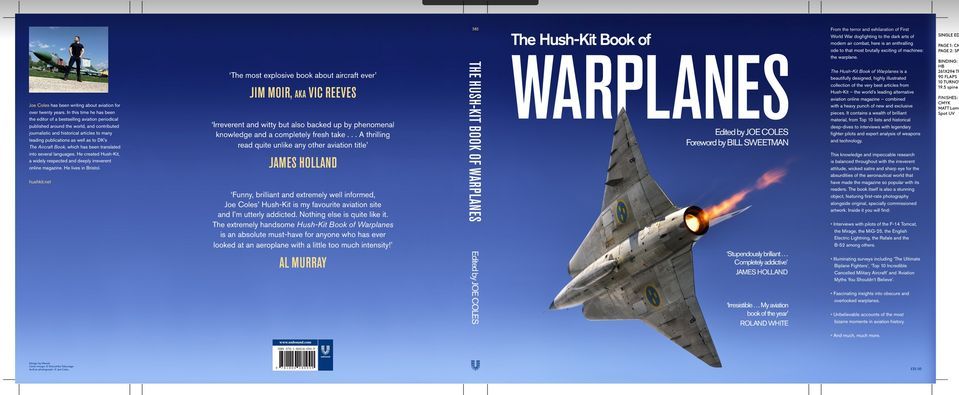


 Initially a degree of stealth was desired, but later in the programme it was decided that this was a redundant quality in an aircraft operating so close to the frontline it would be visible with naked eyes. Its rivals were the IL Kobra 2000 and PZL Mielec M-97/M-99ch. Several configurations of the PZL-230 were offered with turbojet, turboprop and turbofan engines. The 230 won the contest and some development work was done, but it was unsustainable, as Poland faced the economic crisis of transitioning from communism to capitalism. It was terminated in 1994, never having reached a flyable prototype stage.


