10 Most Important RAF aircraft of the Cold War

At the start of the Cold War, in 1947, the British Empire was disintegrating and much of its cities were in ruins. On January 8, the High Explosive Research project was approved, to develop an atomic bomb. Though battered and exhausted from World War II, the nation still had a huge extremely powerful military. The Royal Air Force was a vast armada equipped with the most advanced combat aircraft in the world. Throughout the Cold War, in the period 1947-1991, the RAF would operate some of the most awe-inspiring military aircraft ever built.
Assembling a Top 10 of Britain’s remarkable Cold War aircraft seemed like an easy task, celebrating some well-known, beloved and extremely exciting aeroplanes. But as we dug deeper into the subject, a surprising, and often extremely dark, story emerged.

Across the two decades from 1947, British subject nations sought and fought for independence. Though nominally a posture against Soviet expansion, almost all of the actual wars of this time had a colonial dimension. Often brutal and ineffective, the aerial warfare responses to these insurgent wars, were often far removed from the large-scale conventional warfare that made up the bulk of the RAF’s World War II experience.

We have the choice of defining Cold War operations in one of three ways: those that relate directly to Soviet deterrence; those that centre on opposition to Communist expansion; or all military actions within the years 1947-1991. In reality, the events are far too complex too separate – with even the situation in Northern Ireland having occasional Soviet involvement. With this in mind, we have opted to consider all RAF actions across the Cold War. Whether deterrence worked or not is impossible to definitively prove either way. Another point for contemplation, considering the vast undeniable might of the US military, and the NATO nations’ tight bonds, is whether the UK’s Cold War forces add anything to the overall deterrence effect?
10. Supermarine Spitfire ‘Last RAF fighter to kill’

Spitfires didn’t evaporate at the end of World War II. At the dawn of the Cold War, Royal Air Force Spitfires were everywhere. Though pushed from the sharpest edge of domestic defence by Meteors and Vampires, they served in vast numbers in auxiliary units and remained the most numerous aircraft of the RAF. Across the British Empire and territories, the Spitfire was still king. As peoples around the world fought for independence from Britain, they would learn that a dying empire could still administer pain – often their first experience of imperial airpower was in the form of a strafing Spitfire. Before we discuss this, certain events that took place in 1948, perfectly illustrate how important the Spitfire was in the early Cold War Years. During the 1948 Arab–Israeli War, five Egyptian Spitfire LF 9s mistakenly attacked the RAF base at Ramat David, Palestine, home to aircraft of 32 and 208 Squadrons believing it to be an Israeli base. The British units had been covering the withdrawal of British forces from the port of Haifa. The raid caught the pilots hungover from a Dining-In Night (culminating in the drunken destruction of the Officers Mess to prevent it falling into the hands of the Israelis). The Egyptian raiders destroyed two RAF Spitfire Mk XVIIIs on the ground. The surviving Spitfires took off for a combat air patrol and shot down four Egyptian aircraft. A later attack by five Egyptian Spitfires resulted in all five being destroyed, three by ground fire, two by British Spitfires (the last of which remains the most recent victory in air combat by an RAF pilot in an RAF aircraft). One of the pilots involved in the first incident was Geoff Cooper (from 208 Sqn) who later that year was shot down by the American pilot Chalmers Goodlin, flying an Israeli Spitfire Mk IX. Cooper was found by Bedouin tribesmen and returned to his base. Like the Spitfire, he would later fight in Malaya.
The Malayan National Liberation Army (MNLA) was a communist guerrilla army trying to achieve Malayan independence. It was resisted by British and commonwealth forces in a conflict with all too many parallels with the Vietnam War. The MRLA had its origins in the wartime Malayan People’s Anti-Japanese Army and drew the majority of its support from landless Chinese ‘squatters’ living in the outskirts of the jungle. The British campaign was shameful and involved over 400,000 ethnic Chinese civilians (and some aboriginal people) forcefully moved into brutal internment camps (known as ‘New Villages’, torture, and the odd minor genocide.

When the Malayan insurrection began the RAF’s main local strike element were the Spitfire FR.XVIIIs of 28 and 60 Squadrons, based at Kuala Lumpur. Photo-reconnaissance Spitfire PR.XIXs of 81 Squadron were based at Seletar, Singapore. The conflict was known as the “Anti-British National Liberation War” by the Communist MNLA, but by the rather less grand term “Emergency” by the British (the reason for the odd title being London-based insurers would not have paid out to the rubber planters in instances of civil wars). The Spitfire was heavily involved in the counter-insurgency war.

Armed with guns and the notoriously inaccurate 60-Ib unguided rocket, the Spitfire proved effective. Sixteen Spitfires from the two squadrons based in Singapore flew some 1,800 missions against Communist positions. The last offensive sortie made by RAF Spitfires were flown by four 60 Squadron Mk XVIIIs over Malaya on 1 January 1951; the last operational sortie was flown by Sqn Ldr W.P. Swaby on 1 April 1954.

9. Hawker Hunter
![r/MilitaryPorn - Hawker Hunter FGA.9 of No 43 Squadron based at RAF Khomaksar, Aden fires a salvo of 60lb rockets at an enemy position during operations in the Radfan region of the Federation of South Arabia (now Yemen) - 1964. [OS] [798x800]](https://i0.wp.com/external-preview.redd.it/D1YO_Sn7voayP9KtcUGhR9LslOW6Pj11z9TKV2TDLbo.jpg?w=830&ssl=1)
Much like Keanu Reeves, the Hawker Hunter’s ravishing good looks and impeccable manners have effectively masked a lack of certain essential talents. For example, when the Hunter F.Mk 1 fired its guns at high altitude its engines tended to surge (clearly a big issue but not big enough to stop Hawker making 139 of them). It was also late, short-ranged and rather slow. It entered service in 1954 with a top speed of around Mach .93, a few months later the US F-100 made this look absurdly slow when it rocked into town with a top speed of Mach 1.4. More importantly the Soviet Tu-16 bomber entered service in the same year, and it was only marginally slower than the Hunter. The MiG-19 fighter would make things even more uncomfortable when it began operations with the Soviet air force the next year, as it was almost as fast as the F-100. The MiG-19 was the stuff of nightmares for RAF Hunter pilots.

But in defence of the Hunter, it was a ‘near idiot-proof’ aeroplane, an extremely important quality in an age when peacetime traing was far more dangerous than wartime operations are today. It also didn’t have to dogfight Soviet fighters in RAF service it was set to work attacking insurgents and the odd napalm attack on leaking oil tankers off the coast of Cornwall.
The Hunter went to war in the Suez Crisis of 1956 (also known as the Tripartite Aggression), when Anglo-French-Israeli forces tried to thwart Egyptian attempts to decide the use of Egyptian waterways. Hunter F.5s of No. 1 and No. 34 Squadrons based at RAF Akrotiri in Cyprus flew escort missions in support of Canberra bombers attacking Egypt. The Hunters lack of range made them ill-suited for the mission and they were accordingly reassigned to local air defence.

The 1962 Brunei revolt was an insurrection in the British protectorate of Brunei against the Sultan and the proposed inclusion of Brunei in the Federation of Malaysia. The insurgents were members of the TNKU (North Kalimantan National Army) who wished Brunei to gain independence from the United Kingdom. The TNKU made co-ordinated attacks on Royal Dutch Shell oil installations, police stations, and government facilities. The Royal Air Force deployed Hunters (as well as the much maligned Gloster Javelin) over Brunei to provide support for British ground forces. Hunters made strafing cannon runs against insurgents, and supported the Royal Marines from 42 Commando in the successful hostage rescue in the battle of Limbang.
The resistence to Borneo’s inclusion in a new Federation of Malaysia led to the Borneo Confrontation. It was an archetypal Cold War sitution, with Malaysia having military support from Great Britain, Australia and New Zealand whereas Indonesia had indirect support from the USSR and China. The Hunter was again involved, being deployed in Borneo and Malaya.

In Aden in May 1964, Hunters were used extensively during the Radfan campaign against insurgents attempting to overthrow the Federation of South Arabia. The SAS would would call in close air support strikes, and the Hunters would respond armed with 3-inch high explosive rockets and 30-mm ADEN cannon. Hunters operations continued until the British withdrawal in 1967.

Use discount code SONIC15 today for a whopping 15% discount. Pre-order your copy of The Hush-Kit Book of Warplanes Volume 2 here
8. V-bombers
Avro Vulcan
Here’s a conversation I had today with a friend:
“The thing about nuclear deterrence is you don’t know if it works, I could say my cowboy hat deters dragon attacks. And yes, since I’ve had my cowboy hat I have not once been attacked by dragons.”
“Yes, but if you have tens of thousands of people over forty years involved in manufacturing cowboy hats, wearing cowboy and training to deter dragons with cowboy hats then whether they work becomes irrelevant, they have become important due to the effort involved.” With this in mind, we should mention the RAF’s V-bombers, the unambitious Valiant, the rather weird Vulcan and the extremely potent Victor.
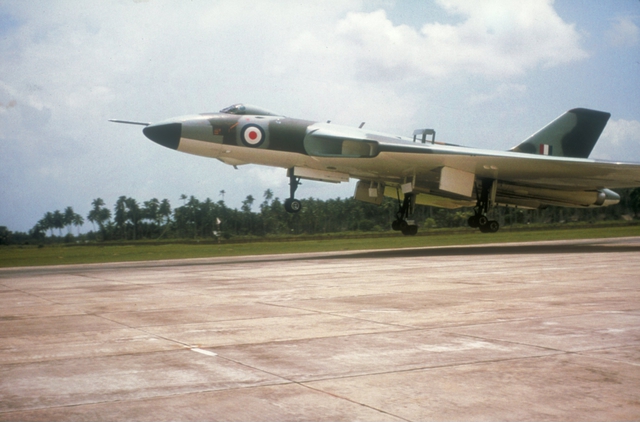
The good looks of the Vulcan distract attention away from the weirdness of a subsonic delta design. This was a hangover from the early 1950s, and meant the Vulcan had to carry a lot of wing with it, its wing area of 330.2 m2 was not far off the 370 m2 of the larger B-52, an aircraft with far superior payload/range performance (twice as good in some parameters).
However, the benefits of the Vulcan’s large wing included remarkable agility at very high altitude. The wing was also needed to enable the Vulcan to cruise marginally faster than conventional swept-wing types. The Vulcan did a lot in the deterrent category mentioned above which may or may not have been meaningful depending on your point of view. The Vulcan carried Britain’s air launched nuclear missile, which was the lamentable (or if you’re part of CND, perhaps wonderful) Blue Steel which had not the range (150 miles) to keep the launch aircraft safe from Soviet SAMs, the reliability (it was estimated that half wouldn’t launch and would have to be dropped in freefall mode) or the quickness of operation (taking 7 hours to prepare for use) to be an effective deterrent. Hope of replacement with a superior US missile was thwarted by the cancellation of the AGM-48 Skybolt (a weapon of ten times the range of Blue Steel) in 1962. After only seven years Blue Steel was retired. The term ‘Blue Steel’ would later be repurposed as a modelling pose in the 2001 film Zoolander.
Sadly, this site will pause operations in mid October if it does not hit its funding targets. If you’ve enjoyed an article you can donate here.
I asked the aircraft designer Stephen McParlin his thoughts, “Skybolt was intended to be carried by V-bombers as a follow-on to Blue Steel, with the launch aircraft having no need to penetrate Soviet airspace… and the U.K. might not have developed an SSBN fleet instead. Polaris was offered to the U.K. as an ad-hoc face-saving measure by JFK… among the consequences being France demanding the same, and on being refused, leaving NATO’s military structures, to develop their own equivalent to Polaris. So the V-bomber fleet gets a longer life as a nuclear deterrent force… The Royal Navy probably gets to keep large deck carriers… CVA-01 gets built… and there are a whole load of hard policy decisions that have different results… Skybolt had been central to U.K. defence thinking, and it’s cancellation by the US, with zero consultation or prior warning, was a huge embarrassment to the government of the day, leaving Harold McMillan very exposed indeed, a mere five years after Suez. Imagine if the US had cancelled the F-35B without telling the U.K. in advance, just as the carriers were fitting out…”
Though extremely ingenious, the Vulcan’s only actual combat missions, in the 1982 Falklands War, relied on labyrinthine, resource-heavy tanker support that if anything, demonstrated that the UK would have been better served by an aircraft more akin to the B-52. Despite this is would be perverse to not include the charismatic 130+ Vulcans that served for three quarters of the Cold War in this list.
Vickers Valiant (service entry 1951)
Often written off as the least advanced of the v-bombers was arguably the most significant. On 11 October 1956, a Valiant B.1 (WZ366) of No 49 Squadron test dropped an atomic bomb on Maralinga, South Australia, this was the first time the British had air-dropped an atomic device (it followed ground detonation tests). In the same month the Valiant was the first of the V-bombers to see combat, during the Suez campaign. During Operation Musketeer, Valiants operating from Malta bombed military airfields, and communication and transport hubs in Egypt. On the first night, six Valiants were sent to attack Cairo West Air Base, which was the home of Egyptian Air Force Ilyushin Il-28 ‘Beagles’ which had been bombing targets in Israel. But the Valiant mission was aborted in flight due to the potential risk to local US personnel. Six Valiants did attack Almaza Air Base, and another five bombed Kibrit Air Base and the Huckstep Barracks. US and Soviet condemnation of the agression led to a swift end to the campaign, and is widely seen as symbolic of the end of Britain’s place as major world power. The campaign damaged British relationships with the US and drove Egypt and several Middle Eastern nations to closer relationships with the Soviet Union.
Valiant B2
When Gary Powers’ U-2 was shot down in 1960, it was clear that flying high offered Britain’s V-bombers no protection. Instead, the RAF began training to go in under the radar. The strain of flying in thick low-level air soon caused fatigue cracks that saw the immediate retirement of the RAF’s Vickers Valiant B1.
‘And paint the fucker black …’
The irony is that Vickers had actually built an aircraft that was perfectly suited to the new tactics. Alongside the standard Valiant, a one-off variation on a theme had been ordered. Based on experience from WWII, the Air Staff wanted a machine that could fly ahead of the main bomber force to accurately mark targets. The result was the Valiant B.2. Beefed up to fly fast and low, the ‘Pathfinder’ was tested at speeds of up to 640mph. That’s comparable to the low-level performance of the USAF’s swing wing B-1B Lancer, a machine that first flew nearly thirty years later and remains in service today.

Lowdown at 600mph, condensation wrapped the bomber in its own flaring cloud. It only added menace to an imposing presence that test pilot Brian Trubshaw had been instrumental in creating. When he saw the bomber’s muscular shape in the Vickers design office, he signalled his approval, then added ‘And paint the fucker black …
(B2 section by Rowland White from this article)
Handley Page Victor
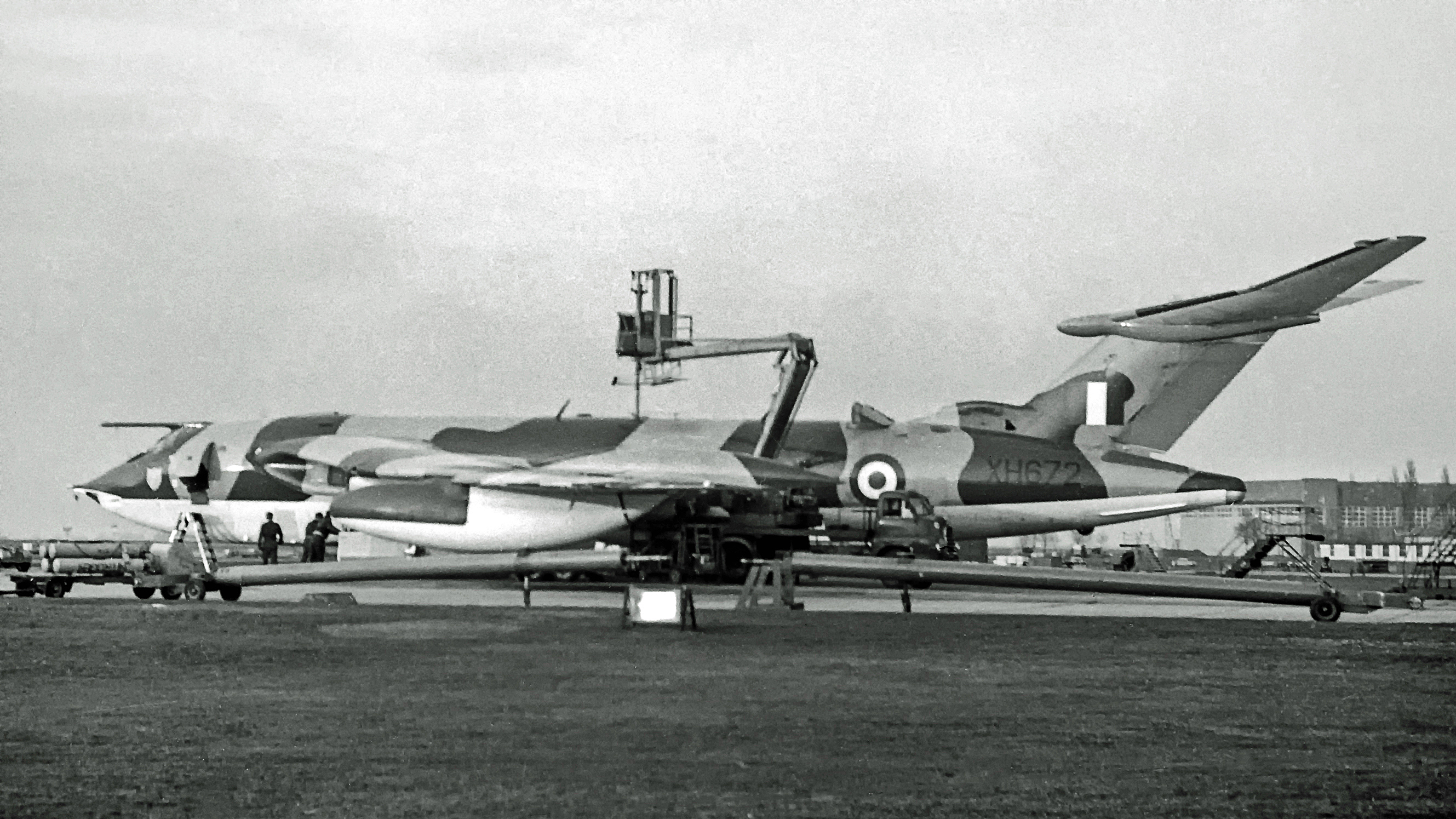
If the V-bombers were Destiny’s Child, then the Victor would be Beyoncé…actually on refection, that might be the Vulcan. Regardless, the Victor was the best bomber and technologically the most advanced.
I return you to my conversation with Stephen McParlin, “At the time of their conceptual design, both Vulcan and Victor were pursuing altitude and Mach targets in excess of any subsequent subsonic aircraft, civil or military. While the Vulcan needed a little additional design effort to make the altitude performance, both achieved their targets on the back of relatively early turbojet designs, and the Mk 2 Victor might well have been the first turbofan-powered military aircraft. In 1963, both were capable of penetrating hostile airspace at speeds and altitudes that were challenging to the best available manned supersonic interceptors, while having the EW capability to tackle the early high-altitude SAMs being deployed by both the US and USSR.“
Rather notably, for a man who contributed so much to British bomber development, the aeronautical engineer Gustav Lachmann was born in Dresden, Germany. As well as co-inventing the slotted flap with Handley Page, he designed the Hampden bomber and proposed the crescent wing configuration for what became the Victor. The crescent wing planform was invented by the German aerodynamicists Rüdiger Kosin and Walther Lehmann, while working for Arado during the Second World War. A wing was constructed in 1945, with the intention of fitting it to the Arado Ar 234 V16. However, the British Army overran the site and the wing was destroyed. Design staff from Handley Page – including Lachmann – were sent to Germany to harvest Arado’s know-how. They incorporated Arado’s crescent wing concept into the nascent Victor.
“Low altitude operations killed the Victor as a useful bomber. It didn’t have the structural strength to operate below Soviet surveillance radars. The Vulcan soldiered on, with the improvements in Soviet defences making them progressively less survivable with time. The technological legacy of Victor was probably greater, as the wing design philosophy for high subsonic Mach wings, and the design methods, developed by Kuechemann and Weber at RAE were subsequently matured right through until the early 1970s. Airbus wing design essentially inherited the knowledge base, and took it further into nonlinear analysis and design techniques, as these emerged from RAE in the 1970s.“
The Victor was never used in anger, its real-world use was limited to air refuelling and reconnaissance. It was good at as a tanker (making the rather bonkers Vulcan Black Buck raid possible among other achievements) and absolutely superb as a strategic reconnaissance aircraft. Though the Victor SR2 strategic reconnaissance aircraft did not serve for long, it is worthy of mention for its spectacular effectiveness. For altitude, speed and sensor variety it was unmatched. It was faster, higher and longer ranged than any other RAF asset, and had the ability to do maritime radar mapping and photorecconnaisance at the same time, essentially a Canberra PR9 and Vulcan MR2 rolled into one. Mapping every vessel in the entire Mediterranean ocean in one morning was possible.
(Thanks to Ron & Jim Smith for guidance on Victor SR2 section.)
Why the crescent wing died
“Structural complexity is part of it. Having two cranks meant local stress concentrations, and Victor also had a honeycomb skin, much more radical than anything in civil aviation… so the Victor wing always had cost of ownership issues. Monitoring the structural life of the wing was an ongoing issue. There was also the required performance. No airliner has ever been required to cruise anywhere near as fast and high without going supersonic. Even the most advanced subsonic business jets of recent years aren’t going there quite yet, and I’d regard doing a wing for a comparable cruise speed as a serious challenge.”

The Victor far outlived the other V-bombers, and even outlived the Cold War. It was retired in 1993. Of 86 built, 12 were lost in accidents. “When considered against the longevity of the B-52, it’s worth considering that the latter made a successful transition to low altitude operations, despite the structure being originally intended for operations at ~40k ft (note that the Mk 2 Vulcan was aiming for 60k+ ft, and the Mk 2 Victor, even higher)… Vulcan never had the range of either at altitude. Would a Mk 2 Victor have made a good cruise missile carrier, like the B-52H? Absolutely… but there was never going to be that kind of investment… and the airframes survived for decades as tankers, serving in hot wars right through to Operation Granby.“
7. De Havilland Canada DHC-1 Chipmunk

For all-out chutzpah and cost effectiveness, the daring Chipmunk missions over Berlin deserves a place in our list. This humble piston-engined exploited legal loopholes to reconnoitre the Soviet zone. Under the cover story of providing continuation training for aircrew stationed in the British Zone, two de Havilland Canada DHC-1 Chipmunk T.10s, joined the Top Secret Operation Schooner (later renamed Op Nylon) to gather intelligence. Three times a week the Cabinet Office in London authorised a covert flight to snoop on Soviet military installations within the Berlin Control Zone using only a hand-held camera, with two lenses (55mm for panoramic views and a 500mm lens for detailed work). Though unrestricted access and Diplomatic Immunity was technically afforded the aircraft by the Potsdam agreement, the soviets were at times aware of the game, and hostile fighters sometimes buzzed the Chipmunks which were also shot by groundfire at least once.

Our shop is HERE selling t-shirts, mugs and other unique items you need in your life. Our Twitter account here @Hush_Kit. Sign up for our newsletter HERE The Hush-Kit Book of Warplanes will feature the finest cuts from this site along with exclusive new articles, explosive photography and gorgeous bespoke illustrations. Pre-order The Hush-Kit Book of Warplanes HERE
6. Gloster Meteor

Much like Britain’s railway system, the Meteor suffered from being the first: the first and only allied jet to see combat in World War II, and the first RAF jet fighter, it came so early that wasn’t able to harvest the wealth of aerodynamical research seized from the defeated Germans, notably the benefit of the swept wing. In 1947, the F-86 arrived on the scene, and the Meteor was utterly outclassed. Illustrating just how quickly the rate of aircraft development was in this time, it should be noted that in both the preceding the Meteor had absolute world speed records. Though I say the Meteor was outclassed, in a 1951 trial at “climbing, turning and zooming below 25,000ft” the Gloster Meteor F8 was found to be superior to the F-86 Sabre (and it was estimated, the MiG-15). The F8 was far more potent than earlier Meteors, a powerful and refined machine with two uprated Derwent 8s, with 3,600 lbf (16 kN) of thrust apiece, structural strengthening, more fuel, better visibility for the pilot and a Martin Baker ejection seat. Between 1950 and 1955, at some of the most dangerous times of the Cold War, the Meteor F8 provided the backbone of Britain’s air defence capability. RAF Meteors served in every war that Britain took part in during its service (apart from Korea) and saw a great deal of action in the 1950s.
Two RAF squadrons used the Meteor in support of the Tripartite Aggression of ’56 but neither of them operated their aircraft directly over Egypt. No.39 Squadron, based on Cyprus, flew NF Mk.13s for night patrols over Cyprus to prevent any Egyptian raids, while Malta-based No.208 Squadron, used its FR Mk.9s to fly armed reconnaissance patrols over the sea towards Egypt looking for Egyptian shipping or aircraft.
In 1955-1958 (some sources say 1960), No.81 Squadron flew reconnaissance missions with their Meteor PR Mk 10s, in support of British operations in Malaya. The war also saw the only time RAF F.Mk 8s went to war, when two aircraft were sent as a detachment in 1955.
Two Meteor PR Mk.10s were used during the Mau Mau Uprising to provide photographic reconnaissance of areas about to be raided by the army. The aircraft were deploying to Kenya in 1954, and remained there until late 1955. They were also deployed to Cyprus and Aden.
The aircraft, of which 3,947 were built, served in huge numbers. It was also a most important aircraft testbed, researching everything from prone pilots to ejection seats, vectored thrust and new engines.

With the Korea War there was a surge in British air power, with the demand for trained military pilots leaping from 300 to 3000 per annum, this was an unrealistic effort that led to the deaths of many inexperienced aircrew. There were other reasons for the high loss rate, despite jet performance the Meteor had instruments and navigational aids more appropriate for the 1930s, and its widely spaced engines caused alarmingly asymmetric power issues if one engine shut down in flight and it also suffered from heavy controls.
The Meteor was a low-risk airframe with a high-risk new concept in propulsion, and it took the Royal Air Force into the jet age.
Weirdly many parts of the Meteor ended up as prop parts in the Star Wars films.
5. North American/Canadair F-86 Sabre

The most successful fighter type flown by RAF pilots in the Cold War was not a Royal Air Force type. Judged on air-to-air kills, it was the F-86 Sabres of USAF. Seventeen RAF pilots completed exchange tours with USAF F-86 units during the Korean War (1950-1953). Five of these accounted for six MiGs, two of them by one pilot, Squadron Leader Graham Hulse, who was (along with one other RAF pilot) was killed in action.

Facing delays with both the Hunter and the Swift, and impressed by its performance in Korea, the RAF wanted F-86s of its own. The RAF desperately needed an aircraft that wouldn’t be eaten alive by the MiG-15, the simplest solution was to procure Canadian-built F-86s from America to act as a stop-gap. The F-86s arrived unpainted in the UK, and were quickly painted in wraparound camouflage and dispatched to West Germany. Most were based in Germany as part of the 2nd Allied Tactical Air Force and proved extremely popular with pilots (most saw their replacement by Swifts and Hunters as a retrograde step). They were the first swept-wing aircraft of the RAF and were far superior in performance to the Vampires they replaced. The huge force of 430 RAF Sabres were extremely capable and served from 1953 until 1956, a critical period in the Cold War.

4. Avro Lincoln/Shackleton ‘Imperial Death Star’

A lot can be learnt about the story of British air power from the story of the Shackleton, a saga that begins in the type’s 1930s pre-history and spans the entire Cold War. It starts with a 1936 bomber requirement that led to the Avro Manchester, a lack-lustre aircraft perfected as the superb Lancaster, this lily was gilded as the Lincoln and finally sent to fight submarines as the Shackleton. It was then, rather absurdly, jerry-rigged as an airborne early warning aircraft in the 1970s.
The Lancaster IV was a powerful beefed-up Lancaster, that emerged so different from the baseline Lanc it merited a new name. It first flew in 1944 and entered service in 1945, missing the Second World War. Nearly 600 Lincolns were built to equip a total of 29 RAF squadrons, most of which were based in the UK. During the 1950s, RAF Lincolns participated in active combat missions in Kenya against Mau-Mau insurgents, where the British met demands for greater freedom with crushing violence, including torture and mass executions.
In 1952 the bomber had the advantage over the interceptor. The alarming reality of this was made clear in the massive training exercise Operation Ardent in the UK. In the exercise Avro Lincolns (as well as Boeing Washington) bombers simulated Soviet Tupolev Tu-4 bombers. Facing them, defence forces consisted of the Gloster Meteor and de Havilland Vampire day and night fighters, RCAF Canadair Sabres and USAF F-86s. The bombers did very well, all too often proving immune from interception.
However, they were not always safe in reality. On 12 March 1953, an RAF Lincoln was shot down 20 miles (32 km) North East of Lüneburg, Germany by several Soviet MiG-15s. The Lincoln was flying to Berlin on a radar reconnaissance flight. All seven crew members were killed.

If the British actions in Malaya can be seen as akin to US actions in Vietnam on a smaller scale then the Lincoln was very much the ‘B-52’ of Malaya. ‘Operation Firedog’ began in July 1948 with the formation of an RAF Task Force at Kuala Lumpur. Muscle came in the form of Lincolns, initially from 57 Squadron. On 15 March 1950, at a time when the British position was looking perilous, eight Lincolns arrived at Tengah. Communist forces in the jungle were small and mobile, and the RAF responded with the brute force of area bombing often in support of special forces. Lincolns were responsible for the bulk of RAF offensive operations in Malaya.
During the Mau Mau Uprising, the Avro Lincoln bomber was used to savagely brutal effect as part of Operation Mushroom dropping nearly 6 million bombs (part of a total of 50,000 tons of British bombs dropped) from 18 November 1953 to 28 July 1955.
In November 1955, four Lincolns sent to the Middle East. In Bahrain, they carried out border patrols of the the Trucial States. It was later sent to Aden.
Shackleton
A long loiter time, bags of internal room and a very strong structure made the Lincoln an ideal choice for the anti-submarine warfare role, in yet another case of a variant earning a new name, the anti-submarine Lincoln ASR.3 became the ‘Shackleton’. On 30 March 1951, the first Shackleton was delivered to No. 120 Squadron RAF, by December 1952 seven squadrons were operating the type. The first operational deployment was in 1955 as a British Army troop transport to Cyprus;. Soon after, the type’s first combat deployment took place as part of the Operation Musketeer.
In 1957, British RAF Shackletons participated heavily during the Jebel Akhdar War in Oman. Again, we see a British military action that is hard to view in a positive light, it was essentially a grubby little oil war. Britain had long cultivated an unelected Sultanate in the region amicable to the British Empire. In 1932, Said Bin Taimur became Sultan, his wish to unify Oman was driven by British interests in the oil rich interior region not under his control. Petroleum Concessions Ltd, the Sultan and British-backed expeditionary conspired to push into the oil rich interior run by the Imam Muhammad al-Khalili. When he died in 1954, his successor, Ghalib al-Hinai, began asserting the imamate’s sovereignty. He issued passports to the region’s citizens and applied for membership to the Arab League. This lead to a rebellion against the sultan by those who supported the elected head of the Imamate of Oman. The British responded with force. ‘The Green Mountain War’ took place in a ‘hot and high’ area inaccessible to helicopters and with forces too scattered for the effective use of air power.
With the arrival of the Nimrod in 1969, it was intended to begin the retirement of the Shackleton fleet. However, when the Royal Navy’s large aircraft carriers and their Gannet aircraft the UK had no airborne early warning radar coverage. As an interim measure, pending the hoped arrival of an advanced Nimrod or Andover based system, 12 Shackletons were fitted with the archaic AN/APS-20 radar sets. Salvaged from the Gannets, this was essentially a 1945 vintage radar designed for use with the Avenger. The resultant machine, the Shackleton AEW was absurdly outdated, vulnerable and vulnerable, but did keep the ‘Shack’ alive until 1991 meaning the Lincoln series spanned the entire Cold War.
3. De Havilland Venom ‘The Colonial Enforcer’
The de Havilland Vampire was an excellent first generation jet fighter, with sparkling agility, heavy firepower and astonishing high altitude performance. But its potential was held back by a thick wing that limited its speed to mach .78. The Rolls-Royce Nene which offered 5,000Ib of thrust, almost twice the thrust of Vampire available to a F.Mk 1, was fitted to Australian FB Mk 30s but despite far more power the increase in speed was incremental. The FB Mk 30s reached 570mph, only 22mph than the far weedier Ghost 3 FB Mk 9s of the RAF. If the greater power availble could be unleashed, the Vampire’s fangs could be further sharpened. What the Vampire needed was a new thin wing. The new aircraft, allocated the designation ‘FB Mk 8’, was to have the 4,850Ib Ghost 103, which though not quite as powerful as the Nene, benefited from being an in-house design better suited to the Vampire and did not require the complicated auxillary intakes of the Nene Vampires (as well the RAAF, the French adopted the Nene Vampire as the ‘Mistral’).
A new thinner wing was made, the new engine installed, and a swept leading edge added (and the forward swept trailing edge of the Vampire) along with other minor refinements. The swept leading edge was necessary to compensate for the heavier engine moving the centre of gravity rearwards. Attractive long-range fuel tanks were added to the wingtips; The new ‘tip-tanks’ added extra endurance at the cost of little drag as well as freeing up underwing space for additional weapons or fuel tanks. It also became 50% heavier. The new machine was now so radically different a new name was in order, the Vampire FB Mk 8 became the Venom. The Venom first flew on 2 September 1949 from Hatfield (close to London) and quickly proved itself a worthy successor to the Vampire. The top speed was a world-class 640mph, the climb rate was more than double that of the Vampire F Mk 1 at a brisk 9,000 feet a minute. It entered service in 1951 by 1955 it was the mainstay of the RAF’s Ground Attack force. Whereas the Vampire was somewhat cute and baby-like appearance, the new Venom had a sleek sinister appearance. This proved appropriate as the new ground attack aircraft soon become a post-colonial thug, employed with great effectiveness in a series of deeply questionable military actions. It took part in the Malayan Emergency from the mid 1950s, where it conducted more than 300 strikes.
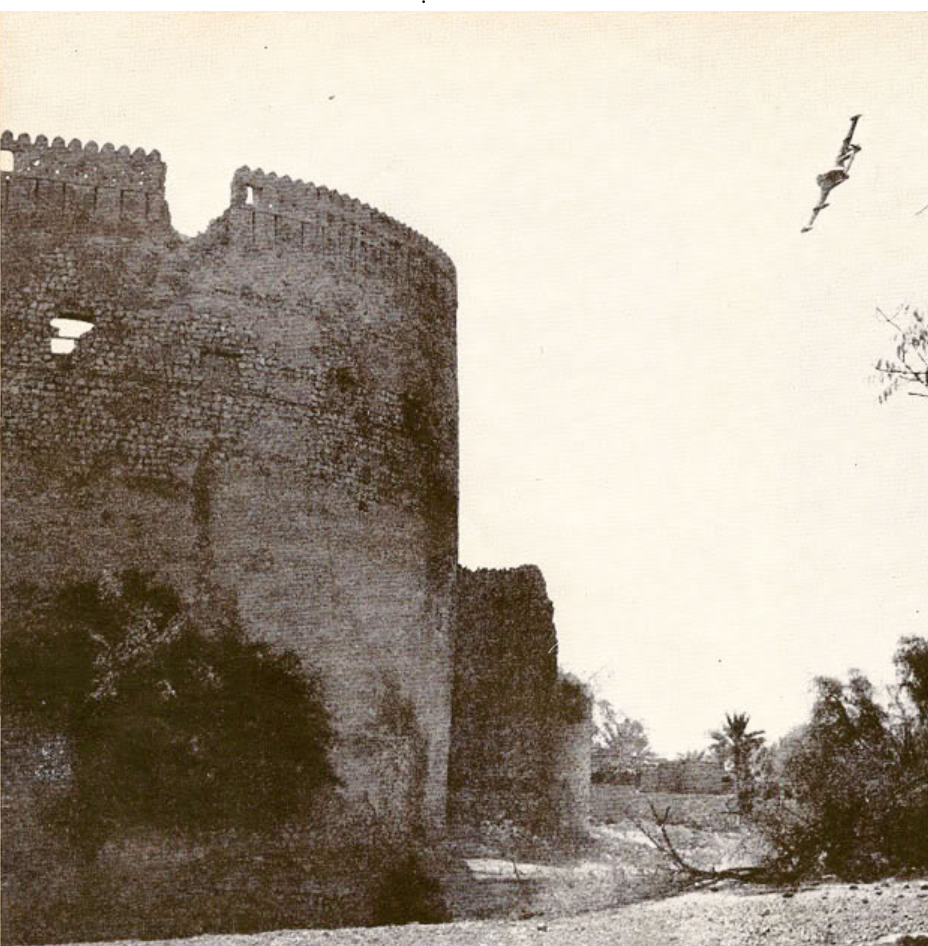
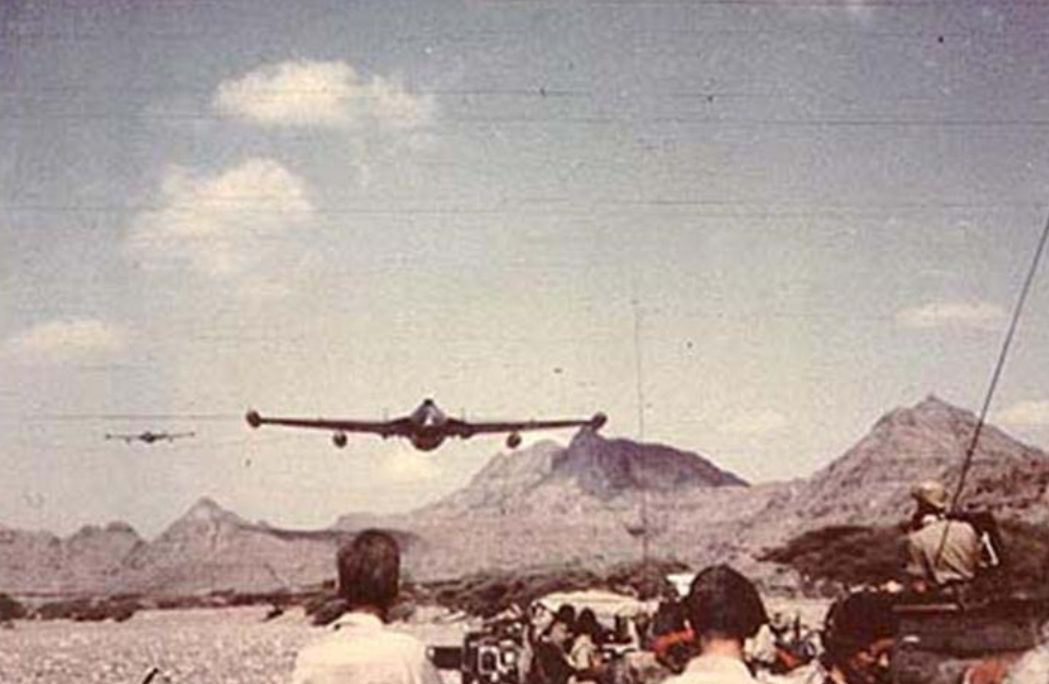
It also bombed Egypt as part of Operation Muskeeter during the Suez Crisis of 1956, in which one Venom was lost to groundfire. Again in 1956, RAF Venoms were deployed during the Aden Emergency, where they were used in support of counterinsurgency operations. In Oman, the first offensive action came with unguided rocket attacks by RAF Venoms. In 1957, British RAF Venoms participated heavily in the Jebel Akhdar War supporting British aims to gain access to oil wells in the interior parts of Oman, attacking mountain top villages, water channels and crops among other targets. Following the advancement of ground forces the RAF flew eight sorties, inflicting many casualties in Firq. The decisive factor was an attack by British Special Air Service (SAS), 1st Battalion of the Cameronians, a troop of the 15/19 Hussars, and a squadron of Ferret armoured cars, supported by RAF Venoms.
2. English Electric Canberra ‘Petter’s Go-getter’
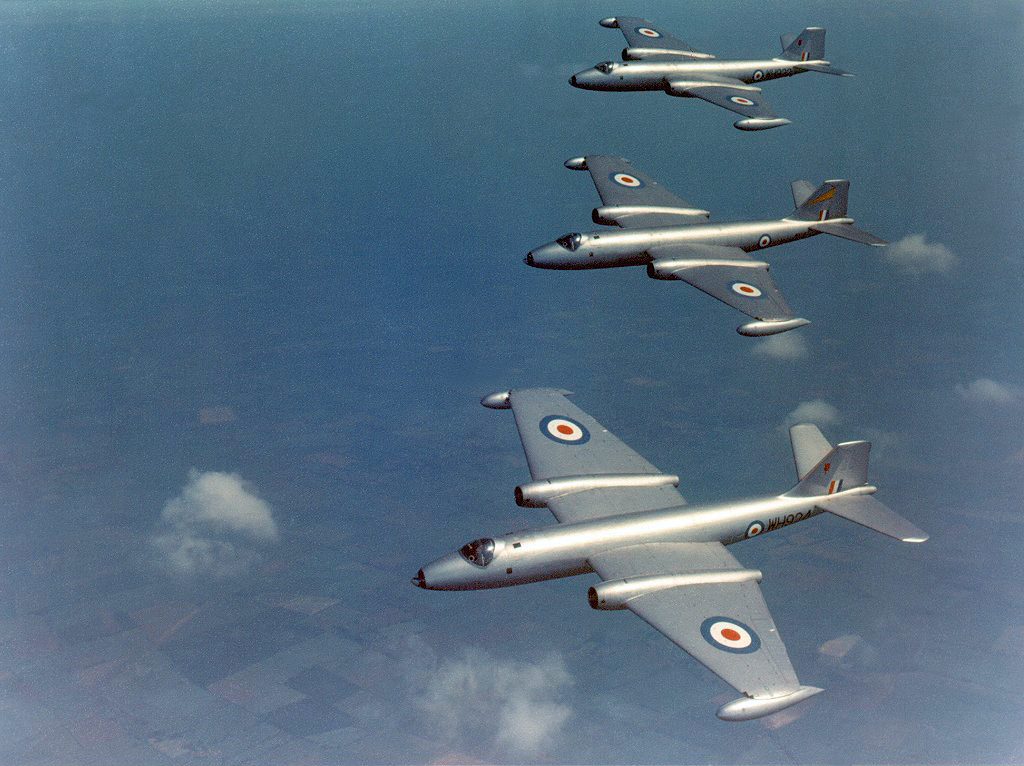
Despite world-leading Brilliance in jet engines, Britain’s early jets were not all they might be. As mentioned, the Meteor didn’t have the swept-back wings fighters needed*, the Attacker was a flop, the Hunter was too late and the Swift was an utter basketcase. But there was an exception, and it came from an unlikely manufacturer. English Electric, a company that had not produced its own aircraft designs since its quant flying boats of 1920s, suddenly came from nowhere to create the best bomber in the world, the remarkable Canberra.

Designer ‘Teddy’ Petter had proposed a fast jet-powered fighter bomber to Westland in 1944, but in a move comparable to refusing to sign The Beatles, they rejected the idea – preferring to devote their efforts to the lamentable Wyvern. Petter found a more welcome reception at English Electric, who after a war of creating other companies’ aircraft realised that smaller post-war production levels would require an in-house design. The English Electric Canberra first flew in 1949 and one can only imagine the Board of Westland’s feelings as they watched as the new aeroplane’s incredible talents became apparent. In 1951 it became the first jet aircraft to make a non-stop Atlantic flight, then for most of the fifties was the highest-flying aeroplane in the world rendering it invulnerable to interception. It snatched 24 point-to-point world records (including New York to London in 6 Hours 17 Mins) and three altitude records including, with a little help from a rocket motor, a climb to 70,310 ft! Everyone was impressed. Even the Americans used them, NASA still does today, which is not bad for an aircraft that had its origins in a replacement for the wartime de Havilland Mosquito!
The RAF loved them and bought a huge amount (782) and it equipped over 55 British squadrons and was in service for 55 years! Fighter-like performance (it was orginally intended as a fighter-bomber), long-range and versatility were the hallmarks of the Canberra. It had a simple strong design, its low-wing loading (around 48 lb/sq ft far lower than the B-47) and surfeit of power allowing it to operate higher than almost any other type.
In the Malayan Emergency (1948–1960), Communist pro-independence fighters faced the armed forces of the British Empire and Commonwealth. Under Operation Firedog the Canberra went to war in Malaya, where its impressive bombload, often six 1,000 Ib bombs, proved devastating (despite British military actions, Malaya achieved independence on 31 August 1957). This was followed shortly afterwards by the shameful British involvement in Suez as part of Operation Musketeer. Never partisan, in several wars, the Canberra fought on both sides, notably the 1982 Falklands War where it was deployed by both the UK and Argentina.
On 4 October 1950, the RAF’s leading recce expert practitioners gathered at RAF Benson for a Strategic Photographic Reconnaissance Conference. The Soviet Union, the greatest military threat to Britain, was developing surface-to-air missiles that could shoot down aircraft at up to 46,000 feet and the formidable MiG-15 was entering service in great numbers. The RAF’s reconnaissance fleet of Second World War Spitfire Mk 19s and Mosquito Mks 34/35 (and the few Meteor PR10s entering service) were utterly inadequate. Likewise, the US believed that none of the USAF’s converted bombers – RB-45s, and RB-47s could fly high enough and that the RB-36, as well as not having a sufficient ceiling, was also all too conspicuous to hostile radars. The new Canberra on the other hand, with a few refinements (increased wing area, power and recce equipment) was seen as a plausible solution. The resultant series of Canberra reconnaissance aircraft remained utterly brilliant until their retirement in 2006.
*RAAF Meteor pilots in Korea who had to face the potent swept-wing MiG-15 sung a song with the opening line ‘All I want for Christmas is my wings swept back’
- Comet/Nimrod

Neither with the Royal Air Force type nor even a military type, as Prime Minister Harold Wilson’s transport to the United States, G-APDI, was nevertheless symbolic of Britain’s greatest victory of the Cold War, avoiding involvement in the Vietnam War. We could have picked one of several types Wilson used for his trips to America but the Comet 4 was the first and the most beautiful. It seemed natural that Britain, as the US’ greatest ally, would send troops in support of the American-led war in Vietnam. As well as taking part in the Korean War, Britain had also been actively involved in several post-colonial conflicts. But Wilson refused, citing Britain’s commitment to the fighting in Borneo as one reason. He also explained that as Britain had been chairs in the Geneva conference of 1954 that had legally divided Vietnam, British involvement would be illegal. Johnson was unimpressed with these reasons and bitterly disappointed by a British leader he considered ‘tricky’ and by a Britain, he believed took more than it gave from ‘the Special Relationship’. Wilson could not support the war. His party was weak and divided, and much of the British public was fiercely against the war, and particularly opposed to the aerial bombing campaign, Operation Rolling Thunder. Wilson headed to Washinton. The subject of British involvement had been discussed for a long time, notably in the 1964 trip, but in ’65 he made it clear he withheld support. Unlike Australia and New Zealand, Britain would not be taking part. Despite this, Secretary of State for Defence Dennis Healey and his close friend US United States Secretary of Defense Robert McNamara remained on good terms.
Britain was spared the prolonged human pain and enormous finacial cost that involvenment in Vietnam would have inevitably involved. Despite many bemoaning Wilson’s Government’s cancellation of the TSR.2 bomber and P.1154 fighter, it is worth considering how many aircraft – and more importantly, men – would have been lost had Britain been mired in the bloody jungle hell of Vietnam.

The transport aircraft that took Healey and Wilson to the United States saved likely more British lives than any other aircraft type on this list. Though symbolic, this is why the Comet 4 must count as our top British Cold War aircraft. It is also here as it formed the basis of the magnificent Nimrod.
Nimrod

“Whilst the boys in Germany were doing their things on dispersed airfields and roads the Nimrod was flying real sorties against real targets day-in day-out. It was one of the only platforms that could do multiple defence tasks at the same time. Defence of the deterrent, maritime rescue, overland recce to name but a few.” – Dave Cawthorn, Nimrod Fleet Planning Manager
“It was the best Maritime Patrol Aircraft around. We were on operations almost constantly around the world for the whole of its time in service, tracking our adversaries above and below the surface. We performed long range ASW/ASuW sorties (including the use of AAR from Op CORPORATE): we could go anywhere in the world from the Artic to the Antarctic. On exercises we routinely excelled in competition with our allies. We saved countless lives provide SAR cover to both civilian and military pers – from our position of Standby in the UK – to support to long range fast jet ex deployments.” – Stuart Roxburgh, former RAF Nimrod pilot
Ireland is the only nation with which the United Kingdom shares a land border, other than that it is surrounded by water; To the south by the English Channel, to the east by the North Sea, to the west by the Irish Sea and the Atlantic Ocean. With tasks including the defence of Royal Navy submarines, saving drowning sailors, recconnaissance, tracking and deterring potentially hostile submarines and surface vessels, and protecting gas and fish resources, there is a lot of work for a British maritime patrol aircraft.
On 2 February 1965, Prime Minister Harold Wilson announced the selection of Hawker Siddeley’s maritime patrol version of the Comet, the HS.801 as a replacement for the Shackleton Mk 2. The Nimrod entered served in 1969 as the interim MR.1 equipped with much the same archaic equipment as the Shackleton. During the Icelandic Cod Wars of 1972-1976, the Nimrod fleet worked with the Royal Navy to protect British fishing ships. It also saved countless lives in the search and rescue mission, and proved an uncannily excellent hunter of even the smallest capsized vessels. The Nimrods enforced Operation Tapestry, protecting fishing rights and monitoring oil and gas extraction. Following the establishment of a 200 nautical miles (370 km) Exclusive Economic Zone (EEZ) in 1977 the Nimrod fleet was given the daunting task of patrolling the vast 270,000 square miles (700,000 km2) area. Nimrods escorted the British Task Force as it sailed towards the Falklands, provided search and rescue as well as acting as communications relay in support of the Operation Black Buck Vulcan raids. Nimrod MR2s stood guard against attacks from Argentinian subs. Equipped with AIM-9 Sidewinder missiles they also become perhaps the largest heaviest ‘fighter’ ever built, the weapons intended not primarily for defence, but for attacking Argentinian recce aircraft. Nimrods carried out extremely long reconnaissance missions, including a mammoth 19-hour patrol which passed within 60 miles (97 km) of the Argentine coast to check that Argentine ships were not at sea. On the night of 20/21 May, one mission took a Nimrod 8,453 miles (13,609 km), the longest distance flight carried out during the Falklands War. In all, Nimrods flew 111 missions from Ascension in support of British operations during the Falklands War.
The Comet was also vitally important for its shadowy work for No 51 Squadron (as both the Comet and the Nimrod). According to one source we spoke to “I’d consider the Comet and Nimrod aircraft of 51 Sqn to be the most important RAF Cold War reconnaissance asset, and I’m not at liberty to discuss why.”

Honourable mentions

Harvards, Brigands, B-29s and Tempest 2s all narrowly missed the cut.
The Wessex, Sycamore, Chinook and Whirlwind were also considered.
The Hercules was too. The Gnat for its PR work as part of the Red Arrows.
The most surprising omission is that British poster-boy for the Cold War, the extremely high performance English Electric Lightning interceptor. If this list was informed only by frequency of appearance in RAF promotional material of the time then the much Lightning would be easily have a place in the top 3. But on closer inspection it was hard to justify its inclusion. It was never used in combat, was ineffective for most of its career and was only used by the RAF in small numbers. The total produced was only 337, and that’s including the aircraft exported to Saudi Arabia and Kuwait. To put that figure into perspective, almost twice as many of the rather more obscure Saab Draken were made. Its final production is utterly dwarfed when compared to other peers, the Mirage III, Su-15, Phantom, F-104 and MiG-21. It entered service in 1960. It was soon apparent that its pitiful endurance and small weapon-load made it unsuitable for its intended role of countering Soviet bombers and reconnaissance aircraft. With the arrival of RAF F-4 Phantom, which had had four times as many missiles, three times the endurance and twice the radar range it was utterly outclassed. According former to RAF Lightning pilot Ian Black, it was unnecessary beyond 1974 and was probably only kept on to maintain the numbers. With all these damning points, sadly we cannot accept the thunderous Lightning in our top 10. Similarly, the Harrier, which much loved did little in reality in the Cold War, other than killing many of the most skilled pilots in the RAF. It should be added that the GR.3 did serve in the Falklands War, though was overshadowed in significance by the Sea Harrier. The F-4 Phantom II was an extremely effective interceptor from 1969 until the end of the Cold War, though did not see actual combat, though scored the RAF’s last ‘kill’, when one accidentally shot down an RAF Jaguar. The introduction of the jet came before the Cold War, meaning the greatest technological leap forward came with the arrival of the Tornado, according to McParlin, “Probably the biggest technological step forward was Tornado… it was the biggest jump from previous aircraft types in terms of the range of new technologies employed. It was immensely more sophisticated than anything that the RAF had operated previously… and more affordably and achievably than TSR2 could have done with valve-based avionics. Lots of earlier projects contributed to what Tornado became, not least AFVG, but Tornado became a real aircraft after a decade of chopping and changing due to politics… and it’s worth considering an alternative universe in which Skybolt was *not* arbitrarily cancelled, and following through the logic of that.”