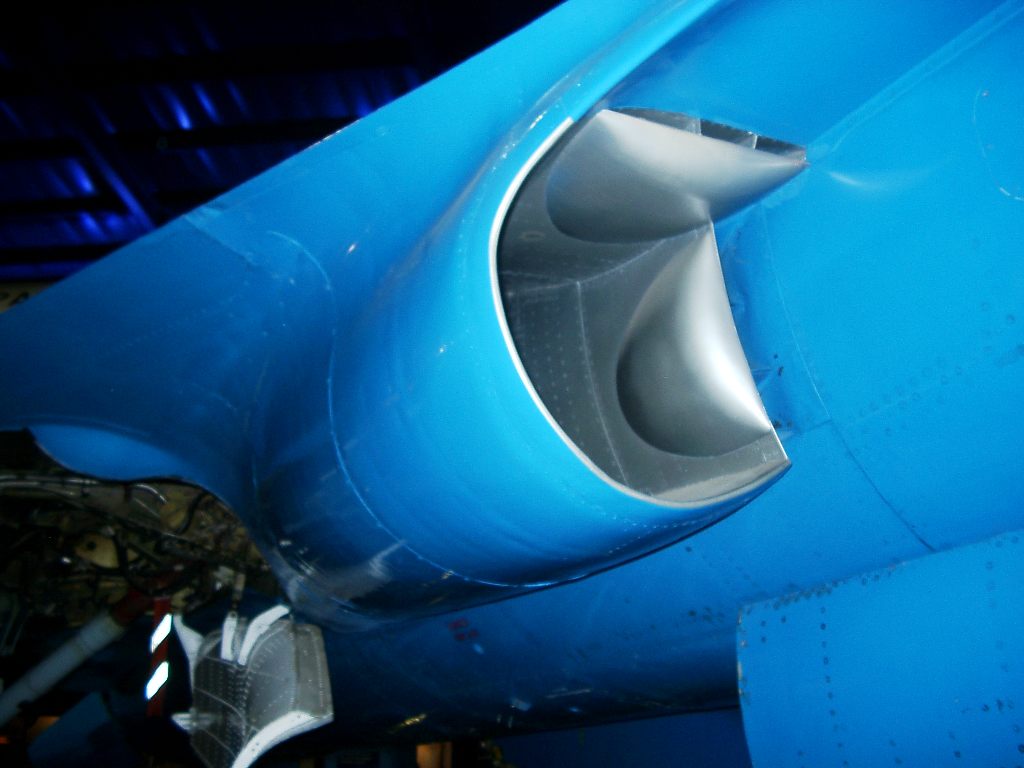
Did Bill Gunston successfully envision a stealthy superfighter jump-jet – or is it just a load of hot gas?

Gunston ‘Stealth VTOL’ Concept Assessment

Warplanes of the Future was my favourite childhood book. The cover featured an exciting vision of futuristic jet fighters. The lead aircraft was a creation of the author, the inimitable Bill Gunston. We asked Jim Smith, who was involved in the assessment of real-life advanced VTOL combat aircraft if Gunston’s delta jump-jet could have worked.

Following some recent social media exchanges, Hush-Kit’s Joe Coles has asked me to write an assessment of the Stealth ASTOVL project mooted by Bill Gunston, published in a 1980s book ‘Advanced Technology Warfare’ (among others).

Illustrations of the ‘Stealth VTOL’ concept are attached, and are of considerable interest to me since the use of the term Stealth and the form of the concept presented, suggest that it lies broadly in the period in which I was assessing ‘real’,  i.e. US and UK Industry-developed ASTOVL concepts as part of a Joint UK MoD and US DoD technical assessment project.

My role in the project was to assess the concepts’ aerodynamics, and in particular to advise on issues associated with ground interaction with the airflow about concepts with differing propulsion arrangements during take-off and vertical landing (VL). The criticality of this aspect is important to note. Different approaches to providing vertical thrust can have very different outcomes in terms of stability, control, and achievable landing weight.

In our programme, we did not consider VTO in detail, mainly because there is little operational benefit. At sufficiently light weights, most aircraft that can achieve a VL could achieve a VTO, but there is generally little to be gained by operating with reduced fuel and payload when you can avoid this with a Short Take-off, especially if assisted by use of a ski-jump ramp.

Gunston

The key factors involved are discussed briefly in the section that follows. This can be skipped if you want to avoid some detail, but, if you stick with it you will have a better understanding of why I think the Gunston concept has some problems.

Propulsion interaction factors affecting aircraft during a Vertical Landing

There are two principal ground-caused mechanisms which can cause difficulties in performing a VL. These are:

  • Hot Gas Ingestion (HGI) also known by the US as Hot Gas Re-ingestion
  • Aerodynamic Suckdown

There are also some propulsion factors that may be important:

  • Ground environment impacts, typically noise, erosion and temperature
  • Intake momentum drag, which can adversely affect stability and control
  • Impact of propulsion system packaging on airframe layout
  • Stealth considerations
  • Propulsion system failure cases

Hot Gas Ingestion

As an aircraft approaches to make a VL, the propulsion system is generating high thrust, generally in the form of columns of high-velocity hot exhaust gas. On striking the ground, this gas travels outwards, and then rises upwards towards the aircraft. If it is then sucked into the aircraft’s engine intakes, the lower density of the exhaust gases due to temperature, and the potentially unsteady nature of the gas flow, can cause a serious loss of thrust, or cause the engine to surge. The severity of this problem depends on the temperature of the exhaust flows, the location of the intake, and any measures to prevent re-circulation of the exhaust gases.

He-Gassen, A Japanese art scroll featuring a people farting at each other

Suckdown

As the jet-borne aircraft nears the ground, the exhaust gases rush outward across the ground surface in a high-speed outward flow under the aircraft. This results in reduced pressure below the aircraft, sucking the aircraft down toward the ground. Factors increasing the severity of this effect include high jet velocities, a low wing, and a large, flat under-surface. Measures to control this effect include the use of barriers and dams to capture the upward flows occurring between pairs (or double pairs) of nozzles, the use of a high wing, and using higher mass flow, but lower velocity jets.

Ground environment impacts, typically noise, erosion and temperature

The jet thrust which supports the aircraft when it is performing a VL is a result of the exhaust flows from the lift system. The nature of these is highly dependent on the details of the propulsion system. At one extreme would be the hot, high-velocity exhaust from an afterburning turbojet engine, while at the other extreme would be the large-scale but low-velocity flow under a helicopter rotor. Lying in between are a range of possibilities, including, listed in order of decreasing flow velocity and temperature:

  • Unaugmented core engine exhaust – Harrier rear nozzle, Yak-38 lift engine
  • Unaugmented exhaust from the fan of a turbofan engine – Harrier front nozzle
  • Mixed Flow from a turbofan engine – McDonnel MFVT project, Boeing X-32
  • Ejector-Augmentor systems – jet flows that entrain large volumes of ambient air – Northrop-Grumman concept in MoD/UK programme
  • Cold fan flows – F-35B front fan, current eVTOL multi-ducted fan projects

Jet noise scales with exhaust velocity to between the 5th and the 8th power. Hot gas exhausts can damage aircraft structures, and high-velocity ground flows cause erosion and can damage equipment. All of these are dangerous to groundcrew, so current thinking is to reduce jet temperatures and velocity as far as possible, while still providing enough thrust for a VL.

Intake Momentum Drag

Intakes are designed to slow down the air flowing into the engine to allow the compressor to function efficiently. In wing-borne flight, we think of the air flowing past the aircraft, due to the aircraft’s motion, being slowed and having its pressure raised to allow the engine to work efficiently. From the aircraft’s perspective, the air is slowed from the free stream value, and the work done in achieving this manifests itself as intake momentum drag. If the intakes are ahead of the centre of gravity (which they will be), and if the aircraft is in a crossflow of any sort – perhaps due to transitioning laterally to land on an aircraft carrier, intake momentum drag can be quite destabilising, especially in yaw. This is certainly the case with the Harrier, and for a slow-moving aircraft nearing a VL, the effect is compounded by the relatively low control power available to the pilot.

Source: http://aircraftwalkaround.hobbyvista.com/BAC221/intake_s2.jpg

Impact of propulsion system packaging on airframe layout

The measures required to manage suckdown and ground environment impacts tend to make low velocity jet flows desirable. However, the various means that have been used to achieve this generally suffer from significant penalties in terms of propulsion system volume. This is coupled with the constraint that in the hover and VL, the engine thrust has to be vertically downwards, and balanced around the aircraft centre of gravity. These propulsion factors can have a dominating effect on the packaging of the airframe, a problem which only becomes more pronounced if the airframe is also required to be stealthy, and to operate at supersonic speeds.

Stealth Considerations

Without drawing on any protected information, one can observe a number of features that are common to aircraft intended to have low radar signature. These are:

  • Alignment of edges and surfaces as far as possible
  • Avoidance of anything resembling a corner reflector
  • Screening and shaping of engine intake and inlet duct so as to avoid direct visibility of the engine front face
  • Carriage of weapons and stores in internal bays
  • Avoidance of opening doors and panels as far as possible, and treatment of those that sre unavoidable
  • Use of conductive coatings for the canopy, and specialist coatings elsewhere

Measures will also be required to reduce Infra-red signatures. These might include, in addition to the above:

  • Mixing of ambient air with exhaust flows to reduce temperature
  • Screening of hot components, and managing cooling flows ao as to avoid hot exhaust flows and airframe hot spots.

Propulsion System Failure Cases

Failure of lift system components is likely to be a critical event for any aircraft performing a VL. However, the degree of criticality does vary. For example, engine failure for a multi-engine helicopter may be an inconvenience rather than a critical flight emergency. On the other hand, failure of one of the lift engines of a Yak-38 results in rapid loss of control, the impact was sufficiently severe that the aircraft was fitted with an auto-eject system.

The Gunston Concept

So, what does all this mean for the Gunston concept?

In the language of ASTOVL assessment, the Gunston design would have been characterised as (Advanced) Vectored Thrust. I have enclosed ‘Advanced’ in brackets here, because it is not clear whether the design is intended to be supersonic or not. If it is designed to be supersonic, then the engine would need some form of plenum chamber burning (PCB) – an afterburner for the front nozzles of a four-poster vectored thrust lift-engine. If this is not used, then the design is essentially a re-packaged Harrier.

Looking at the general issues I have identified, I’ll offer some views on each, as applied in the Gunston design.

Hot-gas Ingestion might not be too much of an issue, although a forward dam might be needed to limit flows from the front nozzles reaching the intake. The likelihood is that the front nozzles will be discharching fan air flow, which would be relatively cool, unless PCB is to be used, in which case HGI would be a significant issue due to the intake being close to the front exhaust flows and the high temperature of the exhaust.

Suckdown would be a major problem for this concept, and possibly more difficult if  PCB is employed. The low wing, the short undercarriage, and the location of the rear nozzles under a large flat plate (the wing) will all increase the degree of difficulty. A box-shaped barrier ahead of the rear nozzles, with sidewalls extending forward to the HGI dam would be required to capture the fountain effect likely to be formed between the front and rear nozzles, presumably deploying when the undercarriage is lowered. The problems will be compounded if PCB is used, because of the high temperature of the front jets. One of the drawings appears to show doors in the relevant area of the fuselage, but these may be to allow engine removal for maintenance.

Ground environment impacts, noise, erosion and temperature impacts will be highly dependent on whether PCB is used. If it is not, the aircraft may be regarded as a repackaged Harrier, albeit with additional suckdown problems due to the low wing and short undercarriage, and HGI problems due to the proximity of the front nozzles to the intake. If PCB were to be used, my first concern would be that the system was never really proven to work. Setting that on one side, and assuming a working system, the augmented jetflow under the aircraft would probably present insuperable problems in all of the three elements noted.

Intake Momentum Drag is specifically mentioned as a factor to be managed using the rotating reaction control valve in the tail. Intake momentum drag was an issue to be managed carefully in the Harrier, as it significantly destabilised that aircraft in yaw, and I assume this is why it was raised for this concept. I am not convinced it would be as great a problem for the Gunston design, but the combination of the lack of a vertical fin, and the possibility of strong vortices being shed from the slender fuselage nose, do suggest that the RCV may well need to deal with both pitch and yaw control separately, rather than by simple rotation.

Impact of propulsion system packaging on airframe layout This is a particular problem for AVT designs, because the engine has to be located so that the exhaust thrust is balanced about the centre of gravity to enable a vertical landing. As a consequence, the engine ends up in the centre of the configuration, rather that, for example, towards the rear of the aircraft, which would be typical for a Conventional Take-Off and Landing (CTOL) aircraft. Knock-on consequences of this are the inevitability of a relatively short intake, and difficulty in packaging other elements of the aircraft, including weapons, fuel and other systems. These constraints also make aircraft development in service difficult – when an improved radar was fitted to produce the Sea Harrier FRS 2, the fuselage had to be lengthened so that additional avionics elements could be located to the rear of the engine installation to better balance the aircraft.

Stealth Considerations are perhaps the most challenging aspect for the Gunston concept. I am assuming that measures such as gold-flashing the cockpit, and the use of LO treatments  in the intake system will prove adequate. The short intake duct, and its positioning on the upper surface, may cause engine integration issues, but let’s assume these are able to be resolved, particularly since the design is clearly intended as a strike aircraft, rather than an air superiority fighter. These are not the main problems.

There are three key issues, the first of which is that the only practical location for the weapons bay is well behind the centre of gravity of the aircraft. We know this has to be essentially midway between the vectored jet nozzles. Carrying four stores in the weapons bay will move the centre of gravity well aft, and will pose significant problems for the flight control system. Let’s assume that this can be resolved for wingborne flight through the use of a full-authority computer-managed flight control system like that used on Eurofighter. Even with this assumption, there remains the problem of landing with the centre of gravity well aft of the centre of thrust. This, of course, will be managed with the swivelling reaction control valve (RCV), I hear the reader say.

Well, maybe, but the geometry suggests the thrust required to be approximately half the weight of the weapons remaining in the weapons bay. If the weapons weigh 4000lb (1814 kg), that RCV has to deliver 2000 lbf (8.9 kN) which is a big ask, and does not seem likely to be available as a bleed flow from the engine.  This is the second significant issue, because committing to release all weapons on every sortie is implausible. If a high and continuous thrust is required from the RCV simply to trim the aircraft in the hover, it is also not evident how the proposed RCV can also be actively controlled to manage the aircraft in yaw, particularly since the design may well be directionally unstable.

The third issue is that the underside of the aircraft is continuously bathed in the hot exhaust flows from the propulsion nozzles. In consequence, there can be no way to visualise this concept as having low observables in the infra-red. Were PCB to be used for the forward nozzles, of course, IR signature would be a yet greater challenge.

Propulsion System Failure Cases are likely to be no worse than for other single-engine STOL and STOVL designs. Control system failures would be more critical than aircraft like the Harrier as this aircraft appears likely to be both longitudinally and directionally unstable.

Conclusions

Examination of the Gunston concept is interesting, not least because it provides insights into the difficulties faced in packaging a stealthy strike aircraft around a four-poster propulsion system, like that of the Harrier. Regrettably, the problems identified in delivering a VL capability from this concept do appear insuperable.

However, the concept, if re-imagined as a CTOL aircraft, and unmanned, appears remarkably prescient and foreshadows designs such as the Boeing X-45, Northrop-Grumman X-47, BAE Systems Taranis and Dassault nEUROn unmanned aircraft.

In a CTOL configuration, with the engine moved to the rear, and stores, sensors and fuel packaged around the centre of gravity all of the issues identified with the concept as a stealthy VTOL platform would be resolved.

The most important Cold War aircraft?

The Cold War took a brief rest between the early 1990s and the 2010s, but serious tension between the largest former Soviet nation and the West has now returned. At the forefront of the original Cold War was air power, and this fearful age sired a multitude of incredible and often long-lived warplanes. In the first of a series of articles written by pilots and subject experts, we consider the question of which Cold War military aircraft was the most important. Let us start with former reconnaissance pilot Robert Hopkins‘ case for the KC-135 family.

Traditional histories of the Boeing KC-135 focus on the means and methods of aerial refuelling, or upon the appearance and configuration of the dozens of unusual KC-135 variants. Similarly, existing studies of the evolution of Western defense policy since the Second World War are often restricted to the political and economic factors. To segregate the means from the motive fails to recognize their complicated interrelationships and concurrent gestation. In fact, weapons and weapon systems have frequently become determinants of strategy instead of merely implements of strategists. The KC-135 and its variants have been more than simple instruments of modern defense policy: for 60 years they have been crucial to its evolution. Their influence, direct or indirect, upon America’s strategic deterrence, conventional force projection, research and development, and intelligence-gathering policies remains unequalled. The KC-135 jet tanker is the first weapons system of the Cold War and, arguably, has proven to be the most important. KC-135s and their variants have affected the development of almost every existing notion of land-based air power today.

​Without the KC-135 tanker fleet, SAC bombers could not reach their strategic targets, effectively emasculating the national policy of Deterrence. Without tankers, tactical fighters and special operations aircraft could not engage in the conventional wars that punctuated and defined open conflict during the Cold War. Without tankers, heavy transports filled with troops and supplies could not fly across vast oceans to enable the rapid build-up of defenses to protect friendly nations under threat of imminent invasion. Without tankers, even advanced ‘silver bullet’ stealth aircraft like the Lockheed F-22 could not fly from their home bases in the United States to engage enemy forces on the other side of the world.

​Reconnaissance variants of the KC-135 have gathered intelligence essential to the assessment of foreign nuclear weapons programs and evolving technologies, provided tactical and operational combat intelligence in multiple wars, and verified foreign compliance (or lack thereof) with international arms limitation or reduction treaties. Most, if not all of these sorties, required air refueling from KC-135 tankers.

​Throughout the Cold War, airborne command posts and those of other nuclear-weapon-wielding commanders defined US (and Western) national security policy. SAC’s EC-135s – one of which was until 1990 always airborne, further reducing US vulnerability to sneak attack – could direct nuclear-armed bombers and their supporting tankers, launch ICBMs, and direct submarines to launch their SLBMs, effectively controlling all three ‘legs’ of America’s strategic triad, dissuading potential adversaries from attempting such an attack. At first these aircraft were little more than a survivable means to launch America’s retaliatory nuclear forces (including nuclear-tipped missiles) in the event of a surprise attack. As technology improved to enable more robust communication in a trans- and post-nuclear attack environment, EC-135 airborne command posts provided a genuine second strike capability, raising the possibility among some policy makers that a global thermonuclear war could be controlled and even won.

​KC-135 variants defined modern jet travel, first by providing the Boeing Company with the economic and logistical means to build its iconic 707 through coproduction, and later as test aircraft that evaluated high-altitude jet routes around the world or in evolving avionics and technology. The C-135’s shortcomings as a troop and cargo transport highlighted the crucial need for a dedicated jet transport. As the 1973 Arab-Israeli War demonstrated, even these capacious transports were effectively limited without the ability to refuel in flight.

​Science and technology benefitted as well from the KC-135. From basic aerodynamic research into large, swept-wing jet aircraft to advanced research in solar physics, the Aurora Borealis, and sending man to the moon, KC-135 variants served as high-altitude, long-endurance platforms capable of carrying delicate scientific equipment and researchers anywhere in the world. These aircraft also supported military research—especially associated with nuclear weapons—that developed and defined multiple weapons, defense and satellite communications, and even stealth technology.

​To be sure, other airplanes throughout the Cold War undertook each of these roles. KC-97s and KC-10s share a portion of the credit for America’s air refueling capability. The U-2 and SR-71, along with the rise of unmanned aerial vehicles (UAVs) were part of SAC’s dedicated reconnaissance fleet. The US Navy’s EC-130Qs, E-6A/Bs, and SAC’s E-4Bs were all interconnected with EC-135 airborne command posts. C-141s, C-5s, and C-17s get the glory for moving men and materiel to hot spots and humanitarian crises around the world, but credit for pioneering international jet cargo goes to the largely forgotten C-135. A B-52 launched the X-15 and myriad research aircraft, and NASA’s C-141 offered a glimpse into the heavens. None of these aircraft, however, did it all.

Robert Hopkins, ex RC-135 pilot and author

Third Edition due out in November. Book signing by the author at SMW in Telford, 12 November 2022.

Third Edition due out in November. Book signing by the author at SMW in Telford, 12 November 2022.

Despite what you’ve heard, the Blackburn Firebrand was NOT terrible, here’s why…

I Am Not The Blackburn Firebrand

IMAGES: BAE Systems

Long derided as a scandalous pilot-killer, the true story of the Blackburn Firebrand is very different argues naval aviation historian Matthew Willis.

I am tired. Another day on Twitter, another bruising at the hands of the mob. ‘Abomination!’ they say. ‘A lemon.’ ‘A disaster’. ‘Should have been turned into catfood tins.’

OK, so those aren’t comments about me directly, although I’ve honestly had worse, and given the state of my mental health, it’s hard to conclude that they are unfair. (Not that I’d make a very good cat food tin, which is now added to the list of things to beat myself up over.)

No, they are talking about the Blackburn Firebrand. The early postwar naval strike-fighter from oop north (or ‘the hellpits of Yorkshire’ as one Twitterer had it) that equipped a mere two Fleet Air Arm squadrons from 1947 to 1953. A rubbish aircraft from a rubbish company, they say. Pathetic. Worthless. Would be better for everyone if it never existed.

We are still talking about the Firebrand, apparently. So why does it feel like a personal attack?

Partly this is my own messed-up brain and is nobody’s fault but my own. Sorry, therapist, nobody’s fault. Partly it is because This Is Not My First Rodeo and yet every time I get chucked off the same horse as if I didn’t have considerable experience, the crowd apparently wondering who this clueless noob is despite my having performed these antics many times already. Yes, I have spent more time than anyone should consider reasonable ‘well-actuallying’ about the Firebrand only for nobody to take the slightest bit of notice. After a while, it starts to get to you.

Roc

It’s true, I have somewhat tied myself professionally to the Blackburn Aircraft And Motor Company, not least in this parish. My first book was a monograph about the loathed Skua, a more recent one about the derided Shark, I’ve written in-depth features about the Baffin and Ripon, and other books about types that were manufactured in quantity by Blackburn, such as the Fairey Swordfish and Barracuda. My apologia for Blackburn – yes, they made more than one good aircraft, the Buccaneer really shouldn’t come as that much of a surprise – can be read here somewhere. I don’t see it as my role to defend these aircraft, exactly. But I do see it as my role to research them assiduously and then tell the truth about them. And in most cases that happens to involve defending them from the vast majority of assertions in print and online, because the truth is that Blackburn aircraft were a lot better than you think. Yes, even the Skua. Yes, even the Firebrand. Yes, even the Roc. Well, OK, probably not the Roc, but there are exceptions to everything.

Skua

Once I started researching these machines – properly researching them, including sifting through archives, interviewing veterans and reading everything I could get my hands on, published and unpublished, the true picture was unquestionably different to READ THE REST OF THIS ARTICLE HERE ON OUR SHINY NEW SITE

The Scopophiliac’s Guide to Aircraft Manufacturers. Part 1: Hawker aircraft ranked by beauty

The “airmail gaze” invokes the sexual politics of the gaze and suggests a sexualised way of looking that empowers AvGeeks and objectifies aeroplanes. In the airmail gaze, the aircraft is visually positioned as an “object” of aerosexual desire. Within this outlook, aircraft types may be reduced to being ranked on desirability alone with no appreciation of their flying qualities or historical importance. To understand the airmail gaze we must first embrace it. So let’s judge aircraft manufacturers through the utterly disgraceful metric of which produced the highest percentage of beautiful aircraft types.

Before we start this reckless meander into beauty fascism let us check how fit the men behind Hawker were. Like most great Britons, Hawker co-founder Harry Hawker wasn’t British – he was Australian – and he sure was ‘beach-ready’. Intense eyes and an athletic build score our Harry a respectable 6.8/10.

The pioneering pilot, racing car driver, motorboat champion and all-around housewives’ favourite, Sir Thomas Sopwith was one hot tamale. There could only be one actor that could play him, Scottish hunk James Mcavoy. All the single ladies and all the single-engined ladies (as Hawker specialised in single-engined aircraft) flocked to form a heteronormative Sopwith Bee-line to meet him. A dainty poetic look scores Thomas an utterly desirable 7/10.

And now we go to the aircraft rankings. We put together a team of the world’s most degenerate aircraft historians, deprived them of sleep and served them bottomless expresso martinis as they made the following controversial decisions. Above 50 is attractive, below unattractive – and 50 is deemed OK. As Hawker had 41 types they did not invoke a penalty for a small number of total types. If you disagree with any of these rankings please support us on Patreon, order The Hush-Kit Book of Warplanes or donate on PayPal (button on the top of this page) before adding your own half-baked opinion in the comments section below.

Most Beautiful

With an impressive beauty score of 90, the P.V.3 fighter prototype of 1934 was Hawker’s most gorgeous aeroplane, and one of the most beautiful ever built. Note the elegant spatted undercarriage, perfectly balanced form, noble nose and polished metal. This dream machine oozed sex, love and any other kind of appeal you can think of.

The Sabre Fury (though an impressive 81/100 if judged in its own right) was judged as a sub-type of the Fury. This was a heartbreaking, but necessary, decision to avoid the vast complexity of judging each re-engined type in its own right. Different engine options are factored into the overall score a type receives. (BAE Systems)
Hunter
Though somewhat underwhelming in flight (too quiet and small) the Sea Hawk is extremely beautiful. The gorgeous uncluttered form is a combination of simple smooth lines and curves.
Horsley

Most ugly

Hawker Duiker

The Duiker (rhymes with biker) was Hawker Engineering’s first in-house attempt at an aeroplane and was named for the African duiker antelope. The meat of the duiker contributed to the spread of Ebola, and several types of duiker are on the endangered list- and its aircraft namesake was similarly unfortunate. Directionally unstable at all speeds, slow and dangerously heavy with inappropriately thin wheels and tyres, the aircraft skulked in shame behind an awkward parasol wing. Its high slab fuselage sides were also utterly inelegant.

The rancid Hotspur complete with Art Deco R2D2.

Average

50/100 Mr Average

To modern eyes, the Hurricane may look rather wonderful, but it is neither the sleekiest – nor the meanest-looking World War II fighter. It looks OK. So now to the scoreboard!

Hawker Aircraft Types Ranked by Beauty

Aircraft type Beauty score out of 100
41. Hawker Duiker 1923 prototype23
40. Hawker Hornbill 192524
39. Hawker Danecock 1925 24
38. Hawker Hotspur 1938 25
37. Hawker P.1127 1960 prototype 43
36. Hawker Woodcock 1923 47
35. Hawker Hedgehog 1924 prototype 48
34. Hawker Hurricane 1935 50
33. Hawker Sea Hurricane50
32. Hawker Harrier 1927 prototype 53
31. Hawker Nimrod 1930 58
30. Hawker Cygnet 192461
29. Hawker Henley 1937 61
28. Hawker Tornado 193965
27. Hawker Hoopoe 192870
26. Hawker Typhoon 1940 70
25. Hawker Audax 1931 71
24. Hawker Hartbeest 1935 71
23. Hawker Tempest 1942 72
22. Hawker F.20/27 1928 prototype 73
21 Hawker Hart 1934 74
20. Hawker Hind 1934 74
19. Hawker F.2/43 Fury 1943 prototype
75
18. Hawker Sea Fury 1944 75
17. Hawker Hornet 1929 77
16. Hawker Hawfinch 1927 78
15. Hawker Tomtit 1928 78
14. Hawker Hector 1936 78
13. Hawker Hart 192880
12. Hawker P.1081 1950 prototype 81
11. Hawker Osprey 1929 82
10. Hawker Demon 1933 82
9. Hawker Dantorp 1932 84
8. Hawker Sea Hawk 1947 85
7. Hawker Hunter 1951 85
6. Hawker Horsley 1925 86
5. Hawker P.1052 1948 prototype 87
4. Hawker P.1072 1950 prototype 88
3. Hawker Fury 1931 89
2. Hawker P.1040 1947 prototype 89
1. Hawker P.V.3 1934 prototype 90

AVERAGE 67%

10 Reasons the Supermarine Seafang DID NOT kill John F. Kennedy

CREDIT: BAE Systems

On November 22, 1963, US President John F. Kennedy was killed riding in an open-topped car, with the first lady, during a presidential motorcade in Dallas. This dark day – and the likely culprit – has been the subject of much-heated discussion and controversy.

We present the case that he could not have been killed by the Supermarine Seafang naval fighter.

Here are 10 reasons that prove conclusively that it was not a Seafang that killed President Kennedy.

10. Despite thousands of onlookers, including a planespotter club meeting in a nearby Chicken Cottage restaurant, there are no reports of a suspicious aircraft matching the Seafang’s description.

9. One of the reasons the Fleet Air Arm favoured the rival Sea Fury over the Seafang, was due to the latter’s inferior low-speed handling characteristics. Hitting the President’s car with accuracy while avoiding high-rise buildings and evading detection would have involved manoeuvring capabilities well beyond that of the Seafang.

8. The Seafang was armed with four 20-mm cannons, yet the round used in the Kennedy killing was a far smaller 6.5-mm rifle round. The greater destructive effect of the Seafang’s armament would have caused a greater deal of collateral damage.

7. Naval Air Station Joint Reserve Base Fort Worth would be the nearest likely airfield. As an 80-mile flight from the book depository, it would have been well within the Seafang’s range, BUT at the time it was not in naval service. It was Carswell Air Force Base under air force command and therefore it would not have supported operations by a British naval fighter.

6. Kennedy’s wartime experience aboard a Motor Torpedo Boat would have made him aware of what an attacking naval fighter sounds like and how best to avoid it: the absence of evasive tactics points to the fact that the President never heard a diving Seafang.

5. The received sound level for a single 20mm cannon is 105 dBA at 50 ft – the sound of four such weapons firing would certainly have been audible. With a likely attack altitude of well below 250 metres the noise would have been as loud as 15 grand pianos falling on Stonehenge.

4. The main proponent of the Seafang Assassination Theory was William Pummel, our research reveals he was an active member of the Cult of the Westland Wyvern (a Yeovil-based religious sect who follow the teachings of a later carrier strike fighter) and thus had a vested interest in discrediting the Seafang.

3. The Seafang’s last flight was in 1946, 17 years before the assassination and 4,664 miles away from the book depository.

2. The Post-JFK Assassination Air Force One Flight Deck Recording contain no sound reminiscent of the glorious throaty roar of the Seafang’s Griffon engine

  1. Most damning, of the eight Seafang airframes made, all were scrapped. This means that for a Seafang to have been used for the assassination it would have involved a team of specialists with access to the original blueprints and factory machining parts to scratch-build a new airframe. This is beyond the realm of possibility. Though it remains possible one Seafang was hidden in a volcano by a disgruntled Supermarine employee who was later coerced by the Mafia or Communist Cuba to use in the assassination, this is unlikely.

VERDICT: MYTH

What happened at Saki air base? The likely cause of the Russian air base explosions in Crimea

Huge explosions rocked a Russian airfield in occupied Ukraine on August 9, in Moscow’s biggest loss of military aircraft in a single day since World War II, but what caused them?

Saki air base, is currently the Crimean home to the 43rd Russian Independent Naval Attack Aviation Regiment (43 OMShAP). Su-24 bombers and Su-30 Flankers operate from the base and around 10 were destroyed during the explosions. What is currently unknown is what caused the explosions, with no official comment yet released from the Ukrainian MoD. We asked Justin Bronk Senior Research Fellow for Airpower and Military Technology at the Royal United Services Institute (RUSI) for his opinion on the likely cause: “Well, what I’m pretty confident about at this stage is that the three large fireball explosions that people are fixating on were not warhead impacts (which have a very different blast shape if you know what to look for), but instead were secondary explosions caused by stored Russian bombs and rockets detonating. The big blasts happen in the middle of what was clearly an already well-established fire – probably aviation fuel. That fire may well have been triggered by Ukrainian special forces using demo charges or munitions dropped from small UAVs, or loitering munitions. Either way, the initial fire spread and caused a chain reaction due to sloppy Russian ammunition storage practice – they were clearly keeping piles of bombs and rockets close to the aircraft as previously observed in Syria.”

Typhoon pilot and technical advisor talk back

Yesterday we published an article asking whether the MBB-VFW Fokker canard delta tactical fighter study was in some ways a superior aircraft to the later Eurofighter Typhoon. As a counterpoint to this we asked the opinions of a former Typhoon combat veteran, Mike Sutton – and Jim Smith who worked on the Typhoon’s development advising the Project Office on Mass and Performance.

“While clearly driven by some of the same design objectives as Typhoon – high energy manoeuvrability, low wave drag and good supersonic performance – I would still regard an emphasis on low-speed, high alpha manoeuvrability as a mistake. Given the ability of all aspect missiles like IRIS-T and ASRAAM, as well as longer-range missiles like Meteor and AMRAAM, to successfully engage pre-merge and at high off-boresight angles, close-in combat has become a situation to avoid, due to the likelihood of a mutual kill.

At various times, vectoring nozzles were proposed and rejected for Typhoon, partly for this reason, and also to avoid the weight penalty and additional complexity in the control system. As usual in International projects, there were different perspectives from the nations, particularly in the early days. Germany in particular used to have national policies in place preventing military action outside its borders, leading to a focus on Air Defence rather than Air Superiority, and, at least to some extent, limiting its interest in long-range offensive strike. Over time, changes in geo-politics and security settings have changed those views. The VFW-Fokker design might have been superior to the MiG-29, but would perhaps struggle against advanced Sukhoi developments and have limited strike capability.

Of course, add an IRST, E-Scan radar, Meteor, ASRAAM or IRIS-T, stores pylons and systems, EW defences and decoys and you might have such a good BVR aircraft that you wouldn’t need the thrust vectoring. And that’s pretty much what happened.”

  • Jim Smith worked on the Typhoon advising the Project Office on Mass and Performance

“I had never heard of the MBB-VFW Fokker before so it’s interesting to see the popularity of canards during that era of aircraft design. As for turning performance, post-stall manoeuvre while being impressive at air shows, is really a last ditch capability in air combat. Most of the time combat aircraft want the ability to target and engage at range, something the Typhoon can do exceedingly well.

If an intercept has gone all the way to a merge (in itself a failure of sorts) even then most of the time fighters want to maintain energy and speed: speed provides tactical options and manoeuvrability when fighting. A turning fight is all about nose position. If you are beaten down on energy having greater nose authority through thrust vectoring or high alpha is useful, but is a corner you end up in rather than one you would aim for.

A rate fighter such as Typhoon will turn well at 9g, has huge thrust-to-weight advantages which means it can use the vertical when most fighters are out of energy and has a high off-boresight missile that the pilot can aim by just looking at their adversary. So the jet is not badly placed. All fighters are a compromise of sorts. More alpha would be welcomed, but not at the cost of any of the jet’s superb multi-role capabilities which have been extensively proven on operations in recent years.”

-Mike Sutton, Former Typhoon Combat pilot

Was this fighter better than the Typhoon? MBB VFW-Fokker Delta Canard Tactical Fighter

In the late 1970s, West Germany wanted a new Air Superiority fighter. Though Britain tried to drag European fighter talks towards aircraft compromised by short take-off and vertical landing, West Germany was not convinced. They want a fast agile fighter that could dogfight with a new breed of ultra-manoeuvrable Soviet fighters that would soon be on their doorstep, the MiG-29 and Su-27. Western intelligence was well aware of the development of this aircraft, and how they would utterly outmatch NATO’s fighter force that largely consisted of Phantoms, Lightnings and Starfighters.

A design was created by the companies that had created the Bf 109 and Fw 190 of wartime fame (Focke-Wulf was part of VFW) as well as the great Fokker fighters of World War I. The result was a formidable prospect, with thrust vectored nozzles and capable of post-stall flight beyond 90 degrees angle of attack. The particular style of belly intake, thrust vectoring and twin tail configuration would have made it a far superior low-speed ‘angles’ fighter to today’s Typhoon, but it would also have been no slouch in the high-speed regime with its distinctive cranked delta. Its very low wing loading would have provided spectacular instantaneous turn rates, and excellent short-field performance.

Its engine compressor face was more buried from prying radar waves than the later Typhoon’s. Though the latter may have inherited the s-shaped intake duct from this design, diagrams appear to show a greater degree of line-of-sight shielding on the German-Dutch design. With its vectored thrust and high angle of attack capabilities, it may also have been adaptable into a carrier aircraft, something which though proposed was never seriously viable for the Typhoon.

The MiG 1.42

Fundamental to judging this design is the different philosophies of obtaining a snap off-boresight missile shot: some designs emphasise moving the entire aircraft, like the F-22, others (such as Typhoon) using an off-boresight cueing system with agile missiles. As efforts to integrate the Scorpion helmet cueing system onto the F-22 have shown, the optimum solution for nations with a big enough budget, is both. It should also be added that Typhoon, though a superb dogfighter, is optimised for the beyond visual range where situational awareness, acceleration and specific excess power and combat persistence are more important than post-stall manoeuvrability. Still, this design offers a fascinating glimpse into contemporary thinking and bears interesting comparison with the Soviet MiG studies for an advanced tactical fighter.

This German-Dutch study would feed into what eventually became the Eurofighter Typhoon.

We asked a Typhoon combat veteran and a technical advisor their opinions on the above here

The 10 Strangest French Aircraft

SNCAC NC.3021 Belphégor high-altitude research aircraft

France is a nation of contradictions, simultaneously ultra-conservative yet radically inventive to the point of absurdity, the forces of conformity and eccentricity have long been at odds in this great European nation. There is a reason that the words outré and avant-garde came from France, such is the presence of radical new thinking in the culture. France’s adventures in aviation embrace both these seemingly opposed aspects of the national psyche, but it is in the realm of the outlandish that we will dwell tonight, mon ami.

Simply developing excellent flying machines wasn’t enough for the French aeronautical pioneers; they frequently sought to revolutionise the very nature of powered flight. The following bizarre bestiary of resultant prototypes and experimental aircraft that flew from the ‘left bank’ of this radical thinking were often unique – and occasionally beyond comprehension, so we just had to find out more. Hugo Mark Michel and Joe Coles take a walk down the forbidden boulevard in search of France’s strangest flying machines.

10. The Fouga CM.88 « Gémeaux »

The Fouga CM.88 Gémeaux (Gemini), was a series of twin-engine flying engine test-beds developed in the 1950s to trial French jet engines. The strange appearance is the result of the fusion of two fuselages from the 1949 Fouga CM.8 Sylphe (the first 100% French jet aircraft). The twinning of an existing fuselage was a good design solution, proving cheaper and easier than developing a brand new aircraft. Its unusual W-shaped tailplane was formed by the fusing of two CM.8 V-tailplanes. As the engines to be tested on the aircraft were experimental, for safety reasons it was decided that the first Gémeaux model would be equipped with two engines, to ensure redundancy in case of failure. The French pilots were not used to landing a twin-engine twin-fuselaged aircraft, so to familiarize themselves, they were dispatched to the USA to train on the F-82 Twin Mustang. But, the French aircraft being a jet, this experience with a propeller aircraft was not very helpful. On 6 November 1951, the second Gémeaux produced became the first aircraft in the world to fly with a turbofan engine*, an Aspin I. The aircraft, built in two copies, had a very short but rich career testing no less than 5 new types of French jet engines. So, on 6 March 1951, the first CM.88 took to the skies, powered by two Turbomeca Pimene engines. The first flights went very well, the aircraft proved both stable and manoeuvrable, albeit with very rough landing characteristics.

(*British aviation historians may be of a different opinion on this)

9. SNCASO Sud-Ouest Delta VX Deltaviex

The extremely attractive SNCASO Sud-Ouest Delta VX Deltaviex was a small experimental jet aircraft built and tested in the 1950s. Despite its name, it was not equipped with a delta wing – but with a very small swept wing raked back at a dramatic 70°. The whole aircraft was tiny, with a wingspan of only 3.4 meters. It was a flying testbed, for a control system using the gases expelled by the engine on the control surfaces (blown flaps were also tested on the Bréguet 960 Vultur, a French Westland Wyvern equivalent). Around 2% of the gases produced by the engine were used to blow the trailing edges of the landing flaps. This system increased lift while stabilising the roll, and allowed a yaw control, replacing the traditional rudder. Thanks to its compact dimensions, it was possible to test it directly in wind tunnels to measure its characteristics precisely, and it was tested in the Chalais-Meudon and Modanee wind tunnels. After this test campaign, the Deltaviex started to make some very short flights, its only test pilot, Robert Fouquet, declared that it was a safe aircraft which controlled itself very well in flight, despite this, it could never make a real extended flight. This was simply too dangerous. Due to its size, it was impossible to install an ejection seat, and in the event of a failure of its single engine, the aircraft would have become uncontrollable and would have left no chance of survival for its pilot. Built in 1953, its existence remained a secret until 1956, when it was presented to the public.

Its poor carcass was saved in 1984 by the Ailes Ancienne de Toulouse where it was gradually restored.

8. Nord.500 « Cadet »

The Nord-Aviation N.500 Cadet was one of the many experimental ADAV (VTOL to English-speakers) research aircraft built in France during the ‘60s. Its basic configuration was similar to the Canadian CL-84 or US XC-142 ‘tilt-wings’ of the same period – and it was developed at the request of the French armed forces. The French military wished to replace helicopters and conventional fixed-wing military transports with fast vertical take-off and landing aircraft. The role of the Cadet was to test and develop, on behalf of SNCAN (becoming Nord-Aviation in ‘58), the new technology of tilt-rotor ducted propellers. Even before the first test of the prototype, Nord Aviation planned to cancel this unlikely project that they had reluctantly inherited.

After the presentation of a model at the 1965 Paris Air Show, two prototypes were assembled in 1967, powered by two 320-hp Allison turbines. The second prototype flew on July 23 1968 in captive flight (attached to the ground by strong steel cables to limit the risk of accidents) – though the world was too distracted by the PLO’s first hijacking of an El Al airliner to pay much attention. The N.500 Cadet made its first and only free flight in 1969, but never made the transition from vertical to horizontal flight. The programme was scrapped in 1971, despite the promise of larger and more powerful versions. The government preferred conventional helicopters, and instead opted for the rather boring Sud-Aviation SA-330 Puma instead.

Though it never entered service, it was probably the inspiration for the fictional Hunter-Killer drones of the Terminator movies, and the ducted fan VTOL concept has never gone away appearing on a multitude of unmanned aircraft and personal transport concepts.

7. Makhonine « Mak-10 » The Flying Extendable Dining Table

Several notable Russian aircraft designers fled to the west following the Russian Revolution of 1917. Sikorsky and Seversky were two of these emigres, and they founded Sikorsky and Republic respectively, two giants of US aviation, but Makhonine – a rather complex individual – took his unusual ideas to France.

By 1931 Ivan Makhonine, was a French nationalised engineer, working on a variable surface wing system (think flying extendable dining table). For take-off, economical cruise and landing the wings of his aircraft were fully extended, for high-speed flight the wing could be telescoped into the thicker inner wing section to reduce drag and lifting surface. In the extended configuration the wingspan gained eight metres.

The whole system was pneumatically operated and was coupled to a manual back-up system. To test his concept, Ivan Makhonine built a large single-engine monoplane equipped with the telescopic wing, the Mak-10 (not to be confused with the MAC-10 submachine gun beloved by Miami gangsters in 1980s movies). It flew for the first time on 11 August 1931, demonstrating that such a wing type could work.

It was nevertheless, like many French aircraft of the time, underpowered. Its twelve-cylinder Lorraine 12Eb engine was enough for such a large aircraft. A second version of the aircraft, the Mak-101, was built at the end of the ’30s to further studies of such an aircraft. The 101 was far more modern, equipped with an enclosed cockpit, retractable landing gear and a Gnome-Rhône 14K Mistral Major engine allowing it to reach 380 km/h. However, before the aircraft could begin its test campaign, the Second World War broke out, and the aircraft was captured by the Germans military. The aircraft was repainted in the colours of the Third Reich and transferred the aircraft to Germany for further tests. Its fate is unknown.

6. Carmier-Arnoux Simplex

From the very beginning of aviation history, French aeronautical engineer René Arnoux was seduced by the promise of flying wing (or tailless) aircraft. Whereas Johnny-come-lately Charles Fauvel (who did not start work until the mid-1920s) is rather better known, Mr Arnoux was an early pioneer who is largely forgotten. He built his first tailless biplane in 1909, followed by a monoplane three years later. During the 1913 Paris Air Show at the Grand Palais, Mr Arnoux exhibited the ‘Stablavion’. Despite its name, this was not a knife-crime-themed rollercoaster, but a two-seater low-wing monoplane powered by a 55-hp engine. The aircraft failed to attract any orders, despite the great hunger for military aeroplanes in the Great War. After the war, Arnoux resumed his research, and produced a second tailless biplane – and founded his company, the Société des Avions Simplex around 1921. The first aircraft produced by this new company was the Carmier-Arnoux Simplex, an extremely elegant tailless racing monoplane. It had a very round, sweeping shape and was powered by a 320-hp Hispano-Suiza engine. It was built to win the Deutsch Cup of 1922, and the prototype managed to reach an unprecedented 385 km/h during tests, far faster than the contemporary official world air speed of 330 km/h.

The piloting of such a machine was made very complex not because of its flying wing formula, but because the pilot couldn’t see very much at all; a cylindrical radiator was located just in front of the open cockpit blocking the forward view and the wide wings prevented any vision towards the ground. Even for a racing aeroplane, the pilot suffered a poor field of regard. A few days before its participation in the 1922 Deutsch Cup, the aeroplane had a serious accident, injuring its pilot Georges Madon. Discouraged by several accidents involving his aircraft, René Arnoux eventually ceased his activity as an aircraft manufacturer.

5. Gerin V-6E « Varivol » Monsieur extensible

The prestigious Coupe Deutsch de la Meurthe was a high-speed race that spurred a bounty of technological innovations in the 1930s, the first retractable landing gear and the first variable pitch propellers among many others. The first variable-surface wing was developed in pursuit of greater speed for the race. This system, although very simple, was nevertheless very heavy. Jacques Gérin’s idea was to divide the wing into two parts, a collapsible part, converted into a flexible covering capable of rolling up on axis, and a more conventional rigid part acting as a wing during high-speed flight. The soft part was stiffened by a system of sliding spars and ribs. In 1936, Gérin had an experimental biplane built to test this new technology.

This system allowed the upper wing to go from a surface area of 6.30 m2 to 26 m2 with the wing fully unfolded, thus reducing drag and theoretically increasing speed, manoeuvrability and handling characteristics during the take-off and landing phases. After a few flights and the destruction of the plane in an accident, work began on a racer derivative. The resultant Gérin V-6E Varivol was completed in 1938. The aircraft looked, at first glance, quite traditional for a racing plane of that time, but it was much more complex than it looked. After wind tunnel testing, the plane was in the process of finishing its development when the War began. Panicked by the German invasion of France, the engineers hid the plane in a barn where it was forgotten for many decades. It was later re-discovered and was restored by the Angers Marcé air museum. It was a very beautiful plane that unfortunately never flew. Its story bears interesting comparison with another beautiful aeroplane, the Bugatti 100P.

4. The Payen « Fléchair »

While the German aerodynamicist Alexander Lippisch swans around the green room of aviation history, sipping martinis and boasting about his pioneering work on delta wings, the French engineer Nicolas Roland Payen modestly sits in the shadows cradling his pastis and bemoaning the peculiarities of fate. Often overlooked, Payen nevertheless was the French father of the delta wing, and in turn the magnificent Mirage and today’s euro-canards.

In November 1931, when he was only 17 years old, he patented the Avion Autoplan, a delta-wing aircraft, but it was in 1935, the year he turned 22, that he designed and built the world’s first true delta-wing aircraft, the PA-100 Fléchair. The PA-100 was unique for its time and remains so even today: Its main wing was a delta wing with flaps to ensure stability during low-speed flight, with two small wings (then known as “machutes”) installed at the front of the airframe to ensure control of the aircraft at low speed (this type of small forward wing will later be known as a ‘canard’ and will be fitted on many delta jets such as the Dassault Rafale, the XB-70 Valkyrie and the Saab Sk 37 Viggen).

The PA-100 with its 180 hp Régnier in-line engine proved to be extremely underpowered, and failed to reach the high speeds required for the wing to be completely effecient. It was after a few flips and a crash on 27 April 1935 that a second prototype named PA-101 was built to take part in the French speed race, the Coupe Deutsch de la Meurthe. The new aircraft had the same overall characteristics as the Pa-100, but this time was equipped with the far meatier 380 horsepower Gnome-Rhône engine of 380 hp of 19 litres. It was the engine’s large displacement that prevented it from taking part in the race, as only aircraft with engines of less than eight litres were allowed to compete. The plane become instead a fairground attraction and was gradually forgotten. The last Payen delta was the PA-22, an experimental aircraft built in 1939 and originally powered by a Melot 1R ramjet. The aircraft was later converted to a conventional engine, the 180 hp six-cylinder Regnier. The aircraft had not yet flown when Germany invaded France in 1940, and the Germans, intrigued by the machine, decided to complete the wind tunnel tests.

After being repainted in German colours, the aircraft was transferred to Villacoublay and in October 1942, pilot Jacques Charpentier made the first flight. An extensive test programme was then launched, but before it was completed, Mr Payen managed to get his aircraft out of the hands of the occupiers, by claiming that modifications were necessary he sent the prototype back to his factory in Juvisy. Continued improvements included a new propeller, this time with variable pitch and additional fuel tanks, but in 1943 an Allied air raid on the Juvisy marshalling yard hit the factory, destroying the PA-22.

The PA-61 of 1965
The PA-61 of 1965

Nicolas Rolland-Payen’s legacy is undeniable today, in addition to the paternity of the delta wing, one of his many great ideas was harnessed by the Space Shuttle. The Shuttle’s rudder neatly split open in two to deploy an airbrake mode, a technology patented and tested by Mr Payen in the late 1940s and early 1950s.

3. The Riout 102T « Alerion »

Since ancient times, birds have been fucking with humans by suggesting to the naive that flapping is a good propulsion technique to emulate. As humans distractedly considered this absurd proposition, birds successfully stole our chips and shat on our car (or carts). Some people couldn’t escape the appeal of flapping machines (ornithopters) and wasted their lives in pursuit of the flapping dream. French engineer René Louis Riout built his first flapping wing aircraft in 1913, the DuBois-Riout. He managed to get the machine off the ground in 1916, but it crashed almost immediately and was condemned to join the eternally rolling montage of disintegrating early flying machines usually accompanied by jaunty comical piano music. Undeterred, Réné Riout continued to develop concepts for flapping-wing aircraft. He built larger and larger models until one day he proposed his ideas to the Service Technique de l’Aéronautique. The latter, interested in the engineer’s strange ideas, agreed to the development of an experimental prototype. And so, the Riout 102T Alerion was born (or hatched). Its fuselage was made of tubular steel and covered with aluminium. The closed cockpit was located at the very front of the machine, in the nose and the engine, a small V-twin engine was installed behind the pilot and the attachment point of the four flapping wings. The aircraft was equipped with four small retractable wheels and four wings operating in pairs. By early 1938, construction of the Alerion was completed and it was moved to Chalais-Meudon (an aeronautical research and development centre to the southwest of Paris). A campaign of wind tunnel testing began with the wings stationary, then later flapping, before the final stage of deformation was tested (it is this deformation that produces a thrust to propel the aircraft). The tiny fragile wings gave way under the rigours of the wind tunnel combined with the violence of the flapping. The damaged machine was not repaired, as there was no financial incentive to complete the development – and it never flew. Miraculously preserved, it is now on display in the Angers-Marcé Aviation Museum as a stylishly melancholy reminder that birds are arseholes.

2. Blériot 125 ‘Plantureuse Pauline

In 1928, the Blériot company created a modern airliner, that looked – and still looks – like nothing else, the rather busty Blériot 125. The specifications called for a passenger aircraft that could carry between ten and twelve passengers over a range of 1000 kilometres. The aircraft was distinguished by the presence of two passenger cabins and a central cockpit, making it a double-beam aircraft. The two massive pods have been compared to both clown shoes and breasts, perhaps giving insights into the different preoccupations of different observers.  

 The 125 was powered by two Hispano-Suiza 12HBr inline engines installed in a push-pull configuration that was rather unusual for the time. It was at the Grand Palais Air Show in Paris in 1930 that the aircraft was presented to the public for the first time. Although there was no aesthetic standard for the perfect design of an airliner as there is today, visitors were surprised by its strange configuration. An American press correspondent cruelly called the twin-engine aircraft a “Flying Joke” – despite his complete lack of knowledge of the aircraft’s performance in the air. For that, it was necessary to wait for the first flight on March 9, 1931. The ‘Flying Joke’ actually had relatively good flying characteristics and was fairly easy to fly. However, its single radiator was insufficient to cool two engines and its thick, asymmetrical, double-beam wing proved rather draggy. But it was not these minor shortcomings, but its unorthodox aesthetics that was to draw the most criticism. Nobody, from the civilian or military world, was interested in ordering this promising machine, whether this was the result of misogyny or just fear of clowns we will never know.

  1. The « Chrysalide » Papin and Rouilly’s Gyroptère

Seemingly a biz-jet designed by H. R. Giger to take him to the depths of Hieronymus Bosch’s hell, let’s meet the utterly unlikely Gyroptère. Engineers Papin and Rouilly created a sort-of helicopter whose flight technique was directly inspired by the fall of the samaras, the winged seeds of the sycamore tree.

It consisted of a single rotating 17-metre-long blade driven by a tip-jet of compressed air, produced by a 80-horsepower Rhone rotary engine driving a compressor. The engine also served, as a counterweight to the blade. The pilot sat at the centre of gravity in a small gondola which was stabilised from the rotation of the blade by a second jet of compressed air. Prayers would seem mandatory for the test pilot strapped to this massive mechanical spinning Edwardian sword.

The configuration allowed, in (the quite likely) case of failure, the pilot to gently lower the machine back to the surface of the water…at least in theory. A prototype was built in 1913, but tests were delayed by both a troubled development and the outbreak of the First World War, and the machine did not make its first attempt to take off until March 1915, from the Cercey reservoir in France. After starting the engine, the canopy began to turn and the machine took off and left the water for a short time before becoming violently unstable. The weird craft hit the surface of the water and sank.

Sure of their machine, despite unconvinced military observers, Papin and Rouilly persisted in hunting for finance for this bizarre project until they finally gave up in 1936.

Though unsuccessful, the Gyroptère was the first rotary craft to use tip-jets without any mechanical link between the rotor and the engine. It was not until the 1950s with the arrival of the SNCASO SO.1221 ‘Djinn’, that principle of tip-jets was to find application on a production aircraft. The overall Gyroptère concept was a technological cul-de-sac, but a fascinating vision of another universe where the giant mechanical tomahawk was a viable form of transport.

The Hush-Kit Book of Warplanes will feature the finest cuts from Hush-Kit along with exclusive new articles, explosive photography and gorgeous bespoke illustrations. Pre-order The Hush-Kit Book of Warplanes here. Save the Hush-Kit blog. If you’ve enjoyed an article you can donate here. Your donations keep this going. Thank you. Our shop is here and our Twitter account here @Hush_Kit. Sign up for our newsletter here. Make vol 2 of The Hush-Kit Book of Warplanes happen by supporting it here.

Screaming about the McDonnell F2H Banshee

The unholy shriek of a banshee heralded the death of a family member, the unholy shriek of the McDonnell Banshee could have been a harbinger of far worse news as it was the first carrier striker capable of deploying nuclear weapons. We spoke to author Rick Burgess to find out more.

“Three F2H-2B Banshees armed with dummy Mk 7 nuclear shapes flew from USS Midway 100 miles off Guantanamo Bay, Cuba, refuelled when airborne, dropped to treetop level over Florida and flew undetected—even though the Air Force had been alerted—to a target in Lake Erie. On the return, the F-86s and F-89s trying to intercept them were baited down to 5,000 feet when the Banshees zoomed to 55,000 feet and left the Air Force interceptors spinning out as they tried to follow them to the high altitude. The Banshees refuelled over the Atlantic and landed on the Midway after a nearly 8-hour flight, a record 2,800-nautical-mile flight from and to a carrier. “

What were the best things about the Banshee?

BOAR (Bombardment Aerial Rocket) nuclear weapon test launch from McDonnell F2H-3 Banshee (BuNo 126484) at NOTS China Lake.

The best things about the Banshee were its range, endurance, and altitude. Being twin-engined, the Banshee could be flown on one engine, which in a typical mission could add 30 minutes to its endurance. Later, aerial refuelling capability added more range. Its altitude capability, combined with very capable cameras, was a great advantage in photo-reconnaissance. The photo Banshee was in very high demand in the Korean War. The Banshee also was the first carrier-based tactical jet capable of delivering a nuclear weapon.

..and the worst? 

The worst was the fact that the wing-tip fuel tanks could not be de-fuelled with the wings folded. If a Banshee was ready to launch on a catapult, and the launch had to be cancelled for whatever reason, the aircraft had to be pulled away with wings extended and de-fuelled, creating problems for the deck handlers doing their dangerous jobs.

What were the origins of the Banshee?

With the development of jet fighters during and after World War II, the US Navy tried to minimize the risk of failure by developing several types simultaneously. The North American FJ-1, Vought F6U, Douglas F3D Skyknight, and McDonnell FD (later FH) were the first generation. The F6U never made it into fleet service and the FJ-1 and FH-1 saw very limited fleet service. The F3D saw limited service on aircraft carriers but became a very successful land-based night fighter and electronic countermeasures aircraft. The F9F Panther and F2H Banshee—a development from the FH-1—entered fleet service before the Korean War. All of these jets are today considered “First Generation” jet fighters.

The F2H-1 Banshee and the F9F-2 Panther both were day fighters, with night-fighting handled by detachments of mostly F4U-5N Corsairs. The next Banshee, the F2H-2 equipped with a nose-mounted radar, began the divergence of fighter squadrons into day fighter and night fighter (later all-weather fighter) squadrons that eventually superseded the night-fighter detachments. The day fighters included the F9F Panther and Cougar, FJ-3 Fury, and early F8U Crusaders. The all-weather line included F2H-2/3/4 Banshees, F3H Demons, F7U Cutlasses F4D Skyrays, later F8U crusaders and F4H Phantom IIs. With the later F8Us and the F4H Phantom II, the lines merged such that by the mid-1960s all carrier-based fighters were all-weather.

How did it get its unusual name?

Some US aircraft manufacturers preferred to use a theme to assign popular names to their products. Grumman’s line of ‘cats’ is a good example: F4F Wildcat, F6F Hellcat, F7F Tigercat, F8F Bearcat, F9F Panther, F9F Cougar, XF10F Jaguar, F11F Tiger, and F-14 Tomcat. Douglas used “Sky” names such as AD Skyraider, XA2D Skyshark, A2D Skywarrior, A4D Skywarrior and F4D Skyray. McDonnell used types of spirit beings: FH Phantom, F2H Banshee, F3H Demon, F-101 Voodoo and F4H Phantom II.

How did it compare with the Panther? 

The Panther was a very rugged aircraft and performed well in the armed reconnaissance sweeps and in dogfighting MiG-15s. It was used in greater numbers over Korea mainly because the Navy initially concentrated the Banshee in Atlantic Fleet squadrons. However, the Banshee’s greater range, endurance, and altitude capabilities made it a preferred fighter, including for photo escort. Carrier air group commanders praised its performance, including its reliability.

Those same qualities, plus a superior camera suite, made the Banshee a particularly superior photo-reconnaissance aircraft. It was in high demand and quickly replaced the F9F-2P in the fleet.

What was its combat history?

The Korean War was the main combat theater for the Banshee. Only four fighter Banshee-equipped fighter squadrons deployed to the war. They flew mainly armed reconnaissance fighter sweeps (train-busting, for example), combat air patrol, and photo escort. (Close air support was mainly the realm of the AD Skyraider and F4U Corsair.) They did encounter MiG-15s on a few occasions but obtained no kills and suffered no losses in aerial combat. Because of their few deployments, their combat losses also were few.

The photo Banshee made more deployments to the Korean War than the fighters because of the high demand for their capabilities. F2H-2Ps were retained in theater and some F9F-2P detachments traded their Panthers for Banshees when possible. The only Marine Corps Banshees in theater were F2H-2Ps assigned to VMCJ-1, which performed magnificently in the reconnaissance role. VMCJ-1 later flew missions over China with F2H-2Ps and a few fighter F2H-2s but were able to evade the Chinese MiG-15 interceptors.

How did it compare with the Cougar? 

My research did not reveal any comparison with the Cougar. The Cougar was a significant improvement over the Panther. The F9F-8P photo Cougar did replace the F2H-2P photo version of the Banshee in the fleet, so the F9F-8P it must have had enough improvements to warrant that replacement.

How did it influence the later Phantom?

The main influence was in the concept of an all-weather fighter, the use of twin engines inside the fuselage or wing roots, and the nose-mounted air-intercept radar. The F3H Demon was a further evolution—except for the single engine—but the F-101 Voodoo shows an obvious ancestry to the F4H Phantom II, including the addition of a radar officer.  

What did pilots think of the Banshee?

Pilots liked it in general, especially for its range, endurance, and altitude capabilities. Carrier air group commanders praised its capabilities. One respected aviation admiral said it was “a good airplane, not a great airplane.”

Which roles was the Banshee assigned and how effective was it at each? 

See above for more detail. Since the Banshee saw little aerial combat, it is hard to judge its prowess in the dog-fighting role. For its day, it was a capable interceptor. It was an excellent ground-attack aircraft for missions like train-busting and flak suppression. It was excellent as a photo-plane escort. It was a nuclear strike aircraft and gave the Navy its first credible carrier-based nuclear strike capability. The photo Banshee was an outstanding photo-reconnaissance aircraft.

Tell me something I don’t know about the Banshee? 

I can’t think of anything. I put everything I knew in the book.

What should I have asked you? 

You should have asked me how many Banshees were lost in mishaps because I don’t know. Because of the COVID pandemic I was not able to gain access to archives to research that number. I suspect the number was high because it was high for most naval fighters of the 1950s. The mishap rates in that decade would be scandalous today. Two or more aircraft were lost daily on average in one year. The angled deck, the fleet replacement squadron concept, and the Naval Air Training and Operating Procedures Standardization programme made huge strides in reducing mishaps.

What drew you to write a Banshee book

I was the co-author of two previous Osprey books, A-1 Skyraider Units of the Vietnam War and AD Skyraider Units of the Korean War. The series editor, Tony Holmes, asked me to write a similar book on the F2H Banshee, in order to complete the set of books on the US Navy and Marine Corps tactical aircraft of the Korean War. Books on the F9F Panther and F4U Corsair units in Korea had been written and the F3D Skyknight book was soon to come.

Strangest story about a Banshee? 

Maybe not strange, but amazing: Three F2H-2B Banshees armed with dummy Mk7 nuclear shapes and flew from USS Midway 100 miles off Guantanamo Bay, Cuba, refuelled when airborne, dropped to treetop level over Florida and flew undetected—even though the Air Force had been alerted—to a target in Lake Erie. On the return, the F-86s and F-89s trying to intercept them were baited down to 5,000 feet when the Banshees zoomed to 55,000 feet and left the Air Force interceptors spinning out as they tried to follow them to the high altitude. The Banshees refuelled over the Atlantic and landed on the Midway after a nearly 8-hour flight, the record 2,800-nautical-mile flight from and to a carrier.   

How did it compare with international rival types?

My research did not focus on this aspect, so I have little knowledge on the comparison. It is notable that the Royal Canadian Navy chose the F2H-3 for its only carrier-based jet fighter, when it could have chosen the Hawker Seahawk, de Havilland Sea Venom, or Sud-Est Aquilon.

The Hush-Kit Book of Warplanes will feature the finest cuts from Hush-Kit along with exclusive new articles, explosive photography and gorgeous bespoke illustrations. Pre-order The Hush-Kit Book of Warplanes hereSave the Hush-Kit blog. If you’ve enjoyed an article you can donate here. Your donations keep this going. Thank you. Our shop is here and our Twitter account here @Hush_Kit. Sign up for our newsletter here.