The Big Push
Today is the big push to get The Hush-Kit Book of Warplanes Vol 2 up to 100% funded. If I can ask a favour please share the hell out of this post and let’s do the impossible. Support simply by pre-ordering your copy here


Today is the big push to get The Hush-Kit Book of Warplanes Vol 2 up to 100% funded. If I can ask a favour please share the hell out of this post and let’s do the impossible. Support simply by pre-ordering your copy here

If you want to fuck up a railway network faster than even privatisation, then you need a Thunderbolt. If you value your life over glamour, then forget all other fighter aircraft. If you wanted to survive the bloody skies of World War Two, you needed to be in the cockpit of the gargantuan Republic P-47 Thunderbolt.
As aerospace engineer Joe Wilding noted, “The top-10 Thunderbolt aces all survived the war. This is a statistic, not shared by any other aircraft in World War 2”. That alone should be enough to give it bragging rights as the king, but there are myriad other reasons to choose the ‘Jug’. More were built than any other American fighter, and it proved itself again and again in every conceivable fighter-bomber role. It was far tougher and longer-ranged than the Spitfire. It had more firepower than the Mustang and carried 65% more ammunition. Whereas most fighter aircraft wheezed and flailed around at higher altitudes, the P-47 could take on the best the enemy had at 30,000 feet with a decisive advantage.


If Streetfighter II is a useful cultural reference for you, the P-47 was a perfect all-rounder like Ryu. Other fighters, like the Spitfire were more specialised – with greater Achilles’ heels – much like Menat.
For the higher-brow thinking in terms of American writers, it was the thuggish shotgun-wielding Ernest Hemingway, as opposed to the elegant but rather more fragile Mustang (which was clearly analogous to Truman Capote). Both Hemingway and the P-47’s primogenitor, the Seversky SEV-3, were present in the Spanish Civil War.
As an aside, in Spain Hemingway drank with Frank Glasgow Tinker, the first pilot to shoot down a Bf 109 (Tinker was not in a SEV-3 for this fight though, but a Polikarpov I-16).

You might prefer Capote as a dinner party guest, but you’d want Hemingway in your corner in a bar brawl. From the Battle of the Bulge to every other rough fight, the Jug was there and winning.
Notably the P-47 was the mount for the remarkable 1oGAVCA, the First Fighter Squadron of the Brazilian Expeditionary Force. This was the elite unit of the XXII Tactical Air Command in Italy. Although it flew a mere 5% of the total of missions carried out by all squadrons under its control it achieved the following percentages of targets destroyed: 85% of ammunition depots, 36% of fuel depots, 28% of bridges (19% damaged), 15% of motor vehicles (13% damaged). Oh, and 10% of horse-drawn vehicles*.
(info source: Ibidem Maximiano, Bonalume, Ricardo N. & Bujeiro, 2011)

The standard Luftwaffe tactic of diving away from attacks from above was suicide against the king of the divers, the P-47. Ideally for an escort fighter, the P-47 was in its element at height. Thanks to its game-changing turbo supercharger, it was more than a match for German fighter aircraft above 30,000 feet. Other than climb and acceleration, it was far superior to the Bf 109G and Fw 190A in every metric at altitudes between 25,000 and 30,000 feet. The P-47’s manoeuvrability and roll rate were far less hampered at high speed and high altitude than other fighters. If you were high you stayed well away from the P-47.
From 1942-1945, the Eighth & Ninth Air Forces alone destroyed 6284 enemy aircraft (in the air and on the ground) with the P-47, a massive blow to Axis air power. The P-47 was categorically a war-changing weapon. Its biggest asset was its survivability, which meant the most important weapon the air force had, experienced pilots, were kept alive.

In the Close Air Support role, the P-47’s fought in coordination with light spotter aircraft and airmen embedded with ground forces. The results were spectacular. Other fighters only paid lip service to air-to-ground weapons, but the P-47s bristled with eight .50 cals, rockets and bombs.
The Jug’s marginal range disadvantage against the famously long-legged Mustang was rectified in the phenomenal P-47N, which was also faster than the P-51D. As noted on this site,“As an an all-round fighting machine, the P-47N has a pretty good claim to being the best Allied fighter of WWII to see production and actual operational service”. Mustang fans would do well to remember that the last air-to-air kill of the Thunderbolt (in Nicaraguan service) was a Mustang.

The P-47N was the most potent Allied fighter of the War, and if further evidence of Republic’s supremacy is needed that Republic was at the cutting edge of piston-engined technology, then let us bring in Exhibit B, the astonishing XF-12 Rainbow. The Rainbow was the most sophisticated and capable piston-engined warplane ever built.

The P-47 was also the best exemplar of the US approach to engineering – and was there at the birth of US mass production dominance. As a machine, the P-51 was too small and too British to typify the American approach, the P-40 too primitive, and the P-38 too weird. Only the P-47 highlights the real American approach of creating things that are absurdly big, powerful and milking the hell out of one world-beating technology (in this case the turbosupercharger) – and then making thousands of them! This is the skyscraper, the Cadillac, or the .50 cal of aeronautical engineering. This is the US fighter aircraft of World War II.
For those of us more versed in modern fighters it is unavoidable to look for a modern-day equivalent. The A-10, the final Republic aircraft, shares its sturdy construction but is far too slow and vulnerable to fast fighters to be seriously deserving of the name Thunderbolt II. As a versatile single-engined aircraft built in huge numbers it would be tempting to compare it to the F-16, but that is a modern P-51. As a heavyweight all-rounder you could see it as the F-15E of its time. But as a massive single-engined fighter-bomber, the F-35 Lightning II, may well become a more appropriate analogue. Time will tell. Like the F-35, it would be easy to knock the Thunderbolt for its unit cost, but this needs to be weighed against a combat aircraft’s chance of making it home; when this is factored in the P-47’s ‘greater’ cost doesn’t look so bad at all.
The Thunderbolt was there when it was needed and could do anything you asked it to do, and what more can you ask? And just listen to the thing dive…talk about fine Georgian whine.
The Jug spilleth over: the manifold relatives of the P-47 Thunderbolt
If asked to name an American fighter of WWII chances are most people would say “why the hell are you asking me that?” but anyone with a passing interest in aviation would probably pick the P-51 Mustang, much to the chagrin of P-47 fans.


The Thunderbolt is very much the American Hawker Hurricane, a rugged, versatile and extremely important aircraft overlooked due to its sexier stablemate. Unlike the dowdy Hurricane’s relationship with the Spitfire however, the P-47 was arguably a better fighter than the Mustang, variations on the P-47 theme ended up proving faster and longer-ranged than their slender P-51 rival and it was always the more versatile design. The antecedents of the Thunderbolt had also been around since the dawn of the ‘modern’ stressed-skin monoplane age and the beginning of the Thunderbolt story starts in a very unexpected place, both conceptually and geographically, its development required two completely separate companies and it nearly joined the jet revolution. Join us as we take a look at the eclectic and somewhat confusing realm of the Thunderbolt Family:
Seversky SEV-3
The Thunderbolt came into being due to the work of two designers, Alexander Nikolaievich Prokofiev de Seversky and Aleksandre Kartvelishvili, known as Alexander Kartveli, both Georgian emigres, thus making the P-47 the most famous Georgian aircraft design in history. The dapper one-legged air-ace de Seversky (he shot down at least 7 aircraft during WWI making him the top ranking naval ace of Imperial Russia) had been selected in early 1918 as assistant naval attaché in the Russian Naval Aviation Mission to the United States and opted to stay in the US whilst Russia was torn apart by civil war. A talented engineer, Seversky became rich from the sale of the world’s first gyroscopically stabilised bombsight and set up the Seversky Aircraft Corporation in 1931 with Kartveli (possessed of two legs), who had spent time during the 1920s working for Bernard and Bleriot in France, as chief designer.

The first product of the new company was the Seversky SEV-3 of which around 35 were built. Despite being a three seat amphibian, this aircraft was the direct ancestor of the Thunderbolt. As may be seen, the SEV-3 possessed the elegant semi-elliptical wing that would find its way largely unchanged into the P-47 and it was an advanced, stressed-skin radial engine monoplane with a distinctly chunky aesthetic that would be carried over into all the fighter designs produced in the immediate future by Seversky and Republic.

The SEV-3 was a fascinating aircraft. In amphibian form, main wheels were housed in the floats but to allow the aircraft to alight on land, the floats had to tip nose down to allow clearance for the tailwheel. The aircraft was also produced as a dedicated landplane with large trouser fairings enclosing the conventional fixed landing gear. The amphibian was to prove the more popular version and on 15 September 1935, a Wright Cyclone-powered SEV-3 set a world record speed for piston engine amphibian aircraft of 230 mph (370.8 km/h) which stood for 49 years.

SEV-3 amphibians served in the Spanish Civil War with the Republican Air Force and with the Colombian Air Force but a planned landplane trainer designated the BT-8, of which 30 were ordered for the USAAC, proved appallingly underpowered and was quickly discarded in favour of the north American BT-9 (which would morph into the fantastically successful T-6 Texan).

Seversky P-35
During development of the SEV-3, the design was tinkered with slightly to produce a two seat fixed-undercarriage fighter called the SEV-2XP with a 735hp Wright R-1820 Cyclone engine replacing the 420hp Wright Whirlwind of the SEV-3. With all this extra horsepower, great things were expected of the new fighter but it was damaged en route to a fly-off against the new Curtiss XP-36. Kartveli took the opportunity to rebuild and rework the aircraft into a single seat fighter with retractable(ish) undercarriage called the SEV-1XP and the new rotund fighter flew for the first time in August 1935, slightly later than the Messerschmitt Bf 109 and slightly before the Hawker Hurricane, both of which were considerably superior to the new Seversky. Nonetheless, the XP-35 was judged superior to the XP-36 (prompting a frenzied and ultimately successful effort to improve the P-36 by Curtiss). 77 P-35s were ordered by the US to become America’s first all-metal cantilever monoplane fighter with retractable undercarriage and enclosed cockpit but the slow P-35 was obsolete by the time deliveries concIuded in 1938 – this placing it in the unenviable position of being at the vanguard of progress whilst simultaneously hopelessly outdated. Nonetheless the type managed to secure an export order from Sweden though not all were delivered due to the June 1940 arms embargo on all nations except the UK.

Curiously, the P-35 drummed up more contemporary interest as a civilian aircraft than a fighter. In 1937 Jackie Cochran flew a Seversky SEV-S1, a variant of the P-35 fighter, from New York, to Miami, Florida, in 4 hours, 12 minutes, 27.2 seconds thus breaking the record set by Howard Hughes in the H1 racer. Cochran also used the Seversky to set the women’s world speed record, managing too coax the aircraft over the magic 300mph mark and garnering her the Harmon International Aviatrix Trophy in 1938. The aircraft was also campaigned in the Bendix air race and was modified into the SEV-1XP ‘Executive’ as a fast business aircraft with a (cramped) cabin for a single passenger in the rear fuselage.

Meanwhile the military P-35s had been despatched to America’s Far Eastern colonial possession, the Philippines. Some of these were from the repossessed Swedish order, which arrived proudly wearing the three crowns marking of the Swedish Air Force. In the Philippines the P-35s unexpectedly found themselves facing the juggernaut of Japanese expansion and proved tragically wanting against modern Japanese fighters, a single air to air ‘kill’ may have been achieved by the P-35 but details are unclear, though one managed to sink a minesweeper. The sole survivor flew its last sortie on 3 May 1942. The P-47 would ultimately avenge this poor showing many times over but it would take a few more goes for Seversky and Kartveli to end up with the Thunderbolt.
Seversky 2PA/A8V1/AT-12 Guardsman
Hindsight is a glorious thing and all that but as if designing a fighter easy for the Japanese to shoot down wasn’t enough, Seversky compounded the issue by selling a very similar fighter to Japan, just to make sure they knew exactly what they were dealing with. This move would prove catastrophic for de Seversky, the Japanese sale made him something of a pariah to the US Army which ordered no further P-35s. Seversky was also rather better at spending money than making it and was estimated to have lost the company over half a million dollars during 1938. As a result, in April 1939, while de Seversky was on an international business trip, the board of directors of the company that he had founded and which bore his name voted him out of office as CEO. The name of the company was changed to Republic and Alexander Kartveli was appointed as vice president and technical director.

The Seversky 2PA, which de Seversky had flogged to the Japanese was a two seat development of the P-35 (itself of course a single seat development of a two seat fighter) intended as a long range bomber escort and dubbed a ‘convoy fighter’ by Seversky. Curiously, the addition of the second crew position under the extended canopy made the aircraft appear considerably sleeker, though admittedly it is difficult to think of any change being made to the P-35 that could possibly make it look less sleek. Japan received 20 of the 2PA-B3 model and issued them to the 12th Kokutai based near Nanking which used them operationally, albeit briefly, in the reconnaissance role during the second Sino-Japanese war. The development of superior indigenous fighters by the Japanese had rendered the A8V1, as it was designated by the Japanese, surplus to requirements and the aircraft had been withdrawn by the time America entered the Second World War, nonetheless the A8V was allocated the sniggerworthy reporting name ‘Dick’ in the expectation that it would be encountered in combat by Allied pilots.

Meanwhile the Japanese order had been noted by Sweden who then ordered 52 2PAs of their own which they designated B6. Only two were delivered before the US arms embargo was enacted, the balance of the Swedish order being taken on by the USAAF and named AT-12 Guardsman, ‘AT’ standing for ‘Advanced Trainer’ though it is unlikely any AT-12 was ever used as a training machine, most being allocated to squadron commanders as high speed courier aircraft. One AT-12 is kept in airworthy condition by the Planes of Fame museum in Chino, California. This is the only flyable Seversky aircraft in the world.
Seversky XP-41
The XP-41 started life as the last of the P-35s off the production line, it was then modified by Kartveli to attain the best possible performance that could be wrung out of the basic design. Externally, the most obvious change was a switch from the cumbersome rearward-retracting undercarriage to a far neater inward retracting design that closed flush when retracted. This was combined with a revised canopy and flush riveting throughout (a first for an American aircraft) resulting in a much more aerodynamic airframe. The engine was switched for a Pratt & Whitney R-1830 Twin Wasp with a two-stage supercharger delivering around 350hp more power than the Twin Wasp fitted in the standard P-35.

These improvements were sufficient to propel the XP-41 up to a creditable maximum speed of 323mph. However, by March of 1939 when the aircraft was first flown this was not all that impressive. The final nail in the coffin came when Seversky’s own AP-4, which could be considered something of a lash-up by comparison, proved to have a better performance than the highly refined and beautifully made XP-41, Kartveli abandoning the design to concentrate on development of the AP-4 into the P-43 Lancer.
Seversky AP-4
Seversky’s numbering system was a mess. The AP-4 was actually preceded by the AP-7, which was Seversky’s designation for the civil P-35s it produced. Seversky’s prototype production was a mess too. The AP-4 was developed concurrently with the generally similar XP-41. It was less aerodynamically advanced, consisting of little more than a stock P-35 with inward retracting undercarriage but critically it had been fitted with Alexander de Seversky’s latest wheeze: a turbosupercharger in the rear fuselage.


This was an unusual location for such a piece of equipment and necessitated extensive ducting to carry exhaust gases to the rear of the fighter and then return the compressed air to the engine. The payoff for all this added complexity was the transformation of the aircraft’s high-altitude performance, proving far superior to Seversky’s own XP-41 which suffered a rapid decline in performance (which wasn’t exactly stellar to begin with) over 15,000ft. At the Army’s Pursuit competition of 1939, the AP-4 proved to have the best performance of all the entrants, but the Curtiss P-40 was judged the winner, largely due to the massive industrial capacity of Curtiss, the Army figuring it was in serious need of a lot of fighters as quickly as possible – correctly, as events were to prove. The fact that the AP-4 caught fire in flight on 22 March 1939 and was destroyed after the pilot bailed out probably didn’t help either. The performance of the AP-4 could not be entirely overlooked however and Seversky received the consolation prize of an order of 13 test examples of a refined AP-4 to be designated the YP-43. By the time the order was placed however, Alexander de Seversky had lost his job and the Seversky Aircraft Corporation had become Republic Aviation.
Republic P-43 Lancer
Whilst definitely a better aircraft than the bulky P-35, the Lancer wasn’t that much better. It certainly looked the part far more effectively though and had a particularly impressive range capability that was to prove extremely useful, though not in its intended role.

The Lancer ditched the somewhat cumbersome canopy design that had remained largely unchanged from the P-35, replacing it with the distinctive narrow spine that extended right up to the hood and that would become a characteristic feature of the earlier ‘razorback’ Thunderbolts. The new aircraft also saw the carburettor air intake moved from the port wing root to a position under the engine resulting in the signature ovoid shape that would be carried over onto the Thunderbolt. The 13 YP-43 test aircraft impressed the Air Corps with their excellent high altitude performance and long range. Unfortunately, although pilot’s reported the aircraft to be generally pleasant to fly the maneouvrability of the Lancer was underwhelming. More serious however, given the reality of modern air to air combat, was the absence of any armour and the lack of self-sealing fuel tank, the wing itself being sealed to form a large fuel tank, a so-called ‘wet wing’ which conferred upon the P-43 its prodigious range. Nor could the wing be retrofitted with self-sealing fuel tanks either, being simply too thin to contain them.

By 1941 when the P-43 first flew it was clearly obsolescent and the Army was far more interested in Kartveli’s AP-10/P-47 design which appeared to offer considerably more development potential. Nonetheless 272 examples of the Lancer were built which made it the most produced Seversky/Republic design so far, although the orders were placed primarily with the primary intention of keeping Republic solvent until P-47 production could begin.

Despite the somewhat lacklustre reception given to the P-43 by the USAAF, the Chinese Air Force ordered over 100 examples of the Republic fighter. In operational service the wet wing gave trouble, the repeated stress of flight and landings caused leaks to appear around rivets and panel joints and the Lancer was prone to catching fire, especially if leaking fuel escaped onto the turbosupercharger. Several P-43s were lost to fire on routine ferry flights causing the deaths of several experienced pilots. On the other hand, the P-43 had a much superior altitude performance to any other Allied aircraft in China, potently demonstrated by ‘Flying Tigers’ pilot Robert Lee Scott Jr who filmed the summit of Mt Everest from a height of 44,000 feet. More relevantly to the war effort, this impressive altitude capability to intercept the Mitsubishi Ki-46 reconnaissance aircraft which was otherwise immune to interception. Gradually the leaky wing situation was improved and some armour added making the aircraft more combatworthy and the Lancer was used ever more as a reconnaissance machine, a role in which it proved extremely useful and serving into 1944 before being replaced by the F-5 Lightning.
Republic XP-44 Rocket

This one didn’t even exist but it came very close. The P-43 possessed obvious potential, especially when compared to the lumbering P-35, but wasn’t fully competitive with the world’s best and thus Kartveli schemed the P-44 ‘Rocket’. Essentially a re-engined P-43, the Rocket was to be powered by a 1400hp Pratt & Whitney R-2180 in a low-drag installation. Estimated top speed was 386mph, a useful increase over the P-43 but the armament was to remain the same quartet of 50 calibre machine-guns. The USAAC was keen and by September 1940 Republic possessed firm orders or letters of intent for more than 900 P-44s, a huge order by the standards of the day.
Nonetheless, the P-44 was destined never to be built. Reports of combat over Europe began to filter back to the US and Kartveli became aware that the AP-4 (and the AP-10 described below) was unlikely to prove a particularly effective fighter. More power, greater speed and better armament were obviously required and Kartveli undertook to rework the AP-4 into a larger, faster aircraft, no longer merely a warmed-over P-43 but an altogether more formidable machine.
Republic XP-47 and XP-47A
At last! It’s the P-47 itself. Or is it? Not exactly, for the first design to be actually designated the P-47 was, bizarrely, a small, lightweight fighter designed around the Allison V-1710 V-12 inline engine – a distinct departure from the huge, radial engine powered heavyweight we know and love (or are barely aware of and totally indifferent towards).

Kartveli proposed the AP-10 during the latter months of 1939 and the Army was keen, ordering two prototypes: an XP-47 with six gun armament and the reduced weight XP-47A with just four guns. The contract also covered tooling for an initial production run of the new fighter. Unfortunately development ran into difficulties, Kartveli found it impossible to keep the weight down whilst allowing for the necessary armament and equipment and at the same time doubt was being cast on the wisdom of using the Allison V-1710. This engine was also fitted to the P-38, P-39, P-40 and in due course, the P-51, thus making all US Army fighters reliant on just one engine type, with all the concomitant risk to the fighter fleet if supply were to be interrupted. With renewed interest in a radial powered aircraft, Kartveli ditched the XP-47/XP-47A and reworked the P-44 design into the AP-4L, or XP-47B as it was known to the Army.
Republic P-47 Thunderbolt
And here it is at last, Alexander Kartveli’s masterpiece, the P-47 Thunderbolt. Carrying over the best traits of the P-43 Lancer, the Thunderbolt was considerably larger and more powerful, indeed it was the largest and heaviest single engine fighter of the entire war. It was also extremely expensive (in 1945 a P-47 cost $83,000 compared to the P-51 at just shy of $51,000). Despite this, it became the most produced American fighter aircraft in history with 15,636 rolling off the production line between late 1941 and December 1945. Entire volumes have been devoted to its development and service, the following is merely a brief introduction to the basic Thunderbolt variants.

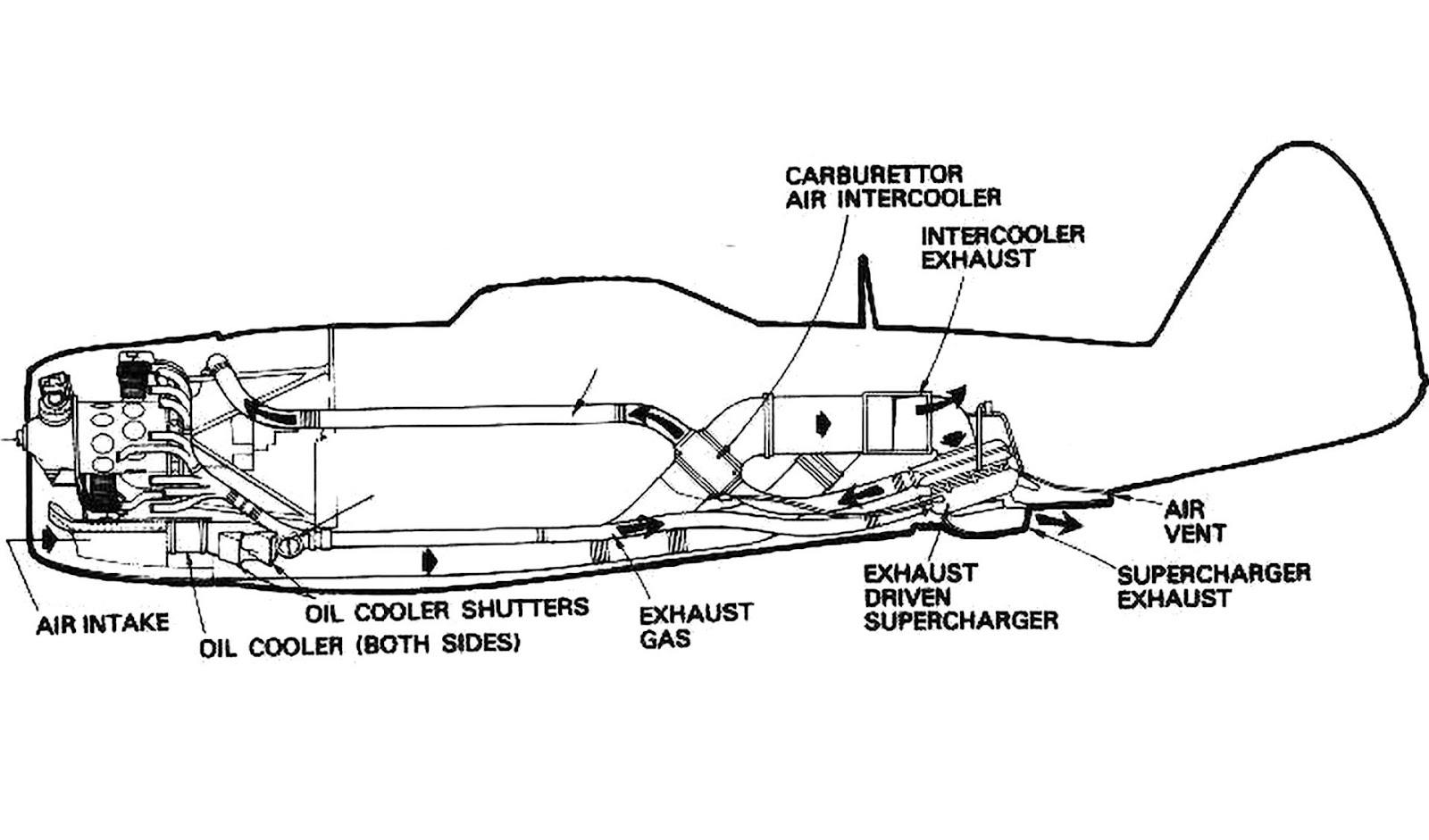
The Thunderbolt prototype, the XP-47B flew for the first time in May 1941. Despite superficially resembling the P-43, it was some 65% heavier and fitted with a Pratt & Whitney R-2800 Double Wasp rated at 2000hp, as also utilised by both the Vought F4U Corsair and Grumman F6F Hellcat. The XP-47B was lost in August 1942 by which time the first production P-47Bs were coming off the line. Unlike the turbosupercharger installation in the P-43, which was almost an afterthought, Kartveli set about designing the ideal installation for this equipment in the new fighter. Accepting that it was best located in the rear fuselage (some 22ft (6.7m) away from the engine) a complicated system of ducting took exhaust gases back to the turbine whilst cooling air was directed to the intercooler and further ducts brought compressed air forward to the carburettor. Despite its complexity, it performed reliably in service and proved surprisingly resilient to battle damage.


171 P-47Bs were built, all of which were retained in the US for training. These were followed by 602 P-47Cs which differed from the B primarily by having an eight inch extension to the forward fuselage to shift the centre of gravity forward and improve flying characteristics. The earlier P-47Bs are easily distinguished by the angled radio mast on the spine. The P-47C was the first Thunderbolt variant to see combat, with the first mission flown on the 10 March 1943. The classic P-47D differed very little from the C model and the two are indistinguishable externally, minor changes were made to the turbosupercharger and a different model of R-2800 engine was fitted. Huge orders were now being placed for the P-47 and Republic could not supply demand, despite a second factory being built to produce it. As a result, orders were placed with Curtiss-Wright to build the Thunderbolt, Curtiss built aircraft being designated P-47G and were essentially identical to the D-model.

It was around this time that the ‘Jug’ nickname was coined for the Thunderbolt. Some sources allege that this is because the aircraft resembles a classic milk jug in profile. However the fact that it requires quite a leap of imagination to visualise suggests that it is possibly a load of rubbish. An alternative theory is that when the 4th Fighter Group (the only fighter group operational with the 8th Air Force in Britain when the P-47 arrived) switched from flying the spitfire to the P-47C, the rotund seven ton Thunderbolt contrasted so starkly with the elegant and comparatively tiny Spitfire V that it acquired the soubriquet of ‘juggernaut’, quickly shortened to ‘jug’. Although the truth will probably never be known, the latter explanation seems (to me at least) more likely.


Following the ‘D’, Republic built the XP-47E which was fitted with a pressurised cockpit and the XP-47F which featured a laminar-flow wing. Both were modified P-47Bs and neither would enter production. Meanwhile, the Thunderbolt was going from strength to strength in combat. The habit of 8th AF pilots of strafing targets of opportunity when returning from escort missions saw the ground attack potential of this purpose-designed high altitude fighter being seriously explored and ultimately resulted in the P-47 becoming the most important USAF fighter-bomber of the war. The P-47 proved highly amenable to this change of role by dint of its heavyweight lifting capability and remarkable ability to absorb battle damage.

Complaints about rearward visibility saw Republic experimentally fit the bubble canopy from a Hawker Typhoon to a P-47D with a cut down rear fuselage. Known as the XP-47K, (a second bubble canopy conversion being designated the XP-47L) the result was so successful that the bubble canopy was introduced on the production line forthwith. Oddly, for such a seemingly major change, neither the P-47K or P-47L designation was used for production aircraft and bubble canopy Thunderbolts remained plain old P-47Ds.

The final iteration of the ‘standard’ P-47 was the ‘hot rod’ P-47M, developed specifically to combat the V-1 flying bomb with uprated engine for maximum speed at low level, though teething troubles prevented the aircraft from entering service until after the V-1 attacks had ceased. 130 P-47Ms were built, externally identical to bubble canopy P-47Ds, these representing the penultimate Thunderbolt variant to achieve series production.
TP-47G ‘Doublebolt’
Although several airframes were field modified with a second seat, the only factory-produced two seaters were a pair of P-47Gs modified on the Curtiss-Wright production line as prototypes of a trainer variant with a pupil’s seat directly in front of the normal cockpit in place of the main fuselage fuel tank. Further production did not go ahead.

Republic XP-47H
Deciding that the regular Thunderbolt wasn’t massive enough already, Republic thought shoving an untried inverted V-16 engine designed by Chrysler might be a good idea. As well they might, for the Chrysler XI-2220 was rated at a lusty 2500hp for take off, making it nearly four times as powerful as the P-35.

Despite its impressive output the XI-2220 possessed a commendably small frontal area and thus combined excellent streamlining with great power, promising excellent performance for the XP-47H. Republic took two P-47-D-15-RAs from the production line in August 1943 and set about modifying them for the new power unit. Unfortunately the modifications required were extensive and the first flight by an XP-47H only took place in July 1945. By then the USAAF was utterly fixated on jet power and the performance of the XP-47H was of largely academic interest. Expected to achieve a maximum speed in the region of 490mph, the top speed recorded in testing was 414mph, though more may well have been possible. Unfortunately, the test programme of the first aircraft was brought to an abrupt end in November after 27 flights totalling 18 hours flying time when the propeller shaft failed, resulting in a dead stick forced landing. The second XP-47H was flown briefly after the war but no further development occurred.

Republic XP-47J Superbolt
Despite the fact that it is obscure in the extreme today, the Superbolt recorded the fastest known speed in level flight of any propeller driven aircraft during WWII, achieving the colossal speed of 505mph (813km/h) on 4 August 1944. It was also decorated with a natty portrait of Superman brandishing a lightning bolt on the cowling, which probably didn’t make it go any faster but certainly ups its credentials as a cultural artefact.


In contrast to the XP-47H, the XP-47J was not a conversion but built from scratch, as such it incorporated a considerable amount of weight saving alterations to the structure. The aircraft was powered by the R-2800-57(C) which delivered 2800hp and was force cooled by an engine driven fan directly behind the propeller spinner. As a weight saving measure two of the machine guns were deleted leaving the XP-47J with six 50 calibre Brownings in the wings. The pilot also benefitted from an extra perspex panel behind the canopy hood which greatly improved the rearward view from the cockpit, though the unbuilt second prototype was intended to feature a bubble canopy.
The Superbolt flew for the first time on 26 November 1943 but didn’t fly again until March of the following year. At some point before August the aircraft was fitted with a General Electric CH-5 supercharger (not turbosupercharger) and became capable of the exceptional speeds that should have rendered it famous but ultimately didn’t.
So why didn’t the P-47 enter production? Mass production of the P-47J actually was seriously considered for a time but ultimately did not go ahead for several reasons. Most seriously, the XP-47J enjoyed only 30% commonality with the P-47D which was busy proving a highly successful fighter in Europe and the Pacific, a switch to the P-47J would have required a significant change to production tooling resulting in delays which could not be tolerated at this stage of the war – better to have a large amount of the extremely good P-47D now than wait several months for the slightly better P-47J. Furthermore, the lightened structure of the XP-47J resulted in a reduced fuel load and therefore a shorter range, at exactly the time when ever longer ranged fighters were desperately needed.

The final nail in the coffin for the P-47J though came from Republic themselves: applying the same engineering solutions to a new aircraft with the even more powerful new R-4360 Wasp Major promised even better performance than that achieved with the Superbolt. This aircraft would subsequently appear as the XP-72 and further development of the P-47J was abandoned.
Republic P-47N
The best of the various Thunderbolt variants and developments to actually enter service, the P-47N also saw the only major change to the basic structure of the P-47 to see series production, featuring a completely new wing.


Much P-47 development work had been performed in an attempt to extend the range of the aircraft and the P-47N, intended as a B-29 escort in the Pacific, took that work to its logical conclusion. With no more room available for fuel in the fuselage and no simple way to increase external tankage the only option for more fuel was to provide wing fuel tanks. With a greater fuel load then pushing up the weight, a strengthened wing with greater area was required and so a new wing was designed with a 22 inch greater span giving an increase of 22 square feet in area, with square cut wingtips fitted for increased roll rate. The maximum fuel load for the P-47N was an astounding 4792 litres (for comparison, the Spitfire Mk.I carried 386 litres). All this fuel pushed the loaded weight up to over nine tonnes and the P-47N was extremely sluggish at take-off until some of that fuel had been expended. Republic’s efforts certainly paid off though – the P-47N could outrange the famously long-legged P-51D and it was no slouch either, topping out at 460mph at 30,000ft, whilst the best the P-51D could manage was (an admittedly still impressive) 440mph at its best height. The big Thunderbolt also retained all the earlier P-47’s best traits such as its superlative damage resistance and exceptional build quality. As an all-round fighting machine, the P-47N has a pretty good claim to being the best Allied fighter of WWII to see production and actual operational service.

The first P-47Ns went into action during April 1945 in the vicinity of Okinawa and mostly flew bombing and strafing missions over Southern Japan until the end of hostilities. During the course of these operations, P-47N pilot Oscar F Perdomo became the last American ‘ace’ of WWII when he shot down five Japanese aircraft in a single mission a mere two days before the end of hostilities. With the end of the war production came to an abrupt end, contracts for 5934 P-47Ns were cancelled, the relatively modest total of 1806 P-47Ns was actually built.
Republic XP-72 Ultrabolt
Despite receiving an order for 100 production P-72s, the mighty Ultrabolt (or Super-Thunderbolt or Superbolt (again)) was destined never to be built in quantity, the USAAF decided the future lay with jet aircraft and changed the order to cover 100 P-84 Thunderjets instead. Given the performance of the early Thunderjet, they may have had cause to regret that decision as the P-72 was an absolutely sensational aircraft that bid fair to becoming the most formidable piston engine fighter ever built. Key to its spectacular potential was its engine, the Pratt & Whitney R-4360 Wasp Major, a ludicrous 28 cylinder four-row radial engine that delivered a whopping 3450hp as fitted to the XP-72 but which would ultimately exceed 4000hp in R-4360-51 VDT form intended for the B-36C. Today the Wasp Major enjoys a somewhat frenetic retirement as the power plant of choice for many of the highly modified Reno air racers. These aircraft are, tellingly, very, very fast indeed.

Schemed as a low-risk back up to Republic’s XP-69 (which would ultimately never be built) and seen as a more promising design than the XP-47J Superbolt, the USAAF was initially very keen on the XP-72 due to its obvious potential for chasing down V-1 flying bombs. Like its XP-47J predecessor, the close cowled engine was force-cooled by a fan and a supercharger was mounted in the rear fuselage, not a turbosupercharger, this being powered by a fluid coupling and shaft drive running back from the engine. Armament fitted to the prototypes was six 50 calibre Brownings, though this could be changed for the fearsome alternative armament of four 37-mm cannon.

Two prototypes were built, flying in February and June 1944 respectively. As completed the XP-72 was roughly the same size and weight as the P-47D but possessed about 50% greater power and was more aerodynamic, the resulting performance was fantastic, a 490mph top speed was recorded and developed versions of the R-4360 were expected to give production P-72s a speed of 540mph (an optimistic figure but indicates the uncharted realms of performance the P-72 was expected to be operating in).
Alas it was not to be. The war situation did not require the P-72 to enter production and the advent of promising new jet fighters suggested that its performance, spectacular though it was, would soon be outclassed by a whole new kind of aircraft. One airframe, without its engine, was given to a Long Island, New York chapter of the Air Scouts in August 1946 and its ultimate fate is a mystery. The other airframe was scrapped.
Republic ‘Jetbolt‘
The ultimate Thunderbolt development never made it off the drawing board but it is an intriguing concept. In 1944, the Army suggested that Republic might look at a jet powered Thunderbolt derivative, the large size of the fuselage was obviously amenable to house potentially quite bulky power units and the airframe was a known quantity with good high speed flying characteristics. Furthermore, with P-47 production in full swing, a jet fighter in the form of the ‘Jetbolt’ (or Turbobolt) might be able to be produced quickly and relatively cheaply without the need to produce substantial amounts of new tooling, an obviously attractive prospect.

Initially the General Electric J31 engine, a centrifugal flow turbojet based on the British Whittle W.2B was considered but even the portly Thunderbolt’s fuselage was not sufficiently large to satisfactorily accomodate this large diameter engine. Further development centred on the Allison J35, America’s first axial flow turbojet, which was slimmer. Removing the R-2800 piston engine freed up space in the nose for the jet intake and the proposed armament of six or eight 50 calibre machine guns giving a more concentrated firepower than the wing mounted guns of the standard Thunderbolt. The jet engine was mounted below the cockpit floor, necessitating a slightly deepened fuselage with the jetpipe taking up the space previously filled by the large turbosupercharger and its extensive associated ducting, which were obviously no longer required.

Ultimately the Jetbolt would progress no further, the P-47 was reaching the aerodynamic limits of its design, even in piston engine form, and jet propulsion promised only a marginal improvement. Kartveli was working on his first purpose-designed jet aircraft by this time and this was clearly a more promising line of development. This would appear in 1946 as the F-84 Thunderjet and brought to an end around a decade of continuous direct line development that all stemmed from the SEV-3 amphibian of 1933 but even this wasn’t quite the end for the P-47 line.
Republic AP-47
In 1948, Republic proposed a mixed-power ground-attack version of the P-47 to be powered by an R-2800 piston engine in the nose and with a Westinghouse 24C jet engine replacing the turbosupercharger in the rear fuselage. The cockpit was to be placed further forward to provide the pilot with a better view over the nose. Oddly for an aircraft featuring a jet engine, a tailwheel undercarriage was intended to be used and the aircraft featured the wing of the P-47N.

Despite some pretty impressive performance estimates, the mixed-power solution for combat aircraft was gradually falling out of vogue in the United States, with pure jet aircraft being developed to fill virtually all combat roles and the Ryan FR-1 Fireball became the only fighter example of this arrangement to actually enter service (with the US Navy). The USAF were not sufficiently interested in the AP-47 to order a prototype and the final iteration of the basic P-47 design remained on the drawing board.

The Hush-Kit Book of Warplanes is a gorgeous heavily-illustrated – and often irreverent – coffee-table book covering the history of military aviation from 1914 – the present. Volume 2 is now crowd fund-raising through advanced pre-orders here.

Top Ten Things about the P-47

The P-47 Thunderbolt was the most versatile fighter aircraft of the Second World War. It was not “best in class” in any category, however, it was very good in just about every category. Fast, long-legged and well armed, it was also the most survivable fighter of the entire war. In scale and concept, the P-47 was a design outlier, and was different from every other fighter of the war. Somehow, the unusual Thunderbolt came together in a magical way that resulted its outstanding operational record. Myth and misconception surround the aircraft, and much of this leads to an under-appreciation of what the aircraft actually accomplished. This article will dive into some of those misconceptions and look at the real capabilities of those ferocious flying juggernaut.

Before we get started, I will address the elephant* in the room: the P-47 is ugly. There, I said it. Many often state that if an aircraft l***s good, it will f*y good. No one ever talks about the corollary, that if an aircraft is ugly, it will not fly well. This is never mentioned because it is not true. And besides, beauty is in the eye of the beholder. There are plenty who love the P-47 due to its rugged, badass looks. It’s in a similar category to the Westland Wyvern and the A-10 Thunderbolt II (the P-47’s grandchild!). Unfortunately I think the (lack of) sex appeal of each of these aircraft has limited their popularity in a wider public (‘P-47 Thunderbolt’ will garner 8 million results of Google search results, compared to over 20 million for the P-51 Mustang).
But aircraft performance and effectiveness is not a popularity contest. The facts stand on their own. So Let’s dig in!
*Note that the heaviest elephant in the room is a metric ton lighter than the P-47.

The P-47 is the largest single piston-engined fighter ever built. And it is indeed large and heavy! Its empty weight is similar to or greater than every other contemporary single-engine fighter’s maximum weight. It is over twice as heavy as the original Spitfire and Me 109 fighters. There is a common misconception that large size and weight correlates with low performance. The perception is that a larger aircraft will be slow, lumbering, unmanoeuvrable, and ineffective. I believe this idea comes from comparison to other large aircraft. And indeed, most larger aircraft (bombers and transports for instance) do fit this description. But that is not specifically due to their size; it is due to their design attributes.
There are two primary metrics that affect a fighter’s performance: wing loading and power to weight ratio. The first of these states how large the wing is relative to the weight of the aircraft, and is measured in pounds per square foot or kilograms per square meter. A larger wing can produce more lift and it determines how aggressively a fighter can turn at a given speed. In general, the lower the wing loading (i.e. the larger the wing), the more “manoeuvrable” a fighter will be. Wing loading is a compromise though. The larger the wing, the more drag it produces. So a really low wing loading limits the top speed of an aircraft. Both manoeuvrability and speed are the key performance qualities of a good fighter.
The second parameter, power-to-weight ratio, states the power of the engine relative to the weight of the aircraft, measured in horsepower per pound or kilowatts per kilogram. This parameter is directly related to the top speed of the aircraft, but also to the takeoff and climb performance. A high power to weight ratio results in an aircraft that will climb and cruise faster than a competitor with a lower ratio.
The bottom line is that size and weight of an aircraft do not determine the aircraft performance. It is quite possible to build a large and heavy high-performance fighter, as long as it has the right sized wing, and a big engine. Let’s look a little deeper at how the P-47 used each of these metrics to its advantage.
The P-47 had much smaller and humbler beginnings. The concept started in the late 1930s as two different evolutions of the successful, but dated, P-35 design. The company delivered a small number of P-43’s with a similar design and layout, but using a much smaller R-1830 engine. The next iteration, the P-44, was to use the liquid-cooled Allison V-1710, but was never built. In late 1939, after Germany started its rampage in Europe, the US Army Air Corp had a meeting to discuss the noncompetitive state of the current and coming US fighters. The conclusions that emerged from the meeting was that the Air Corp desperately needed a fighter with more speed, more armor, and more firepower. Alexander Katveli, the Chief Designer of Seversky Aircraft happened to be in attendance. On the train ride home, he sketched an up-scaled version of the P-43 with the goal of meeting this newly desired aircraft specification.

More armour and armament means more weight. To be a competitive fighter, the engine power would have to grow as well. Katvelli turned to the new R-2800 twin-row radial engine being developed by Pratt & Whitney as the only viable powerplant. This engine had over 50% more displacement than the Allison, and initially had 33% more horsepower. A second problem that plagued US fighters of the day was the lack of sufficient power and performance at higher altitudes. Most of the contemporary American engines used a single-stage, single-speed supercharger. This design leads to significant falloff in power at altitudes starting around 15,000 feet. The combat experience in Europe was showing that the air battles were often going to be fought much higher than this.
The R-2800 engine had a single-stage supercharger which was integral to the engine. The P-47 design added an exhaust-driven turbo-supercharger to create a second stage. A turbo-supercharger is effectively a variable speed device, being engine exhaust-driven and having a wastegate control system. This allows peak engine power throughout a wide range of altitudes. By comparison, the famous Rolls-Royce Merlin engine used a 2-speed, fixed-ratio supercharger which provided peak power at only two specific altitudes.

The downside of a turbo-supercharger is that the installation occupies a lot of space. Fortunately the P-47 was already being drawn as a large fighter, and Kartveli was able to squeeze the turbo and even larger intercooler into the belly of the aircraft. This packaging is the primary reason the aircraft looks more like a pregnant whale rather than a sleek fighter, thus contributing to the perception of it being a dog.
Later versions of the R-2800 engine increased the boost pressure of the supercharger system and, along with the use of water-methanol injection, could deliver over 2,800 HP.
Manoeuvrability is a term that gets tossed around a lot. It’s a simple concept. But when applied to a fighter, it quickly becomes complex. There are at least four aspects that affect what we call “maneuverability.” First is the aircraft’s roll rate, or how fast the pilot can bank the wings when choosing to fly in a different direction. Several aircraft details determine this parameter including the wing span, the size and design of the ailerons, and the weight distribution of the aircraft. (Aircraft with twin-engines on the wings have reduced roll rate.) I think roll rate is somewhat overrated in assessing maneuverability. In most dogfights, a majority of the time is spent in sustained turns, not switching turn direction. But a pilot will always be happier with an aircraft that responds quicker to control inputs.


The most important manoeuvrability aspect is the turn rate. However, there are really two versions of this: instantaneous and sustained. Instantaneous turn rate is the maximum rate at which you can turn as soon as you roll to a given bank angle and pull back on the stick. The force to create this turn is created by wing lift, and in a fighter it can be a LOT of lift. The aircraft wing is what determines instantaneous turn rate. A large wing and/or a well-designed wing can produce a lot of lift, and therefore a high turn rate. Unfortunately this lift creates a lot of extra drag. As soon as you start this maximum performance turn, you start slowing down. This leads us to the second turn rate parameter: maximum sustained turn. As you slow down in a turn, the drag will decrease and eventually you will reach an equilibrium point where drag matches the thrust your engine can produce, and you can sit here turning until your fuel runs out. This turn rate is lower (usually much lower) than the instantaneous rate. But this is where many dogfights culminate – slower, sustained turning battles with the better aircraft and/or pilot out-turning the opponent and claiming victory.
A fourth manoeuvrability aspect is the difference between turn rate and turn radius. These are related, but not the same thing. The relation is affected by the speed of the aircraft. When flying slower, a given turn rate will result in a smaller turning radius. The relationship between these three (speed, rate, radius) complicates a dogfight. This can be used to an advantage if you can force your opponent into a speed range where your aircraft is superior in either rate or radius and you maneuver accordingly.
A final comment on manoeuvrability – it is greatly affected by altitude. Both the aircraft aerodynamics and the engine performance change with altitude. The balance of these determines the aircraft manoeuvrability. An ace aircraft at one altitude might be a complete dog at a different altitude.
Let’s get back to the P-47. How did it rate in the manoeuvrability category? The basic answer is “pretty good.” Many fighters could outturn it, especially at lower altitudes. But the margin was small – small enough that a better pilot in a P-47 could often outturn a lesser pilot in a Me109 or Fw190. (It takes a lot of skill to precisely fly a fighter at its maximum turn performance.) The P-47 wing loading was not as low as some of the higher-performance fighters and its instantaneous turning ability was a little less because of this. However, the big R-2800 engine really helped its sustained turn performance. This is particularly true at higher altitudes. The turbo-supercharger provided tremendous power at 25,000 feet and higher. This allowed the aircraft to be on par or better than any of its opponents in a sustained fight at these altitudes.
If you enjoyed The Hush-Kit Book of Warplanes, then please do write a nice review on Amazon as this really helps us.

A quick note on the P-47 wing. You will often hear this called the “famous Seversky wing.” The lineage of Seversky aircraft dating back to the early 1930s shared a common wing design in both planform and a proprietary airfoil. The planform is elliptical, which is a theoretical optimum for reducing drag due to lift–a critical factor for fighter turning performance. However, you can get an almost equal performance with other wing shapes that might have other benefits such as easier manufacturing or better stall characteristics. At first glance, the Seversky wing looks similar to the elliptical Spitfire wing. The primary difference is the chord layout in the planform view. The P-47 has a straight leading edge, which is much easier to manufacture. All of the elliptical curvature is pushed to the trailing edge control surfaces. These are easier to build with curved edges. (The aerodynamics performance is essentially the same.) The P-47 and Spitfire designers have both commented that the elliptical wing is not just about aerodynamic efficiency. It also provides a thickness distribution that is convenient for both installing large guns, and providing structural efficiency. For all of these reasons, the P-47 did indeed have a very good wing.

The range of the P-47 is probably the most misunderstood part of its performance. You often hear about how Mustangs could exclusively escort bombers all the way to Berlin, and thus turned the tide of the war. The real story is much more complicated and steeped in Air Corps politics. The reality is that the P-47 could also escort to Berlin and further much earlier than many people think.
Aircraft range is a simple parameter affected primarily by two things. First is how efficient the aircraft can fly at given speed and altitude measured by how much fuel it needs per hour. Second is how much fuel it can carry. The P-47 does burn a lot of fuel with its large size and weight. However, this larger size also allows it to carry proportionately more fuel. Per the pilot’s manual, the P-47D with maximum internal fuel could fly 890 miles (compared to 1,120 for the Mustang). With two drop tanks, the Thunderbolt range increases to 1,360 miles, leaving plenty of margin for the 1,000 mile round trip from England to Berlin.

So why does everyone think the P-47 can’t reach Berlin? Much of this misconception comes from some range maps that were published at various times by the US Army Air Corp which show the Mustang having superior range. I highly recommend watching the “Greg’s Airplanes and Automobiles” YouTube episode on the range of the P-47. Piecing together a lot of historical data, he tells a compelling story about how this myth evolved. Early in the war, the US bomber doctrine was anchored on the idea of bomber self-defence. It was believed the combination of speed, altitude, and defensive firepower would ensure the bombers would get through to the target without the need for fighter protection. Because of this, the Air Corp leadership downplayed the need for long-range fighters in an effort to spend more funds on bomber development. This even went as far as showing no interest in the development of fighter drop tanks.
Reality prevailed once the bombing effort commenced in Europe and it was quickly learned that the bomber did indeed require fighter escort to minimize bomber losses. The Air Corp leadership was slow to learn or at least admit this lesson which likely explains the existence of these range maps with misleading information. Eventually all of this caught up, drop tanks were used, and long range escort mission were flown by both the P-51 and P-47.
The final P-47N version had a redesigned wing with internal fuel and larger drop tanks, enabling an escort range in excess of 1,000 miles. This version was developed to escort B-29s in the Pacific theater. Given this extended range, and the consistent performance at high altitudes, the aircraft was incredibly effective in this role.

In level flight, the Thunderbolt top speed performance is much like the rest of its performance envelope. It was not the fastest aircraft at any altitude. But it was very fast and was quite competitive in top speed. This is particularly true at high altitudes, where its engine produces superior horsepower. At 30,000 feet, the P-47D was within 7 mph of catching a P-51D, and significantly faster than an FW190A-8 or Bf109G.
The final P-47N version was extremely fast, again, especially at high altitude. Its R-2800 engine could produce 2,800 horsepower with water-methanol injection and this resulted in a top speed of 470mph.
To fully appreciate the speed capabilities of the P-47, you have to talk about its ability to dive. We will dig into that next.


Donald Balkeslee, the first Thunderbolt ace is quoted saying “It ought to be able to dive, because it certainly can’t climb.” We will begin this topic with a brief discussion of the physics of diving.
Just like manoeuvrability, the ability to dive is complex and affected by many parameters. At the beginning of a dive you have to manoeuvre the aircraft into a diving attitude, either by pushing the nose over, or rolling upside down and pulling the nose down. Once you are in a nose-down diving attitude, the aircraft will accelerate due to the relative balance of aircraft weight, drag, and thrust available. All of these affect the acceleration rate, and your ability to pull away from (or catch) an opponent who is also diving. Depending on the dive angle, at some point your aircraft will reach a speed limit, which requires you to reduce the dive angle to prevent exceeding the limit. At any given altitude, this limit might be set by the indicated airspeed or the Mach number (the speed relative to the speed of sound). The relationship between these two limits is complex, and it changes as your altitude changes. Finally, a dive is affected by the controllability of the aircraft as it reaches higher speed, and the ability for the pilot to maneuver out of the dive before impacting the ground.
The P-47 was excellent in every one of these dive aspects, which makes it one of the best diving aircraft of the period. With its throttle-body fuel injection, the engine did not suffer from negative-g fuel starvation like the early Merlin engines. So a pilot could freely push the nose over to initiate a dive without the fear of the engine cutting out. Once in the dive, the P-47 accelerated quickly due its engine power and reasonably low drag. Best of all, the Thunderbolt had one of the highest dive speed and Mach limits of any fighter of the era. So the aircraft could keep accelerating away from an opponent. Finally, the P-47 was highly controllable in a dive, with little concern about Mach effects reducing the control authority. Many fighters of the era had Mach limits set with margin to a flight condition from which you could not recover. Most models of the P-47 also had a dive brake, which allowed an even steeper dive angle, and more recovery margin at the end of the dive.
This dive ability was a real benefit for P-47 pilots and contributed to its high survivability rate. If a pilot was found in a condition where the aircraft performance was less than an opponents, diving away from the opponent was almost always an option. This would usually result in escaping the immediate threat.

We have talked about how the size and weight of the P-47 didn’t really hurt its performance due to the well-chosen design parameters and a large engine. Now let’s talk about what that extra weight allows you to do. The short answer is you can carry a lot of armament!
The P-47 had eight Browning M2 50-calibre machine-guns, four in each wing, whereas most contemporary fighters had no more than six fifty cals. The Thunderbolt sometimes gets criticised for not having any larger-calibre cannon. The aircraft certainly could have carried them. However, for its intended mission of destroying enemy fighters, the 50-calibre round is quite effective, and the combined firing rate of its eight guns meant a much higher probability of getting hits than with a slower-firing cannon.
The aircraft could carry 3,400 rounds of ammunition which, for comparison, was 65% more than a P-51. This high quantity of ammunition resulted in an interesting evolutionary role for the aircraft as the war progressed. At the end of an escort mission, the pilots often found they had significant unused ammunition. A tactic was developed for the pilots to then drop to a lower altitude and strafe ground targets of opportunity on the flight home. With eight guns and good diving qualities, the aircraft proved highly effective in this role. As the Luftwaffe became less of a threat late in the war, P-47s were more often assigned to ground attack as a primary mission because of their effectiveness in this role.
In addition to the guns, the P-47 could carry a heavy load on its external hard points. Between two wing racks and a belly rack, the aircraft could carry up to 2,500 lbs of external weapons. Initially this mostly consisted of bombs. Later, the aircraft was equipped to carry ten “High Velocity Aircraft Rockets” or HVAR. These unguided rockets did not have pinpoint accuracy, but were quite effective against larger ground targets. Each had a 45-pound warhead which was equivalent to a 105-mm Howitzer artillery round.

The P-47 was the first aircraft to drop a Napalm munition in combat. The original version of this was fabricated in the Pacific theater using drop tanks. This of course went on to infamous use in later wars. The aircraft could also carry a chemical dispersal pod. This is rarely discussed for political reasons. But the capability was in place for use of such a weapon late in the Pacific war if it came to that.

One of the original goals for a future fighter, as defined by the Army Air Corp in that 1939 meeting, was an increase in armour and aircraft systems to improve the survivability of both the aircraft and the pilot. The P-47’s size and weight made this feasible.
The P-47 had thicker armour in more locations around the pilot than any other contemporary fighter. There were a lot of other features on the aircraft that offered protection and made the aircraft more survivable in a crash landing. With a smooth belly free of cooling features, the aircraft responded well in a gear-up landing with minimal tendency to overturn. Additionally the fuselage contained an internal belly skid structure that contributed to survivability in a crash. It also made the aircraft more repairable after the crash. The original razorback P-47 had a substantial roll-over structure behind the pilot. This was omitted in later versions with the bubble canopy due to a low occurrence of roll-over accidents and the added benefit of better pilot visibility.
An aircraft with an aircooled-engine is generally considered more survivable than a liquid-cooled counterpart. The cooling lines and radiators are particularly vulnerable in that the engine will likely quit soon after a single hit to one of these systems. By comparison, an engine can typically run much longer after a hit to air cooling ducts, or even the turbocharger (at reduced performance).
All of these resulted in a very survivable aircraft. The top-10 Thunderbolt Aces all survived the war. This is a statistic, not shared by any other aircraft in World War 2.

All of these factors contributed to the P-47 being a very effective fighter in the Second World War, against both air and ground targets. The overall aircraft destroyed and the kill ratio for the P-47 was impressive. By the end of the war, the Mustang had beat the Thunderbolt in both of these categories, by a healthy margin. However, these metrics alone don’t tell the complete story. You have to factor in both how and when the aircraft was used.
The Thunderbolt started flying significant combat missions in Europe in the Spring of 1943. This was around 9 months before the Mustang arrived. During this time, the Luftwaffe was at the peak of its experience and effectiveness. This provided a very challenging opponent for the Thunderbolt pilots. By the time the Mustang was flying in significant numbers, the establishment of Allied air superiority was setting in, and many of the more experienced Luftwaffe pilots were no longer in the fight. Additionally, the German aircraft had a more difficult time keeping up with the performance advances of the Allied aircraft due to a shortage of certain materials and high-octane fuel. Before the Allied invasion on D-Day, The P-47 had amassed over three times the combat flight hours of the P-51, and 50% more than the P-38.
A second factor is how the aircraft was used. Due to its superior firepower (and a reduced threat from the Luftwaffe) more P-47 sorties were ground attack missions in the later stages of the war. While these missions were highly effective and greatly appreciated by the ground forces, they don’t contribute to air-to-air statistics, which is how most people judge a fighter’s effectiveness. However, there is much more to the story than these simplified statistics.

The above facts and commentary make the case for the P-47 being one of the most well-balanced, versatile, and effective fighters of the Second World War. It excelled at every mission it was assigned, and proved to be a well-loved aircraft by both the pilots and the mechanics supporting the aircraft.
Between its size, and complexity of the turbo-supercharging system, the P-47 was an expensive aircraft to produce. It cost over 50% more to build than the P-51. Despite this, the P-47 was (and likely will remain) the highest-produced fighter in US history. It is a strong contender on the world-wide fighter production rankings as well, coming in at number 6.
`The P-47 left quite a legacy in years to come. Most aircraft companies (like musicians and authors) tend to attempt a repeat of a previous winning formula when embarking on an updated endeavour. This was certainly true of Republic Aviation. After the war the company switched over to the development of jet aircraft. The first-generation F-84 was only partially successful, but the company learned a lot about this new form of propulsion and how to properly design a fighter around a jet engine. The next aircraft, the F-105 was a very successful ground attack aircraft. Following the P-47 family heritage, it became the largest single-engine jet fighter ever produced, and had similar traits of heavy firepower and strong armour. The final success story with the same lineage was the A-10 Thunderbolt II, for much the same reason.`The P-47 left quite a legacy in years to come. Most aircraft companies (like musicians and authors) tend to attempt a repeat of a previous winning formula when embarking on an updated endeavor. This was certainly true of Republic Aviation. After the war the company switched over to the development of jet aircraft. The first-generation F-84 was only partially successful, but the company learned a lot about this new form of propulsion and how to properly design a fighter around a jet engine. The next aircraft, the F-105 was a very successful ground attack aircraft. Following the P-47 family heritage, it became the largest single-engine jet fighter ever produced, and had similar traits of heavy firepower and strong armor. The final success story with the same lineage was the A-10 Thunderbolt II, for much the same reason.
Joe Wilding was the co-founder of Boom Supersonic, an independent company attempting to build a supersonic transport aircraft. He is Chief Engineer at Cosmic Aerospace, Engineering Mentor and Coach.


Brazilian P-47 Thunderbolt post tree.
Despite being complex and expensive to operate, the P-47 was rugged, potent and reliable. After 1945 the Thunderbolt was eagerly snapped up by a swathe of nations, particularly in Central and South America. Nicaragua was a major user of the type and loaned a handful to the CIA-backed Guatemalan insurgent Air Force in 1954 who used the Thunderbolts in the early stages of a successful coup to oust the democratically elected government and install the military dictatorship of Carlos Castillo Armas. The final aerial combat for the mighty ‘Jug’ came in January 1955: during a border dispute, Gerald Delarm Amador (who has earlier flown in the same aircraft in the Guatemalan coup) shot down a Costa Rican Mustang in a Nicaraguan F-47N. This aircraft survives in the collection of the Commemorative Air Force in the US. Last user of the Thunderbolt though was Peru, the last operational Peruvian Thunderbolts were withdrawn in 1966.
The 12 nastiest aircraft ever made

Aeroplanes are wonderful and terrible. Though they have made the world smaller, they have also made it dirtier and more endangered. In this top (or bottom) 12 we will look at aircraft that are particularly filthy as solo artists – and ones that have proved so popular that their net effect is globally terrifying. Set watches for doomsday, and let’s meet 12 of the worst offenders that ever flew.
12. Fairchild C-123 Provider ‘Bad Healthcare Provider’

Agent Orange was just one of a diabolical gang of quaintly-named Rainbow Herbicides. Inspired by British use of toxic jungle-killing chemicals in the so-called ‘Malayan Emergency’*, US forces attempted to expose Viet Cong forces by removing the cover allowed by dense jungle, and to destroy crops to starve them out. Secretary of State Dean Rusk advised President John F. Kennedy that the British cop-out* had established a precedent of legality. A decade (61-71) of air deployed anti-crop and defoliation efforts left the ground poisoned and resulted in massive long-term health problems and terrible birth defects for the unlucky civilian population.
*One benefit of the British repeatedly to avoiding the term ‘war’ was that accusations of military chemical warfare could be denied, as this was a ‘policing’ action.
11. Messerschmitt Me 163/North American X-15 ‘Rockets to the crypt’

Horribly toxic rocket fuel and high altitude flight make these two speedsters particularly bad. The 163 flew more, but the X-15 flew higher and so increasing its environmental effect.
10. Avro Lancaster ‘Av-death-row’

The worst aerial attack in European history in terms of structural damage was on Hamburg on 27 July 1943. 787 RAF aircraft – 353 of them Avro Lancasters* burnt 18,000 civilians to death in a firestorm that destroyed much of the city. Across World War II, Lancasters flew a total over 156,000 sorties and dropped over 608,000 tons of bombs.
9. Boeing B-17 Flying Fortress ‘Memphis Smell’
In World War II, B-17s dropped a staggering 640,036 tons of bombs. The nearest rival to this, the B-24, dropped 452,508 tons of 464,500+ tons released by all other U.S aircraft types.
(the rest were 74 Vickers Wellingtons, 116 Short Stirlings, 244 Handley Page Halifaxes)
8. North American XB-70 Valkyrie ‘Viking Sky Burial’

Generally speaking the higher a jet aircraft flies the worse its environmental impact. Flying at an extraordinary 70,000–75,000 ft (21,000–23,000 m) the Valkyrie mach 3 bomber, with six General Electric YJ93 was an absolutely filthy beast. Airframe-for-airframe the six-engined Valkyrie was the least Green aircraft in history.
7. Lockheed SR-71 Blackbird ‘Trisonic Plague’

Though three times less damaging to the environment than the XB-70, the SR-71 flew many more hours at extreme altitudes. It is not known (at least to us) whether its special JP-7 jet fuel was better or worse than standard fuel.
The Hush-Kit Book of Warplanes is a gorgeous heavily-illustrated – and often irreverent – coffee-table book covering the history of military aviation from 1914 – the present. Volume 2 is now crowd fund-raising through advanced pre-orders here.
6. Boeing B-29 Superfortress ‘Carbon Sasquatch Footprint’

One dropped atomic bomb releases about 690m tonnes of CO2, and destroying cities with firebombs is also not so green. The B-29 competes with the B-52, B-17 and Lancaster as the most destructive aircraft in history and may edge ahead of both in terms of C02.
5. Boeing 747 ‘Jumbo Number 5’

With a cruising height of 35,105 feet, four engines and many long-haul routes, the 1,500 747s made have done an awful lot of damage. Considering there were single 747s with more than 136,569 flight hours alone, then the 747 has a huge grubby footprint.
4. Aérospatiale-BAC Concorde ‘The shitting aristocrat’

Spending more time per airframe at supersonic speeds (at extremely high altitudes) than any aircraft in history, Concorde’s green credentials were pretty damn poor. It was also one of only two airliners (the other was the Tu-144) that used afterburners. Add to that its contributions to acoustic pollution and the most beautiful machine in human history starts to look very ugly. The Soviet Tu-144 was even dirtier but didn’t fly very much.
3. Boeing 737 ‘The price of success’

As with anything, there is evil in the large-scale, so the effect of the extremely popularity of the Boeing 737, which in itself is not the worst, is sobering. For total net effect, rather than dirtiness per airframe, the Boeing 737 has to be the worst. With 264 million flight hours under its petite belt. The A320 series (essentially a European 737) is also a prime offender due to its popularity.
2. Boeing B-52 Stratofortress ‘The Dirty Reaper’

Between 6 and 8 million tons of munitions were dropped or launched during the Vietnam War (this compares with 2,057,244 tons dropped by US bombers in World War II), around 1000Ibs for each Vietnamese citizen. The majority of this figure was by USAF, and much of the USAF total from its heaviest bomber, the B-52. The Vietnam air campaign featured the longest and largest aerial bombardment. The B-52 has probably killed more people than any other aircraft as well as taking part in part in more atomic weapons test than any other aircraft (its closest rivals for nuclear weapons test are likely the Tu-16 and Tu-95). Even when it is not bombing the B-52 is a dirty bastard, one flypast from the eight-engined dinosaur is akin emits “as much carbon dioxide as 130 average mid-size cars emit per year.”

Blaming World War II on the ‘109 is not as ridiculous as it first sounds. The Blitzkrieg method of combined fighting required air superiority, and until the arrival of the Fw 190 in 1941, Germany had no first-class single-engined fighter other than the Bf 109. Neither the invasion of France, the trauma of ‘Fighter Day’ or the attempted invasion of the USSR could have been considered without the 109. World War II was a catastrophe for the environment and CO2 emissions and it could not have happened without the nasty little 109.
This site has over 1000 articles that are currently absolutely free to read, doing this kind of thing takes a massive amount of time and effort. If you appreciate what we do, then please use the donation buttons on this page. We want to keep this site free, but we are struggling. Thanks, HK


The Republic XP-69 would have been a fast and well-armed menace, capable of blasting enemy aircraft to pieces, even at extreme altitudes. But, it was swatted from history by bad luck.
Contra-rotating propellers (two sets of propellers sharing an axle and counter-rotating) are fuel efficient and offer a far great amount of power for a given frontal cross-section, but they’re frightening loud and hideously complex. A British invention, the contra-rotating propeller was thought of by the utterly brilliant polymath Frederick W. Lanchester some time before 1909. Though he may have looked like a supporting cast member in feel-good comedy set in the North of England, he was an astonishing man in many ways comparable to Nikola Tesla. Much like Tesla, he was brilliant at everything. He was excellent at singing, radical new automotive ideas, aerodynamic theory and poetry among many other talents. In fact he was pretty brilliant at everything, apart from capitalism. He contributed much to the world but was always short of money.

The British used this configuration on all their most unlucky aircraft: the fabulous capable but ill-fated Martin-Baker MB.5, and the technically brilliant and commercially unfortunate Brabazon and Princess. Only the unfeasibly hideous Westland Wyvern, Gannet, Sturgeon and admittedly passible Shackleton made it into service on contra alone (others, such as the Spitfire and Seafire, had a contra version). The French tried a racer, the gorgeous Bugatti 100P, a promising design thwarted by the German invasion of France. The Soviets, managed to get a four-engined fast bomber into service, the Tu-95/142, as well as an airliner derivative (the Tu-114) and a terrible VVIP transport, the Tu-116. The US gave its most eccentric aircraft concepts of the 1940s and ’50s contra-rotating propellers.
The Reluctant Rocket
In 1941 the USAAF, keen to shake-off the American love affair with mediocre and overly conventional fighters, asked aircraft manufacturers to submit unorthodox 450mph fighters for consideration. To make it even more high-risk they also invited engine manufacturers to submit new and unorthodox ideas. Republic responded to the request for fighter submissions with the AP-12 ‘Rocket’. With its mid-mounted engine and contra-rotating props it shared much conceptually with the Bugatti 100P. It did badly when assessed against the other designers, achieving 12th or 13th ranking. Republic went back to the drawing board.

They responded with plans for a high-performance high altitude interceptor, the XP-69, which was designed for a top speed of 450mph+, armed with one or two 37-mm cannon and two .50 cal heavy machine guns. The aircraft was in many ways an excellent design by a superb design team, but its downfall was technical risk. The fighter combined the incomplete 42-cylinder R-2160 engine with a new propeller configuration, and a pressurised cockpit. When the engine programmed struggled, USAAF turned to another Republic aircraft, the XP-72.
Cock & Bear story
The failure of the R-2160 impacted on some other promising designs, notably the Lockheed XP-58 Chain Lightning and the Vultee XP-68 Tornado. Today, the unholy row of contra-propellers can be heard on the Tu-95 ‘Bear’ bombers of the Russian Air Force, and if still flying, the Antonov An-22. Will this technology die with the ‘Bear’? Probably not, as whenever aviation fuel prices get high enough, designers turn back to studying the Lanchester’s contra-rotational ideas.
The Hush-Kit Book of Warplanes Vol 2 is funded by pre-orders, and is now 69% funded. Get involved here. What, you haven’t even ordered the first one yet? That’s embarrassing, but we can save you face here.

Paul Woodford is a former F-15 pilot and the following is a guest post from his excellent blog.
The F-22 Raptor, originally meant to replace the F-15 Eagle, has finally scored an air-to-air kill. Just a hundred and three to go, boys and girls, and you’ll catch up to the Eagle. If luck smiles upon you, not all future engagements will be against defenseless unarmed non-maneuvering stationary targets!

I should be embarrassed: in the days leading up to the shutdown, I didn’t think it’d be doable with air-to-air missiles, either radar or heat-seeking, and that some poor fighter jock was going to have to try to gun it down, which would have presented all manner of tricky problems. I went public with a tweet to that effect.
It turned out I was wrong, and the balloon was destroyed with what was almost certainly a heat-seeking missile, an AIM-9X. The AIM-9Ls & Ms I’m familiar with from my days flying F-15s had incredibly sensitive seeker heads, but there was no way they could’ve seen a balloon; the X must represent a giant step in technology.
If today’s AIM-9 missiles are able to track the minuscule IR energy of a balloon, than today’s radar-guided AMRAAMs might be good enough to guide on the tiny radar return from a balloon’s payload or sensor package. But I wouldn’t want to risk it; if I’d been in charge of the mission, I’d have done just what the Air Force did: go for a heat-seeker shot. Why? Radar guided air-to-air missiles have a lower probability of kill than heat-seekers, and you’d want to splash the target on the first try. Especially since everything you do will be plainly visible to thousands of taxpayers down on the ground. Go, Air Force — you did it right!

I’m also proud the Air Force used Frank 01 and Frank 02 callsigns for the Raptors sent to shoot down the balloon. Frank Luke was a WWI ace with 19 kills, most scored against German observation balloons. Luke, an Arizonan, was popularly referred to as the “Arizona Balloon Buster.” Luke AFB in Phoenix, where I trained on the F-15 (and where new F-35 pilots train today) is named after him. I can’t help but think that in addition to acknowledging part of its heritage, the Air Force (and the spirit of Frank Luke) also saw the humor in it.
Because you know F-22 pilots will forever more be the butt of balloon jokes. I hope they have thicker skins than Chinese President Xi Jinping, who so hates being reminded who he looks like he puts people in prison for pointing it out and has banned the movie Christoper Robin, an adaption of A.A. Milne’s Winnie the Pooh stories. You did notice Winnie on the patch, right? Genius.
On the political side, I don’t have much to say. Had I been President, I hope I would have done exactly as Biden did, ignoring the squealing of Republicans and MAGAts and waiting patiently until the wind blew the balloon over water, then downing it quickly and decisively. Will it impact our relations with the Chinese? Sure. And so what? What a stupid way to spy on other countries, anyway, launching balloons that can’t be guided and are totally at the mercy of winds aloft. That’s what satellites are for, and doesn’t China have a bunch of those in orbit already?
Howdy! I’m Paul, and this is my blog. It’s the best blog. You can buy me a cup of joe if you agree!
© 2023, Paul Woodford. All rights reserved.

Anti-balloon warfare

Yesterday, a Langley-based F-22 Raptor fighter aircraft destroyed a snooping un-crewed Chinese reconnaissance balloon in US waters. The balloon had already crossed Canada and the US, but it was deemed safer to shoot it down over water. The balloon was shot down with an AIM-9X infra-red guided missile. With the balloon at around 65,000 feet, this was one of the highest altitude aerial kills in history and the first air-to-air ‘kill’ for the F-22. But this is just the latest in a story that is over a hundred years old.
25 years ago Western fighters failed to shoot down a scientific balloon despite over 1000 20-mm cannon rounds being fired. This may not have surprised fighter pilots of an earlier generation, the ‘balloon busters’ of World War One who took on the enemy’s artillery-spotting balloons with mixed success. Normal bullets proved ineffective for anti-balloon duties. This was not reliably rectified until the arrival to the Western Front of Pomeroy incendiary – and Buckingham flat-nosed incendiary bullets in 1917. Unguided rockets were less accurate and potentially more dangerous to the launch platform.

Belgian Willy Omer François Jean baron Coppens d’Houthulst DSO MC was the ‘top balloon buster’ with 35 victories. He was first assigned to the the Sixieme Escradrille as a sergent 1st class (Sergeant First Class) on 8 April 1917, with a brief stint flying BE-2c two-seaters. He was quickly moved to Quatrieme Escadrille, which was equipped with Farman pushers. By May he had moved onto the Sopwith 1½ Strutter and almost immediately took the type to combat.

Not staying rooted for long, by mid July, he moved to the single-seater pursuit fighter unit 1ère Escadrille de Chasse (1st Pursuit Squadron). He was given a Nieuport 16 (the rest of the unit flew the superior Nieuport 17). No other pilots accepted the offer of the new Hanriot HD.1, but Willy’s enthusiasm (and success) convinced others, who took his lead. Coppen’s adopted the tactic of opening fire at extremely close range with extreme effectiveness, blasting both air balloons and aeroplanes from the sky. Even without incendiary ammunition he destroyed many balloons or forced their occupants to abandon their aircraft in flight. He was one of many ‘balloon busting’ aces.

Project Mogul was a 1940s effort by the US to use infra-sound-sensor-equipped balloons to detect atomic explosions. The cover-up of one Mogul balloon crash with a deliberate lie, resulted in the Roswell myth of alien spacecraft in US hands. In the Cold War the West used surveillance balloons over the USSR, we spoke to a former Soviet air force Su-15 pilot noted, “The regiment was constantly on combat readiness. Two aircraft were always in a state of quick readiness alert: One for high altitude target interception (with four air-to-air missiles), and the second for the “work” purposes of the low-speed interception of reconnaissance air balloons (four air-to-air missiles, two GSh-23 cannon pods on hardpoints).
The high altitude performance of surveillance balloons, that generally operate from 60-120,000 feet can be challenging targets to fighter aircraft that are generally limited to 50,000 feet altitude. Historically, pressure suits were required in the event of pressure loss above 50,000 feet, though with increased systems reliability, the pilots of newer fighter aircraft (particularly the F-22, Typhoon, Rafale and Su-57) fly extremely high without them. The higher thrust-to-weight ratios and lower-wing loading of these aircraft makes them far more effective in the thin air of high altitude than older fighters like the F-4 Phantom II.
With their long endurance, ability to loiter and high altitude performance aerostats remain an effective way of gathering information, they are also less predictable and cheaper than satellites, and less hazardous (both to the crew’s safety and in politically terms) than manned heavy-than-air reconnaissance aircraft.

The Sea Harrier served the Indian Navy until 2016. We spoke to Commodore Jaideep Avinash Maolankar (retired) to find out more about this unique British fighter-bomber.
Describe the Sea Harrier in 3 words
Can I use three phrases instead?
Feral yet refined (think Lord Greystoke/Tarzan)
Separated the men from the boys (wink-wink “Harrier Boys”).
No respect for seniority, only for skill and wakefulness

Flying the Sea Harrier

Is the Sea Harrier harder to fly (and land / take off) than other types?
By the time the Sea Harrier came around, it had already accumulated over twenty years of iterative evolution from the original P1127. Combined with Hawker’s impeccable flight control pedigree (think Seahawk/Hunter), the recipe made for a superb ‘conventional’ aircraft with a huge array of unconventional possibilities. All unique flight characteristics of the Harrier family could be traced directly to its VSTOL design features – very high T/W, vectoring thrust, reaction controls and high wing loading. Often these created adverse side effects, but always made for exciting flying.
Up & Away
When flown conventionally she handled just superbly – great harmony, terrific roll acceleration etc. I would go so far as to say – like a very high T/W Hunter. Although, to be honest, some of the V/STOL-mandated design features had interesting knock-on effects, not readily apparent to the naked eye.

The mid-fuselage location of the Pegasus engine meant that the tailplane was always deeply immersed in its jet wake. That made for near-neutral speed stability if the engine was spooled up (seen as virtually no pitch trim changes with speed). The good – no need to remember to retrim specifically for A/G weapons release after an ACM scrimmage. The not so good – it made her very easy to overstress. Lacking any pitch control gearing mechanism and only a ‘g’ feel bobweight, stick loads remained light until after the g had built up. Only those who hit upon “Smooth onset of g / flying with one’s wrist/elbow on the thigh” could maintain an overstress-free record. And oh yes, one had to remember to fly with the flaps partially deflected throughout! – except when extending/trying to accel – and then remember to put them back down before turning, else overstressing just became that much easier!
Conversely, much of this speed agnostic ‘equilibrium’ disappeared with a change of power setting, especially if one throttled right back. Not surprisingly, coaxing precision flying out of the beast meant absolutely avoiding power changes. The key to a happy instrument rating test was thus to set the power for each manoeuvre in one big plug (hence necessarily from memory) as opposed to small continuous incremental changes advocated by purists. The relevant cheat code was obviously to set the smallest possible increment one could get away with, ride out the initial boorish response and then finesse the manoeuvre. That would often leave the examiner tut-tutting about “your lack of hormones” while grudgingly admitting that the “height/speed variations were within standards”. Not without reason was the briefing guide titled “IRT without Tears”.
An existential need to hover efficiently over a wide range of fuel states/external stores drove the designers to minimise thrust wasted on trimming. The serendipitous discovery of VIFF also demanded controlled pitch effects when vectoring thrust. All this meant that the engine’s thrust vector had to always pass through or close to the aircraft’s c.g. at all deflection angles. Hence the thoroughbred Pegasus incorporated a surprising range of engineering tweaks to keep the thrust centre invariant across the vectoring range. Alongside, the whole Harrier family’s core DNA sought to maintain its c.g. nearly invariant across the full range of configs and fuel states. A simple/elegant fuel transfer sequence and deliberate alignment of all store pylons made the aircraft behave extremely consistently. As a result, there were few if any flight manual handling entries unique to individual configurations.

When completely wing-borne, the high wing loading gave it a Starfighter/MiG-21-like demeanour. The high T/W, a near-delta planform (look again, it’s not that far off!) and powerful pitch control flight over authority offered a wide range of angles of attack, with retention of control down to very low speeds (even without the benefit of reaction controls). In fact, controlled flight was possible at speeds low enough for some of the more exotic forces to manifest themselves. Rare is the ‘conventional’ fighter pilot who cares about gyroscopics and show me one other pilot strain that has even heard of ‘intake momentum drag yaw’.

At low speeds, she was quite happy to fly to any angle of attack so long as you didn’t let her “slot” (sit with a fixed sideslip angle). A good SHAR bobby, with a lively pair of feet working autonomically (I use that word with precision!) driving the sideslip vane up front, could easily find himself scissoring at 100 KIAS! Any unwanted gyroscopics were fortunately taken care of by the Pegasus’ contra-rotating spools.
Unfortunately, at higher Machs, a really strong wing rock dramatically limited the usable AoA. Snapping the stick back at high speeds could thus lead to indescribable manoeuvres, apart from overstress.
The absence of reheat meant there was no dramatic penalty by way of heat signature or fuel consumption at combat power ratings. Hence one could use Combat power for ACM with abandon, even against all-aspect IR missiles. Or for that matter even ignore the fuel gauge – the other guy would invariably call ‘Bingo’ first!
F-14 versus F-15 here
Takeoff/Landing
The ability to combine jet-borne and wing-borne lift in virtually any ratio meant it could perform an essentially limitless variety of takeoffs/launches and landings. Besides the obvious effect on takeoff/landing speed, she changed character quite significantly according to which element was preponderant. The weird undercarriage layout imposed another unique constraint – all landings/takeoffs had to be flown in a fixed pitch attitude throughout -‘Four Square’ in QFI speak (used to be a popular cigarette brand in the 80’s)! This was a weird world, unique to the Harrier family and made for rather interesting flying.

The launch involved probably the fiercest acceleration any pilot could ask for – with longitudinal acceleration somewhere between 0.6 and 1.1g. The standard ‘Short Take-Off’ required rotating the nozzles coupled with a perfectly timed and entirely instinctive pitch correction that was coarse in any language. Done properly, to quote one of my anglophile instructors, she would “leap enthusiastically into the air!” Attempting to unstick by the obvious artifice of pulling back on the stick (as in a conventional take-off) led to an exceedingly ugly bounder. Only to be expected once you notice that the outriggers were visibly abaft the main leg and would obstinately resist any attempt at nose-up rotation or handsome departure. Many years later, deja-vu said “you should’ve known this” during just such an ugly takeoff – on the first flight of the LCA (Navy), but that’s a story for another day. Lateral handling on the ground was superb though – a very innovative slider linkage in the NWS offered Formula-1 car level steering.
The stock landing used 60° nozzle resulting in about equal amounts of wing and jet-borne lift. As speeds were reduced on the approach, with progressively increasing nozzle deflection, the aircraft had to be flown using the classic “Power for slope – Stick for AoA” technique – to that one would have add “Rudder to keep her from going wherever she wanted!” Per a vocabulary that I acquired only many years later, she was quite “decoupled” – significant attitude changes could be made with minimal effect on the flight path and vice versa!

Counter-intuitively, most VSTOL work was done with nose-down pitch trim settings! At the slower end, one could almost hit the forward stop. I remember thinking, for my very first simulator check ride, that “nose-down” couldn’t be correct, the QFI must’ve meant “nose-up 5°”; the ensuing wild pitch-up is seared in my memory! Conversely, during a “conventional” landing, one could just as easily find oneself running out of stick, bumping against the ejection seat-pan handle! Harrier tribal knowledge of powering one’s way out of this fix, rather than merely hoping for more stick, helped me avoid a Jaguar mess one other day (she wouldn’t flare due to a mismanaged fuel sequence – Don’t even get me started about that particular example of British design!)
The most magical of all landings would have to be the “Nozzly” or “Fixed Throttle Slow Landing”. Freeze the power at whatever was available and then manage one’s speed purely by the use of nozzles. Of course, all changes in flight path would be achieved much more slowly. But, for anybody who loves just really flying the thing, just incredibly satisfying. Pretty useful too for nursing a sick bird home after having flown through a flock of birds; or a surge in an air test!
Through all these weird combinations of wing/thrust-borne flight, the one thing that never failed to impress as one slowed down, was the seamless transition from aerodynamic to reaction controls. An incredible piece of British design as it should be!
I recommend you pre-order The Hush-Kit Book of Warplanes Vol.3 here

Naturally, with the range of such quirks, there were few, if any, fence-sitters amongst those who flew her. Whilst the saner ones struggled to analyse their way out of trouble, the weirdos revelled in her brutishness. At least in the Indian Navy, pilots were ‘naturally selected’ to fly the SHAR (as theorised by one C. R. Darwin, M.A.), on the basis of skill levels demonstrated in prior training. Unfortunately, many of the techniques emphasised on more conventional aircraft as ‘good habits’ were of little use to the Harrier. Hence, anyone unwilling to abandon their hard-won “skills” would struggle to make the shift, cursed by their prior success. And there were plenty of those good sticks who couldn’t reconcile with the beast, with those converting onto the Harrier too late in life tending to suffer the most. Again, exactly as postulated by the Rt. Hon. Gentleman himself.
Have you flown DACT from the Sea Harrier, if so which types and how did it go?

Being the only ‘fighter’ child in the Indian Navy meant that DACT was essentially limited to the big sky-blue bruisers who lived up North. Therefore all the DACT stories are framed by the Air Force-Navy culture wars that Sharkey Ward has set to music so profusely! In a hilariously macabre twist worthy of Hawkeye Pierce’s personal scriptwriter, we were deemed too ‘dangerous’ (Maverick #1 style) to be allowed DACT with anyone other than the IAF’s Top Guns at TACDE. Far from complaining, these proved to be terribly fruitful sessions, both ways I dare say. Inevitably, each phase would begin with the stated aim of teaching the Harrier hill-billys the art of manoeuvre against the ‘superior’ performance of a MiG-21. A few turns, zooms and reversals later this would transition to a more egalitarian “Sport of Kings’. True learning would then ensue amidst much more appropriate bonhomie.
Even after one got past the sky-blue tinted lenses, the Sea Harrier DACT experience could be largely described as the swagger of the unwary ‘conventional’ knight, scornfully appraising a strange misshapen beast he viewed as beneath his station. While the discerning could sense the rhino-like energy beneath a stubbornly subsonic Dad-body, few if any appreciated Taylor-Scott’s superb weapon-sensor-ergonomic integration hidden in the cockpit. The sheer simplicity of a two-command “Accept-Reject” style UI is something that I have hoped to recreate in all my cockpit work ever since. Hence, even the legacy (non-upgraded) SHAR, brought to bear an advanced weapon system centred around the Magic-2 missile. I suspect the Falklands performance with the 9-Lima had a lot to do with that very elegance.
And then, in its incorrigible desire to be different, the SHAR upended even the no-brainer thumb rules of air combat – clean up, jettison stores etc..
Most SHAR pilots preferred to fight with the appropriately named Combat Tanks installed as the aircraft seemed to actually handle better and with little discernible loss of performance. I had actually resolved to understand this anomaly, via a full Test-pilot style study, during my squadron command tenure; the full 22 yards – flight manual comparisons, stab & control flight evaluations, comparative performance tests etc. But as with all good resolutions…. Whatever the reasons, it allowed one to gain moral ascendancy as each DACT rodeo progressed; by retaining drop tanks while the opposing DACTees inevitably slicked-up their jets in an attempt to restore the natural order of things.
The Hush-Kit Book of Warplanes, is a gorgeous heavily illustrated – and often irreverent- coffee-table book covering the history of military aviation 1914 – the present.

To this day I feel pretty smug about having gotten away with the final LUSH kit configuration. I mean disguising a really smart datalink as an ACMI debrief tool under the gobbledygook acronym of CMMFR deserves some kind of an award. “
Similarly, the mandated config of Flaps to Mid (rather than fully up) being preferred for air combat was equally inviting of inquiry. For the purists, Mid after having selected fully Up, not Mid from fully Down. While this was more directly understandable, I still wonder how Hawker-Siddeley Aviation got past the Procurement Executive with this heresy! If one was a glutton for workload, useful advantage could be gained by timely retraction for acceleration and back to mid for manoeuvre.
Conversely, the highly anticipated ‘difference’ that rarely materialised was the use of nozzles for manoeuvre. Although dutifully trained per a syllabus of ‘bite’ turns and VIFF, surprisingly few SHAR pilots learned to extract significant combat advantage from the nozzles. The core problem was of course the loss of performance accompanying every short-lived manoeuvre enhancement. Exaggerated nozzle vectoring as a one-shot measure did obviously have its benefits but most pilots needed significant goading to employ this tactic during actual air combat situations. An extensive campaign we ran in-house, with dedicated setups necessitating a healthy usage of nozzles, did convince most pilots of the benefits but that nagging feeling of loosening of control remained disconcerting to many. Paul Tremelling has done a lot more justice to this aspect of VIFF on the SHAR in his various writings.

The last ‘myth’ – ability to manoeuvre at very low speeds due to its reaction controls – was just that, a myth. Additional control power was potentially available by deflecting nozzles beyond the 16° (?? – my memory fails me) needed to activate the reaction controls. For one, it wasn’t really necessary as the aerodynamic controls remained quite powerful. On the other hand, it was often an actual nuisance. One couldn’t keep the nozzles deflected permanently and the alternating addition/subtraction of control power with intermittent use was more distracting than useful.

As the novelty of the SHAR wore off for the Air Force, we were of course allowed some DACT with other types (disclaimer – my operational tenure was solely on the non-upgraded SHAR). One mission that sticks in the memory is of a radar-silent interception of a Mirage 2000 jammer pair, because it embodied some very Harriery (is that an adjective?) attributes. For background, the pair were supposed to provide Stand-off screening to another ‘Strike’ pair attempting to molest our ‘Mother’ (Those who know, know. Those who don’t, well good luck!). Quixotically, the old Blue Fox would dutifully continue to scan the skies even when it was silenced. As the Jammer pair were triggered into responding by the ships’ radars, a jamming strobe dutifully lit up on the SHAR CAP’s radar scope. Demanding ‘lock’ on this strobe yielded the extremely useful attribute of accurate angles-only tracking along with the vital ‘target cross’ on the HUD. The naked man’s eye, aided unfairly thus, achieved an absurdly long-range visual ‘Tally’. One peek is worth a thousand radar sweeps later, a mildly aggressive pull down through the blind spot above every fighter pilot’s helmet ended up with the SHARs in the saddle, just begging for a photo for bragging rights. Not via the sh!##~ 16 mm HUD camera, but the more professional 70 mm film of the F95. For the uninitiated, this was the side/slightly downward-looking camera intended for photo recce. To capture an aircraft in the frame, one had to come up abreast and above (or level but banking away). To all appearances, this position was indistinguishable from an unsighted pilot narrowly escaping a mid-air collision! Much recrimination and name-calling on the R/T followed, exacerbated by disbelief based on our radar silence and the irritation of blue-bloods having to tangle with street urchins. Eventually, this was only settled in the debrief with the flourish of some perfectly framed F95 images! A true embodiment, if any, of the classic EW proverb that a grizzled old Israeli colonel had tried gamely to drum into my head – “One man’s jammer is another man’s transponder – the methods are the same – the difference lies only in the context”.

Was the Sea Harrier lacking any important equipment when you flew it? Almost unanimously, most pilots would say, an autopilot. Especially since every cockpit carried a few redundant gauges implying that one had been intended. I remember discovering in later years why it wasn’t added – something about the inadequate control authority that could be safely handled in hard-over failure cases and vice versa. And even while understanding that rationale as a Test Pilot, I still believe that it could’ve been done with the prevalent tech had it been wanted badly enough. I know in my heart that it would’ve saved several pilots, besides making a ‘night’ in the office, especially afloat, pretty much just another day’s work!
NOTE FROM EDITOR: In reply to the autopilot comment above I received the following email:
“I never thought I’d get to correct an Indian Commodore, but there you go. Not a lot of people know this and very, very few care – but I wrote the Safety Case for the SHAR Autopilot, so I surmise the reason that Commodore Maolankar didn’t get to use autopilot was financial, not technical…
The way it worked was this. The SHAR autopilot was connected to the Inertial Platform in the jet. Contrary to Cdr M’s comments, it actually had very low authority, around 10% of full deflection, so it wasn’t going to break the jet. (Actually, and even less interestingly, it had full authority in the pitch axis, but only at the speed of the trim, so again, it wasn’t going to break the jet.)
However… the IN platform was simplex, and rather fallible. So the scenario that I pointed out might be problematic was not some big violent jerking failure, but a slow insidious drift that wouldn’t get the pilot’s attention. Imagine – top of climb, into cloud, select autopilot, attend to some high-workload switchery, platform quietly wanders off by itself and drags the autopilot along with it at 1.05g, only clue before the enormous splash being that the wind noise would have increased.
This was problematic to the OEM and to Boscombe Down. The discipline of System Safety had been invented along time after the Harrier, and was being inflicted on it in retrospect. We all know the basic design was solidly happy with its compromises – the IN wasn’t going to get tripled (doubled doesn’t help – one fails but you don’t know which one.) But everyone needed a clearance and the autopilot would of course actually be helpful to workload.
The clearance, therefore, was for use of autopilot “with frequent cross-referencing to the flight instruments.”
A task that was supposed to be a forty-hour job for the New Boy (me) turned into a 250-hour monster with multiple tedious meetings with Boscombe who could never remember what it was they had agreed to last month. That money wasn’t spent on making anyone any safer, the OEM wasn’t making more money and no-one was having fun. They weren’t ungrateful for me spotting something no-one else had worried about, but, you know. Also, it seemed to me that an autopilot that required cross-referencing was intellectually bankrupt (how pompous of me, but not totally stupid; and since then I’ve learned that pilots would have kept a wary eye on things as a matter of course, never mind my little line deep in the manual.) So I didn’t last long in Engineering but used my Russian language skills within the same organisation to go do fun things like an airline for Kazakhstan and ultimately, the roaring success that was NATO upgrades to Mi 24s for Eastern European nations. The GEC Marconi jackboot and FCPA sent me on my way after almost fifteen years of fun, and I now work as an Aerospace Subject Matter Expert at a major management consultancy.
So I suspect the Indian Navy chose not to pay for autopilot as a costed option – they were famously stingy, and the OEM wasn’t necessarily keen to give “additional capability” (hah !) away.
My opposite number back in the day used to go off to Lancashire occasionally to tackle System Safety for Nimrod. Given the tragedy that ended in, I do wonder what stories he might have to tell. – Ian Ferguson”
Now back to Mao…
Was there any kit you would have liked to have seen added? The Varuna series of Indo-French naval exercises included, from the year 2002 onwards, a serious air group element. That was the first time we were allowed to play well outside our league. Imagine a two SHAR CAP trying to work around a Rafale fighter sweep while attempting to poach a multi-SuE strike, overall backed up by an E2C. And multiple repeats of the same! These came as a well-deserved yet refreshing cultural shock – imagine having one’s headquarters-approved draft of rules of combat being brusquely dismissed during the planning conference as “what you’re proposing isn’t air combat, just fly swatting”! Certainly helped to kick off a much deeper understanding of BVR combat (particularly in the at-sea context) and an overall revolution in exercise realism.
It was this series of exercises that germinated the kernel of the LUSH configuration. While Naval HQ was keenly pushing for integration of the Derby BVR missile on the SHAR, the blinkers were clearly on – a dead giveaway was the very name of the project – Limited Upgrade of Sea Harrier! But the deeply imbibed lessons from the Ex-Varuna DACT clearly showed that besides the obligatory radar upgrade, meaningful capability would only be achieved if it included a deeply integrated datalink and a host of features/applications riding on this infrastructure! Having been deeply imbued with the “White Tigers” ethos of “if anything goes wrong, you are most likely to be Exhibit ‘A’. Or if you’re particularly lucky, then Witness no 1. Hence if you aren’t willing to accept No for an answer – don’t ask for permission”. Or as Dan Wieden, of Nike fame, would put it – Just do It! The result of all unavoidable subterfuge undertaken in the national interest was that we actually got just what we needed – while avoiding the very problems that bedevilled the F/A2 upgrade (new radome shape leading to engine surges, too heavy for tropical climes etc.).
To this day I feel pretty smug about having gotten away with the final LUSH kit configuration. I mean disguising a really smart datalink as an ACMI debrief tool under the gobbledygook acronym of CMMFR deserves some kind of an award. But I also know that we missed a trick or two – I had thought true HOTAS with a new throttle grip incorporating all the radar controls would not have been possible, hence we remained mired in the old ‘one left hand three levers’ concerto (throttle, nozzle and radar hand-controller). And the really big miss was not utilising the underbelly gun mounts for an additional pair of BVR rails (a-la F/A2)! Instead, we wasted our energies and money on a Derby/Magic twin rail clunker on the outboard pylons with entirely predictable disappointing results.
The Hush-Kit Book of Warplanes Vol.2 can be pre-ordered here.

Was it the right choice for the Indian Navy?
It was a great choice for its time. We needed to sustain an afloat air wing with affordable aircraft carriers and this was about the best we could have chosen. The only problem is we didn’t go in the whole hog – if it’s worth doing in the first place then it’s worth overdoing it is a slogan that needs regular reminding. We should have bought more than 23+4 to begin with, then supplemented that with an attrition buy (which never happened, okay just two beat-up trainers) and finally a mid-life upgrade (much earlier than we eventually did).

Was it a particularly dangerous aircraft to fly?
Yep. Of course, the youthful mind rationalised it as “difficult” rather than “dangerous”. Still, one was acutely aware that “the cold clammy hand of the Harrier never strayed very far from your family jewels”. She remained terribly unforgiving of carelessness and made it a point to periodically remind even high-timing veterans that howsoever high and mighty you may be ….
Apart from the obvious VSTOL hazards, she seemed to be particularly prone to inducing disorientation. The difficulties of instrument flying were exacerbated by an essentially circular HUD picture which seemed to be particularly seductive if kept at higher than the bare minimum brightness. That lesson has meant that I have explored the lower end of many HUD brightness knobs on all manner of aircraft!
What was the best thing about it?
Given the overall size of the aircraft and its 1960’s DNA, I now know that we have to thank John Farley for the absolutely wonderful SHAR cockpit. The enhanced all-round visibility must have required serious engineering effort while Taylor-Scott’s work on the Cockpit ergonomics was just exceptional. The utter elegance of a “Mode” selector followed by ‘Accept or Reject” as the core HOTAS controls allowed true multi-role exploitation with certainty and ease. And just how good was the layout of the warning lights? A simple array along the instrument panel coamings accommodated a surprising number of lights with no obstruction to external vision. And had the effect of permitting intuitive appreciation of any light’s criticality as the vital ones were closer to the HUD and less critical ones further away. In fact, given some experience, one could unerringly guess the specific nature of a warning through one’s peripheral vision, even without actually looking down to read the caption.
And of course her unmistakable signature, the turbofan “whine”
….and the worst?
I basically flew the 2nd batch configuration, newly delivered just as I joined the White Tigers. For the first decade or more, the aircraft, at least the single-seaters, were essentially bulletproof. Just can’t remember any inflight emergencies and really very few snags. Naturally, this could not be sustained in later years. And that’s when one realised the cost incurred for housing such a big engine in the middle of such a small fuselage. Nearly all major mechanicals were buried under the engine – hence this would have to be removed for most repairs. To make matters worse, much of the electronics were in the bay aft of the engine with nearly all the related wiring routed to the cockpit through the single-piece wing. Hence any repairs to thingamajigs below the engine, demanded the removal of firstly the wing, then the engine to access and when putting everything back one realised that nearly all systems had been disturbed due to the wing removal. The overall maintenance workload was not sustainable once the aircraft started ageing.
The core of the aircraft’s capabilities revolved around the actual engine thrust available in installed condition and extremely rapid thrust modulation capability for VSTOL. Given the complex hydro-mechanical engine fuel controls, these required careful setup to achieve a safe aircraft. A&E check flights were therefore essentially a series of trial-and-error attempts at finding the correct settings. Particularly fidgety was the Pressure Ratio limiter for high-altitude operations. If one was sloppy, she just wouldn’t climb to ceiling; and if one overdid it, there was the obligatory pop-surge waiting. I actually believed that one could judge the material state of a SHAR squadron simply by reading the air test records. That’s in addition to the state of the canopies of course!

If a Sea Harrier faced an F-16 in a dogfight, how should the Sea Harrier pilot fight?
Boelcke Dicta!
Hard to spot?
She always was small, hence difficult to spot. The original two-tone colour scheme of the 1st batch aircraft (Dark Sea Grey uppers and White underside) wasn’t particularly stealthy, at least for the role of interception of low-flying strike aircraft. Besides being impossible to keep the white underbelly presentable, the dark grey stuck out as a black speck against the sky! The 2nd batch of aircraft was delivered with light grey undersides. But these were only slightly more presentable, yet equally inappropriately camouflaged.
NO NEED TO WORRY ABOUT P&P AS THE HUSH-KIT BOOK OF WARPLANES IS AVAILABLE ON KINDLE HERE
We undertook a complete revamp of the paint scheme in the last third of its life which made the aircraft light grey all over. This was frighteningly effective even at surprisingly close ranges. The prototype of this modification used matt finish paint which very rapidly accumulated a ‘patina’!! rendering it even harder to spot. Sadly this had to be reverted to a gloss finish for husbandry reasons. Besides the overall colour change, this scheme also introduced a host of detail elements which I am still proud of. Most of these were completely functional design elements intended to either enhance medium-close range camouflage also or aid inflight visual inspection of critical elements. A few were simply to mask the inescapable grimy elbows and knees of a VSTOL bird. And of course, how could one fail to include an odd flourish to emphasise the Tiger iconography, all while still serving a functional purpose?
How well-armed was the Sea Harrier?

Fit for purpose for the absolute prime task of “Get the MR!” Two Magics was more than enough.
A bit short of breath for the Alt-prime task of thwarting multi-directional attacks by ASM armed strike aircraft. Two Magics just weren’t good enough. Unfortunately, the Falklands lessons-learnt driven “Twin-Magic” config was just too ponderous for air combat while also being too heavy for a safe recovery in our tropical climes. Obviously, things became a lot better with the introduction of the Derby BVR AAM, but I never stood CAP or Condition 1 deck alert with that! And the twin Derby/Magic combo, although very real, was even more of a work of fiction!
Unfortunately, the Sea Eagle was a bit of a damp squib. Great on paper, but we really could never get it to work reliably. As young guns, we considered the anti-ship strike task a little grungy, especially the unguided weapons bits. Besides unfavourable thrill quotient comparisons with air-to-air missions, the prospect of overflying angry ships didn’t sound too inspiring. Although, I dare say we were damn good at it, having a deeply empathetic understanding of ships as only guys who have stood watches on deck can. With age and a little exposure to the French carrier force with their investments in the un-sexy Super E, I realise we really missed a trick there. A very short and twisted ‘counterfactuals’ mind game of ‘reductio ad absurdum’ or ‘exaggerate to see if it still makes sense’, would’ve made us see the light. As the fleet aged and the air wing size shrank, the air defence task quickly became unachievable well before its anti-ship potential became irrelevant. In hindsight, if one had to choose just one, an air wing capable only of strike with anti-ship missiles would’ve probably served us better than a force solely capable of air-to-air. But for that, we first need a doctrinal debate on “What is an Aircraft Carrier? Why do we want one? Or two, or three!”

Which weapons did you fire from the Sea Harrier and what was it like? What was it like firing the cannon?
The whole range of unguided weapons in copious amounts. The quantities fired really took a quantum leap once we convinced the Navy to stop counting weapons expended for air displays against our training quotas. Honestly felt a bit like Milo Minderbender while justifying that policy change, as that was the Trojan horse for a similar justification regarding the flying hours permitted – so that the mindless hours of “ironing the air” didn’t count against pilot training!
During my front-line tenure I managed to fire one Magic-1 air-to-air missile. Despite all the briefing, the surprising pull of the rocket motor before the detents let go was surpassed only by the speed of closure of the debris cloud after the missile hit its target. Several years later, as part of the LUSH of course I made sure to corner most of the developmental Derby firings, claiming Test Pilot privilege.
The Aden cannons were pretty anti-climactic to fire. Their belly installation ensured a much attenuated visceral feel to the actual firing. And the link ejection mechanism was always cranky, inevitably leading one to walk away with a few link strikes on the tailplane. Actually they were much more fun to see from the outside. Watching firing on the splash target towed astern the carrier is a fun way to spend a lazy afternoon.

Do you miss the Sea Harrier?
Well, I shed literal tears when I handed over command of the White Tigers, convinced that was the last time I would ever fly her. And then had to do it all over again at the end of the LUSH upgrade program – but this time I knew it really was the end.

So many little design details I admired about her are buried as easter eggs in the design of the LCA Tejas and even more so, the LCA (Navy).
In later years, I’ve pretty much scoured Amazon for the full range of Sea Harrier books. Soaked up the wonderful hours upon hours of oral history in the Imperial War Museum’s absolutely amazing sound archives (Bill Bedford, John Farley, Sharkey Ward, Tim Gedge ….)
Come to think of it, a recent experience of just standing silently in the presence of a P1127/Kestrel mash-up at Cosford was the closest I’ve been to a spiritual rapture.
So, maybe I do miss the old girl a bit.

What was your most memorable experience on the Sea Harrier?

Without a doubt, the opportunity to give back to the fleet via the LUSH upgrade. It was an exceptionally well-conceived and executed upgrade, even if I say so, undertaken without any involvement of the aircraft’s OEM! Essentially I was loaned to M/s Elta who were responsible for putting the whole kit together. They, in turn, were smart enough to see this as an opportunity to stitch together a properly engineered weapon system that would be attractive to other customers too – as opposed to just trying to maximise profits off this single contract. Thus they were open to a 1st principles approach to design of the upgrade, even if it led well beyond the letter of the contract. Not having to fight the prime contractor thus left me free to focus on the difficult task of flight testing the new equipment. With neither, the Indian Navy nor M/s IAI (who were responsible for flight test) having deep design knowledge of the aircraft, we essentially ran a full analogy/regression based flight test programme. The basic aircraft was first mapped over the full flight envelope and then a complete set of regression tests with the new configurations was used to check for anomalies. The opportunity to see the whole programme through, from concept to proof firing, virtually single-handedly was just exactly what I needed to equip me to take on the LCA (Navy) programme. The learning value of this programme was such that, despite my complete lack of conviction about the twin missile configurations, I chose to go through with it as a training ground for the next generation of Navy test pilots. Essentially threw him into the deep end and said “you are welcome to join the LCA programme if you make it through!” Of course, by then there were enough guardrails to the playpen, but I doubt I let him know that.
Besides LUSH, I would think the sheer bull-headedness required for night operations afloat was personality transforming. Achieving the capability to launch into a dark blackness, and undertake a bunch of rough and tumble air interceptions good enough to qualify as operations-ready was by itself worth something. And then being able to switch the brain to Zen mode constantly minimising errors and deviations while coming in for recovery. Even one’s sweat smelt different after a Dark night recovery on a carrier. Never mistook it for fun, but always knew that one was at the cutting edge of the Navy’s sword.
Tell me something I don’t know about the Sea Harrier
After 5000 words of rambling, I’m not sure there’s much left to surprise you with!
What should I have asked you? “How do you recognise a Sea Harrier driver?” – by his autonomic feet movements, hyperactive left hand, multi-disciplinary thinking and oversized but entirely justified ego!