
The case for the Focke-Wulf Ta 152H being the greatest fighter of the Second World War

Let’s forget bullshit reasons like historical significance or being in the right place at the right time, and instead, look at what you would be best taking into combat at the end of the war if you wished to win. The answer is, of course, the absolute bastard that was the Ta 152H. Boasting superior sustained turn rates to the later Sea Fury or Bearcat, a lower wing loading than the P-47, Spitfire and Bearcat, and even a better climb rate than the Do 335 or MB5, the Ta 152H was clearly a fire-breathing monster of immense performance.
Top speed at high altitude is a double-edged sword. On the one hand, the thin air provides for low parasitic drag. On the other hand, this thin air also makes it harder to produce lift, so induced drag is higher. Finally, engine performance, and thus thrust, tends to decrease with altitude. So, the balance between these three speed-related aspects is not necessarily any better than at lower altitudes. However, with the right aircraft design, very high speeds can be achieved at high altitudes. The Focke-Wulf Ta 152H was just such an aircraft. This design, a derivative of the infamous Fw 190 fighter, was developed as an advanced bomber interceptor. It had upgrades specifically targeted at improving the high-altitude performance to counter a looming threat of Allied B-29s over Germany.

The first upgrade was a high aspect ratio wing to reduce the induced drag. It had almost 40 per cent more wingspan than an Fw 190. This decreased roll performance is not a critical factor when attacking lumbering bombers. Secondly, the aircraft had an upgraded Junkers Jumo 213E with both MW-50 water/methanol injection at low altitudes and GM-1 nitrous oxide injection at high altitudes. This allowed higher boost pressures and allowed the aircraft to accelerate to a maximum of 472 mph (760 km/h) at higher altitudes, over 30 mph (48 km/h) faster than the fastest Fw 190D. On nitro, it got higher than a teenager hoofing a party balloon, climbing above 49,000 feet! This was around 8,000 feet for most high-performance fighters. The Ta 152H had a pressurised cockpit, further adding to its high-altitude fighting capabilities. Its primary adversary, the B-29, never showed up in Europe during the war. The lower operational altitudes of the previous bombers could be countered with the existing fighters, and the Ta 152H became something of a weapon without a mission.
Because of this, and the declining production during the later stages of the war, only sixty-nine were built. The utterly distinctive Ta 152H performed phenomenally, but its dependence on performance-enhancing laughing gas to enter the club loses it the respect of its peers in the 450mph+ Club. The Ta 154C was a 450-club member too, capable of 460 mph (740 km/h) at 32,810 feet (10,000 m) with MW 50 boost (not GM-1).
If you value flying high, flying fast, and turning like the devil, as you should, then the Ta 152H was the greatest fighter of World War II.

10 things that sucked about the F-8 Crusader

Fast and agile, with a decent range, the Crusader carrier fighter enjoys a positive reputation as ‘The Last Gunfighter’. It has been described as.“..by far one of the greatest fighters of its era”; we even rated it the second-best fighter of 1969. This sleek Cold War aircraft even boasts the best kill-to-loss ratio of any US fighter aircraft in Vietnam. But, as we shall see, a great deal was wrong with the F-8. And there wasn’t a long wait to find this out, the first production F8U-1 was also the first to be lost, killing pilot Harry Brackett; a truly shocking number of incidents, many fatal, would follow. By the time the Crusader retired, there had been call to use the ejection seat over 500 times, the first in 1956 (a year before the type entered service) and the last in 1997 (in French service). Here are 10 things that sucked about the F-8 Crusader.
10. Missiles

The F-8 could carry a maximum of four air-to-air missiles, half that of the F-4 Phantom II. Even carrying four AIM-9 Sidewinder air-to-air missiles, proved draggy and made it harder for the Crusader to reach minimum landing weight if the weapons were not expended. Because of this, the F-8 most often went to war with only two missiles. This lack of missile persistence was a big deal, as the gun installation was terrible and the probability of kill of 1960s missiles was terrible.
Another reason for an often smaller weapon load was a shortage of AIM-9s, particularly in 1966 (and of AIM-9Ds in 1968). Each variant of the Sidewinder employed by the Crusader in Vietnam had its own limitations: the B was relatively slow, bad at turning with a small warhead; the radar-guided C was withdrawn before being used in combat due to maintenance problems; and the generally superior D had less reliable fuzing than the B.

9. Bang bang bad


Though famed as the ‘Last Gunfighter’, all but one of the F-8’s kills were with missiles. This was because of the many problems with the F-8’s gun installation. A major issue was the Colt Mk 12 cannon hated being fired above a rather conservative 3.5G (the M61 Vulcan used by other US fighters was rated up to 7.33G).
The guns’ rate of fire was unpredictable, sometimes even zero, and they suffered from pneumatic charging issues and ‘barrel whip’, which caused inaccurate fire. Up to 1966, the guns jammed in three out of eight engagements.
8. Engine

There are plenty of reasons you want a quick-responding engine in a carrier aircraft, as a delay can cost you your life. The two-second afterburner delay in early versions caused a lot of heartbreak; when pilot Tom Irwin tried to land his F-8C in 1965, it caught the fourth wire, but his arrestor hook point sheared from the shank, causing his aircraft to keep rolling rather than stopping on the deck. His only chance was to take off again, but his burner was too slow in response to get him to a safe minimum speed of 80 knots. Too slow to even eject, he flew into the sea, whereupon his afterburner ignited, causing the engine to explode. Miraculously he escaped his aircraft, manually, in record time and survived. In similar circumstances, four out of five pilots were killed.
7. Rockets

Early Crusaders carried internal rocket packs, that were opened before firing. To minimise frontal cross-section the magazines of sixteen rockets were mounted one behind the other. If one rocket failed to leave the launcher, it could be hit by a round from behind with potentially catastrophic consequences. If a round failed to clear the launcher it could mean the launcher could not retract, the extended launcher blocked the nose gear door making it impossible to extend the nose gear. If when the rockets did fire, they were comically inaccurate, “One study indicated that 128 rockets, four Crusaders’ worth, would have to be expended on one bomber for a 97% probability that it would be hit at least once.1”.

6. Inferiority to the F-4

In the first training dogfight sortie, an F-8 pilot would employ the type’s superior instantaneous turning performance to better the F-4, but a mere five engagements later, the F-4 pilots would learn how to use their superior power to better the F-8; a well-trained F-4 pilot could best the F-8. This is extremely significant as one of the few trump cards the F-8 has against the F-4 is its superior agility. The F-4 enjoys two to four times the missile load, over twice the bombload, superior situational awareness, superior radar, climb rate and critically, was far safer to operate from a carrier.
(Those accusing this of being an apples-to-oranges comparison should look at the role and real-world taskings, not the weight class. Likewise, though often described as different generations, both the first flight and service entry of the two types were only separated by around 1000 days.)
5. Bad situational awareness

Pilot George Wright noted in his description of a one-way mission in the Crusader, “The F-8’s cockpit visibility wasn’t the greatest, so you always raised your seat as much as you could. But you didn’t want it so high that you would have trouble grabbing the two yellow-and-black-striped handles above your helmet, the handles that fired your ejection seat.” He also singled out the absence of a HUD in the F-8H as a dangerous omission that contributed to his failure to pull out soon enough from a strafing run. So the view out was poor, there was no HUD, and as the type had been created as a day-only fighter, its radar was barely useful. The first radar was little more than a gun ranger, but even improved later radars were poor, the AN/APQ-83 was better but one of the first cadre of Top Gun Instructors Jim Alderink considered this ‘a piece of garbage’. The F-8 relied on guidance from an air and ground controller; the radar’s detection range for the MiG-17 was dangerously small. Conceived as a day-only fighter…

4. Juliet blues, the F-8J 
The initial J variant attempted to solve many of the Crusader’s shortcomings but, in doing so, added 2,000 lbs of weight and 1,000 lb of power lost to boundary layer control. There were also wing cracks and a lack of spares. The result was a dangerously underpowered machine with inferior manoeuvrability and greater maintenance requirements, requiring expensive remedies—and happening in a major war just when fighters were most needed.


3. Out-turned by the MiG-17
As it could with every other US fighter, the veteran MiG-17 could outturn the Crusader at 300-350 Knots Indicated Airspeed (KIAS). It was superior training and missiles that enabled the Crusader to better the MiG-17. In fighting the MiG-21 in Vietnam, the Crusader did not have a distinct performance advantage. The MiG-21 had superior acceleration above Mach 1.1, and superior instantaneous G below 400 KIAS
2. Vietnam
That it took part in the horror of the Vietnam War itself sucks. But we shall not dwell on the many horrors inflicted by air power in the war, but instead, look at the Crusader’s survivability. A total of 118 total were lost, 57 in combat.
(*some sources put this as 170 in total)

1. Dangerous as hell!

The primary requirement of an aircraft is to keep the crew safe, and on this most important quality, the Crusader cannot be judged in a rosy light. This was perhaps not surprising as it was just one in a line of ‘hot’ aircraft created by Vought. Their best, the famous Corsair of World War II, had nastier handling than the Hellcat, and the jet-powered Cutlass was a disaster. The Crusader’s safety record, even for the notoriously dangerous class of late 1950s carrier aircraft was abysmal. Professor Michael Weaver notes, “In 1966… F-8s suffered an accident rate of 3.26 per 10,000 flying hours. Only the A-4E Skyhawk approached that rate, and the rate for the F-4 was only 2.72.”

The Crusader was a handful, which was painfully apparent when it came to landing, a terrible quality in a carrier aircraft. There is an entire page devoted to Crusader crashes here.
“By the time the Crusader retired, pilots had made 493 ejections from all models of the F-8. Overall, 517 of the 1261 Crusaders had been built had been lost, a loss rate of 41 per cent”, Peter Mersky notes. Considering the number of aircraft built, 737 entries in the Aviation Safety Network database is clearly atrocious.
According to Peter E. Davies, “Four carrier-bourne evaluation cruises showed that Crusader was hard to keep on “speed’ for carrier landings. Without the angled deck and mirror landing and mirrored landing system added to World War II-vintage SCB-27C Essex- and Midway-class carriers, the aircraft might never have reached the required safety standards.”
The high approach speed of 147 knots was a big issue on smaller carriers such as the Essex-class. Consistent speed was also important. To help, an autothrottle (Approach Power Compensator) was added in 1964, but even this caused problems as over-reliance on the APC was equally dangerous. Another peculiarity of the F-8 was its odd relationship between nose attitude and sink rate caused by its oddest design feature, on landing the wing stayed at the same angle of attack as the fuselage tilted (the wing was mounted on mechanism). Things were particularly counter-intuitive for the pilot in the final approach stages, which again required attention.
The Crusader, fine in many ways, sucked unforgivably badly in some of the most significant categories.
Postscript
“I flew the Crusader for 7 years from ’67-’73, and the Phantom for one year. Like every ‘Sader driver, I loved that bird. It was the sports car of the fleet. So smooth and responsive, and a damn good fighter. But you’re right about its practical weak spots. It was certainly one of the Navy’s most dangerous aircraft. I can add a couple more gripes: 1. Inflight refueling could be a nightmare. With the probe next to the pilot’s head off the port side of the cockpit, you couldn’t see the basket while you were plugging. If the basket was dancing, which it did in that placement, it could impact the cockpit, and it has happened that it broke the plexiglass. 2. The relatively low max legal G load of 6.4 should have been higher. Of course, when it’s for real you take what the bird will give you, but the wings were constantly getting overstressed, even in practice hops. 3. At high G load and slow speed, the ‘Sader had a very short temper. That is, you had to be nibbling at the edge of moderate buffet to get max turn rate, but if you pull an extra tenth of a G or sneak in some rudder to help the turn, the a/c would suddenly depart, not into a predictable spin but an irregular violent “falling leaf” maneuver with the nose oscillating from 70 deg up to 70 deg down, hard to get out of. This made my transition to the Phantom in my last year hard to get used to. In the F-4, when you’re pulling G’s in a hassle, you’re in heavy buffet all the time. The Phantom’s violent shaking of the a/c under a heavy G load is just normal. The ‘Sader would be spread in pieces all over the ground if you subjected it to that, but the F-4’s powerful J-79’s kept it plowing right through the heavy buffet. But the Phantom’s not an a/c I fell in love with. That’s reserved for the ‘Sader – or the Gator, as we also called it. A great bird with a some warts.”
Sources
This site takes a lot of time and effort, if you think I deserve something back for this work then please hit the buttons on this page. Every donation is gratefully received.
F-8 Crusader, Vietnam 1963-1973, Peter E Davies
An Examination of the F-8 Crusader through Archival Sources – Professor Michael Weaver
USN F-8 training manual
https://thanlont.blogspot.com/2013/03/a-brief-history-of-f8u-crusader-armament.html
https://thanlont.blogspot.com/2008/12/missed-it-by-that-much-ii.html
Vought F-8 Crusader Peter Mersky
Support The Hush-Kit Book of Warplanes Vol 3 here.
10 MORE of the Worst British military aircraft
I took the F-4 Phantom to War
The case for the Westland Whirlwind being the greatest fighter of the Second World War

With only 114 built and a rather irrelevant combat record, the Whirlwind may at first glance seem a bizarre candidate for the title of ‘greatest fighter of the Second World War’. Has the recent sunshine cooked my brain and left me vulnerable to wild ‘hot takes’? Well, maybe, but that doesn’t mean there isn’t a real case to be made here.
The Westland Whirlwind is the Velvet Underground of World War II aircraft: unpopular, ahead of its time, and far more influential than sales units alone* might suggest. The Whirlwind was the fastest fighter in the world when it first flew in 1938, and the best armed, with a nose toting more firepower than a libertarian barn-dance. Whereas most other fighters of the time did all they could to obscure the pilot’s view, Whirlwind designer Teddy Petter generously blessed the aircraft with a fully transparent canopy, as Matt Bearman pointed out in his Hush-Kit article “Drawings for Westland Aircraft Co’s proposed P-9 from early 1937 show a perfectly smooth, teardrop-shaped and fully transparent canopy. This was extraordinarily ambitious – as the technique and tooling to manufacture such a large acrylic bubble didn’t yet exist. It was as though Petter assumed it would be invented before he had to build a prototype.”
The Whirlwind embraced much of the latest thinking in aircraft design and construction, and was a generation ahead of the handful of Spitfire Mk Is then in service with the Royal Air Force. To stand as the ‘greatest’ we must fend off the predictable claims from supporters of the likes of the Spitfire, Mustang and the other ‘A-listers’. In doing so, we must look at the vital issue of legacy in terms of both sales and design influence on later aircraft. The legacy of the A-listers we have all heard of, is striking in its absence: as can be seen from Supermarine’s woeful attempts at early jets, the Spitfire was a design cul de sac; the Messerschmitt Bf 109, slats aside, even more so; and it is even the case for the Mustang.
The Whirlwind on the other hand was a jet aircraft just waiting for a jet. When Gloster created the Meteor, the first Allied jet fighter, it didn’t lean to heavily on its own design history but instead created a design far more redolent of the Whirlwind. With four nose-mounted cannons, bubble canopy (of later variants) and cruciform tail with acorn and twin engines on the wings, it is very much a jet Whirlwind. Even more directly related to the Whirlwind is the English Electric Canberra, which started as a jet replacement for the Mosquito based on the Westland Welkin (essentially a high-altitude Whirlwind).

The Meteor and Canberra were categorically the most successful British post-war aircraft. The Meteor started the jet age for the Allies, and a total of 3,947 were built by the time production ceased in 1955. The Canberra was the highest-flying and most agile bomber of its generation, and 949 were built in the UK and Australia. It was so good, in fact, that even the US wanted some and created over 400 as the Martin B-57.

The Velvet Underground did not outsell The Beatles nor make as much money, but their stylistic influence on future music, as David Bowie explains below, was far more significant. Likewise, the Whirlwind did not shoot down more aircraft than the Spitfire, nor sell as many units, but as an aircraft design, its legacy is more significant.

Descendents of the Mustang did not fight in Vietnam or provide vital military intelligence in Afghanistan and around India in the 21st century – or still serve with NASA today for that matter. To appreciate the Whirlwind you have to look at the big picture (something the reconnaissance Canberra excelled at) and when you zoom out enough, it is clear the Westland Whirlwind was indeed the greatest fighter of World War II, winning not the present but far out into the future.
*Though the VU were selling more than apocryphal stories suggest.

Alternative Rock Records With Aircraft on the Cover

Aviation enthusiasts, in all their fussy, pedantic, literal-thinking fuckery, should not be allowed anywhere near anything as gloriously grubby as alternative rock. Sadly, helped across the rubicon of brain hemispheres by music’s greatest traitors, record collectors, we have let Matthew Dupuy befoul the world of alternative rock with a look at record covers through the lens of the aerophile.

1: Suede – Sci-Fi Lullabies (B-sides compilation album, 1997)

Aircraft depicted: An image by photographer John Kippin of the bullet-riddled carcass of an English Electric Lightning, used as a target at Otterburn Training Area in Northumberland, North-East England. On CD releases, the wider aspect ratio of the front cover means a similarly dilapidated Hawker Hunter can also be seen in the distance, under a rudimentary camo net on the left-hand edge of the image.
Does the image accurately reflect the music?: Yes. Without a doubt. Kippin’s image of ruined, obsolete machinery in a harsh, overcast landscape, with its uneasy blend of loneliness and implied violence, perfectly captures the atmosphere of Suede’s stories of drugs, sleaze and doomed urban youth.
How good is the record?: Despite being a B-sides collection, the care Suede took over their early singles means the sprawling double-album that is Sci-Fi Lullabies is actually one of their best records and well worth investigating. The first disc, in particular, is absolutely stunning.
A 2013 NME poll saw it included in their list of the 500 greatest albums of all time, which is pretty good going for a B-sides compilation.
2: Les Rallizes Dénudés – Yodo-Go-A-Go-Go [Flightless Bird Needs Water Wings] (Bootleg album, 2007)

Aircraft depicted: A China Southern Airlines Boeing 757-200, involved in a Chinese government anti-hijacking exercise at Urumqi International Airport in October 2004.
Does the image accurately reflect the music?: Sort of. It is unclear if Les Rallizes’ hellish oeuvre could really be accurately described by anything as prosaic as a photograph. I’m not sure what would describe it. One of Bacon’s “screaming pope” paintings, perhaps? Or maybe the aftermath of a particularly gruesome murder?
The image on the cover obliquely refers to the activities of one of the band’s founder members – bassist Moriaki Wakabayashi – who graduated from playing with Les Rallizes to participating in the hijacking of a Japan Air Lines Boeing 727 in 1970, along with fellow conspirators from the completely deranged Japanese Red Army Faction (an incident that could be a separate Hush Kit article on its own).
After some shenanigans and the taking hostage of Japan’s Transport Minister in exchange for releasing 23 women and children on the flight, they had the aircraft flown to North Korea, where Wakabayashi and his comrades were decorated as heroes and still reside, albeit unwillingly.
So it reflects that aspect of the band pretty well. But does it represent the music? Impossible to say. It’s impossible to say if some of it is music at all, to be honest.
How good is the record?: It rather depends what you mean when you say “good”. Les Rallizes Dénudés were one of the strangest bands who ever existed. Their entire output consists of bootlegs of varying quality, so none of it is recorded in a way that you would really describe as “good”.
Even when captured in reasonably decent quality, much of their music is like staring into a howling abyss of white noise. ‘Smoking Cigarette Blues’, the fourth track on this haphazard collection, goes on for nearly 20 minutes and sounds like somebody has put Jimi Hendrix, an early incarnation of The Rolling Stones and the house band for the musical The War of the Worlds into a rapidly spinning cement mixer, locked it in a shed and then recorded the resulting cacophony from a bunker half a mile away. It is a genuinely terrifying hurricane of incomprehensible, but oddly muffled noise that seems to go on forever.
I mean, if you like that sort of thing (and a growing cult of saucer-eyed noiseniks apparently do), then I imagine it’s great . But if you prefer your music to not actively wish you harm, then maybe give this one a miss.
3. The Dead Kennedys – ‘Holiday In Cambodia’ (7” Single, 1980)

Aircraft depicted: The unmistakable outline of a B-52 dropping a string of bombs, presumably referring to the use of the BUFF in the deeply questionable Operation Menu raids over Cambodia in 1969 and 1970. ‘Holiday In Cambodia’ was released with at least three different sleeves in different markets, with this one mostly used in Europe. Of the three, it is the only one depicting the B-52.
Does the image accurately reflect the music?: Anyone who has heard ‘Holiday In Cambodia’ will know that it is one of the great punk singles, featuring a monumental, doom-laden intro more indicative of an imminent air raid than pretty much any other song imaginable. A terrifying, rapidly building tidal wave of thundering bass, stampeding drums and slashing, echoey guitars, it is what Holst’s ‘Mars, the Bringer of War’ would have sounded like if it had been composed by four snotty, unwashed punks from San Francisco. So yes, it sounds exactly like the cover. In the best way.
How good is the record?: I just compared it to Holst and I wasn’t joking. It’s a masterpiece.
4. Mystere V – ‘No Message’ (7” single, 1980)

Aircraft depicted: A contemporaneous NME review of this single suggests it has “diagrams of the French fighter plane on the cover”. But this is why you should never employ music journalists in your Observer Corp, as that clearly isn’t a Mystere. If the band’s name is a nod to the French fighter, then they are not referring to any known type. The model following the Mystere IV was the extremely handsome Super Mystere. This was almost an entirely different aircraft from its predecessor, it was not known as the Mystere V, and it looked entirely unlike the aircraft on the cover of ‘No Message’. So, in conclusion:
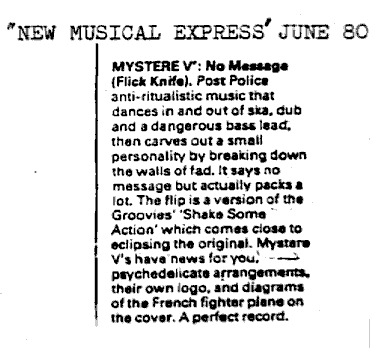
- The aircraft on the cover appears to be a freelance drawing of a generic space shuttle, loosely modelled on the NASA prototype
- The NME is completely useless as a source for identifying aircraft.
Does the image accurately reflect the music?: Not really, no. I think the cover is a vague gesture to the band’s name rather than the song, which has no discernible relation to aeronautical themes. The sleeve credits its design to “Frenchy”, who according to the Mysteres’ drummer was “a non musician, a punk, who was then forming an indie-punk record label”. It is notable that “aircraft expert” is not listed among his attributes.
How good is the record?: I’m gonna be honest here and admit I bought this in a shop in Camden about 20 years ago because I liked the cover and the band name, then put it in a box and forgot about it. I only heard it for the first time recently when I was looking at records for this article. And it’s good. A bassy post-punk/ska number with appealingly glassy, echoey early 1980s production on it.
Weirdly, it makes me think of ‘Hollywood Nights’ by Bob Seger & The Silver Bullet Band, as they have similar chord sequences despite being extremely different songs. It has a functional cover of The Flamin’ Groovies’ ‘Shake Some Action’ on the B-side that the world didn’t really need. Not bad, though. Well worth a speculative £2 Camden purchase.
5. Talking Heads – Remain In Light (Album, 1980)

Aircraft depicted: 1980 was clearly quite the year for record sleeves depicting aeroplanes. In this case it is a flight of four US Navy Grumman TBF Avengers flying in formation over Norfolk, Virginia in September 1942*. This image has been digitally manipulated, with the aircraft being coloured in red and green and superimposed over the Himalayas. The image was selected from US Navy stock images by Talking Heads’ bassist Tina Weymouth, partly in tribute to her father, who had served as a US Navy pilot in World War II**.

This stock image was then manipulated on a computer at MIT by researcher Walter Bender, a process that took an astonishing length of time with the tiny amount of processing power then available, but which nevertheless made it the first album ever released with a computer-designed sleeve.
The resulting picture decorates the rear cover of Talking Heads’ seminal post-punk classic album, with the front cover displaying digitally defaced portraits of the band members. The Avenger image had originally been intended for the front cover to go with the album’s working title of Melody Attack, but it was later relegated to the back cover when the title was changed.
The innovative methods used in the sleeve’s creation, along with its striking design by graphic artist Tibor Kalman, led to the sleeve and its associated artwork being retained as a valuable cultural artifact by the Museum of Modern Art in New York.
* There is a common misconception that the Remain In Light Avenger image represents Flight 19, the Avenger training flight that disappeared in the Bermuda Triangle in 1945. While Weymouth may have considered this (the fate of Flight 19 was part of the plot of Close Encounters of the Third Kind, Steven Spielberg’s hit sci-fi movie that had come out in 1977, so it was in the public consciousness), she never mentioned it in interviews if she did.
** Tina Weymouth’s father, Ralph Weymouth, actually flew the Douglas SBD Dauntless dive bomber from the carriers Saratoga and Lexington during the war, rather than the Avenger. His exceptional wartime piloting exploits won him a Navy Cross and no fewer than five DFCs. He later transferred to jets, fought in Korea and finally retired as a Vice Admiral in 1973, before becoming an anti-nuclear campaigner as a consequence of his service in the occupation forces in Japan after the war. He died in January 2020 at the age of 102. He was quite the badass.
Does the image accurately reflect the music?: Kalman suggested that the image of the Avengers was retained after the album’s title was changed because it was appropriate, as the Iranian Hostage Crisis was going on when the album was recorded and released, but this is an oblique reference at best.
In truth the choice of a flight of Avengers was an odd one, given the era in which it was released. However, the hard, heavy outlines of the aircraft placed in an environment they are not intended for echoes the album’s unusual mix of edgy funk, angular post-punk, African-influenced polyrhythms and general Brian Eno-produced weirdness, with lyrical themes of faceless bureaucracy, post-colonial politics and the blending of government and capitalism.
In short, Tina Weymouth knew what she was doing.
How good is the record?: It’s the one with ‘Once In A Lifetime’ on it. And it’s not even the best song on there. If that isn’t good enough, then I’m not sure I can help you.
6. Godspeed You! Black Emperor – Yanqui U.X.O. (Album, 2002)

Aircraft depicted: No actual aircraft, but instead a rear-facing camera captures the release of what look like napalm canisters, presumably over Vietnam. You wouldn’t believe how much Vietnam-era ground attack footage I watched to try and find this one, but oddly the only source I could find was a political protest film (skip to around 3:30) made by Indian film-maker K P Sasi in 2005. This clearly isn’t the original source and I suspect it comes from Vietnam-era USAF footage of a ground attack run, as shown by similar rear-facing footage shown in this official film.
The image is very grainy, but the shiny aluminium finish and lack of fins on the weapons suggest they are fuel-air explosives being dropped at low altitude: probably BLU-27 or Mk 77 FAE bombs with end caps attached.
There is no way of telling what aircraft they were dropped from, but the low speed differential of the aircraft relative to the falling, high-drag bombs in the film suggest a low-speed aircraft, like a Douglas A-1 Skyraider. Alternatively, the inside sleeve of the record includes a grainy picture of a Douglas A-4 Skyhawk, though this is more likely a randomly chosen image on a theme, rather than a clue to the front cover’s origins.
Does the image accurately reflect the music?: It certainly reflects the band’s anarchist, anti-war political leanings, but given the music consists of long, almost ambient instrumental pieces in a sub-genre known as “post-rock”, it doesn’t exactly mesh with the sound they make. They may think otherwise (the back sleeve of the record is covered with a tortuous diagram purportedly showing the links between four major record companies and weapons manufacturers) and their music does have some very intense moments, but the cover is honestly a fairly jarring mismatch with Godspeed’s lengthy, droning soundscapes. It is also very out of step with the cover images on most of their other releases. Maybe that’s the point?

How good is the record?: It’s certainly not chart music, so One Direction fans will be disappointed. Nevertheless, it is often very beautiful in a glacial, inexorable way and the band have a very loyal following of the sorts of people who probably decorate their walls with pictures and news articles connected by lengths of bright red string attached to safety pins. But then I just spent several hours looking up Vietnam-era ground attack footage and specifications of bombs, so who’s the chump, eh?
7. Blur – ‘For Tomorrow’ (Single, 1993) – Keith Park Life

Aircraft depicted: Two early-model Supermarine Spitfires silhouetted against the bright blue sky and stormy-looking clouds as they bank towards the viewer, in an oil painting by artist Paul Stephens.
Does the image accurately reflect the music?: Blur had been sent off on a 44-date tour of the US and UK in 1992 by their record company, in order to recoup a £60,000 debt run up due to questionable management. The tour was a harrowing ordeal, where the band drank heavily, played to disinterested crowds only interested in grunge, and frequently ended up fighting each other out of sheer frustration.
On their return to the UK, they resolved to produce a record that examined the Britain they had missed during their time abroad, an album that evolved into 1993’s Modern Life Is Rubbish. ‘For Tomorrow’ was the first single from that album, and it is a paean to a partly mythical retro-future Britain, as previously imagined into being by the likes of The Kinks, The Small Faces, The Jam and Slade.
The band reportedly put Spitfires on the cover as it was the most British thing they could think of. And yes, it sounds just like that.
How good is the record?: Genuinely marvellous. Given that when it was recorded, the band were broke, miserable, under threat of being dropped by their label and had to abort their first attempt at recording the album after disappointing results, it is remarkable that ‘For Tomorrow’ came out as it did. Managing to somehow sound simultaneously lush and edgy, it is fresh, accomplished and introduced us to the idea of Britpop: something that until then we hadn’t known about and didn’t know we wanted.
8. Scarfo – Luxury Plane Crash (Album, 1997)

Aircraft depicted: A Swissair Convair CV990 Coronado with landing gear down, about to land at an airport that may be Hong Kong Kai Tak. All of the Swissair branding has been removed, presumably along with the notoriously filthy dark trails from the General Electric CJ805-23B turbofan engines (a type based on the equally smoky GE J79 turbojet of F-4 Phantom fame).
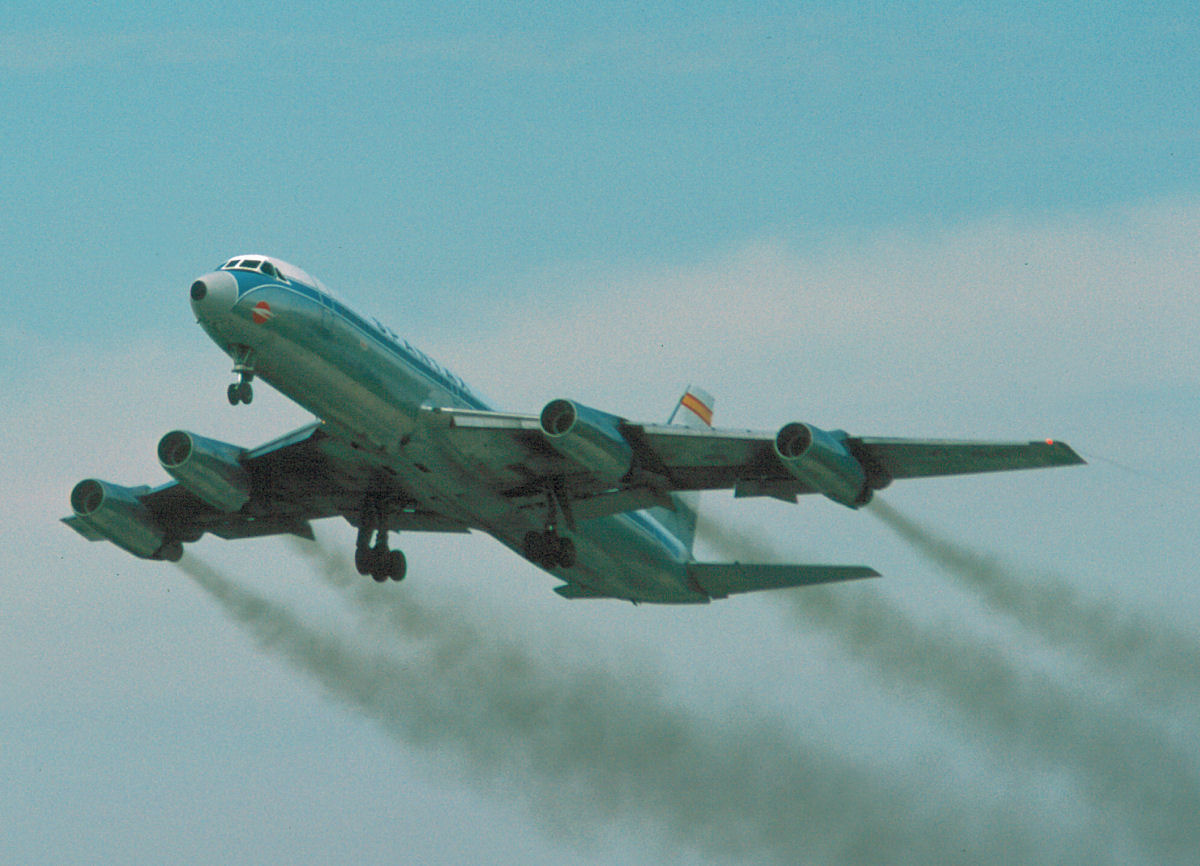
It isn’t clear if the aircraft and background are from the same photograph, as the image has clearly been modified. The tower blocks look like Kai Tak, though, and Swissair Coronados did fly there from Zurich, as shown in this period film, although the thirsty 990 had to stop for a drink four times on the way.
Does the image accurately reflect the music?: Given Scarfo were a tight, spiky, late-Britpop outfit known for their sharp songwriting, sharp clothes and fondness for obscure and arcane equipment, the cover of Luxury Plane Crash is a bit underwhelming. Rather than fitting seamlessly with the atmosphere of the record (as with Suede’s Sci-Fi Lullabies) or making a clear reference to it (as with Les Rallizes’ Flightless Bird…), this cover has the clear implication of an overworked design team saying “will this do?”
How good is the record?: It has its moments. The band have some difficulty maintaining the wiry, frenetic energy of the singles ‘ELO’, ‘Alkaline’ and ‘Cosmonaut No 7’ and the record is a bit patchy as a result. But it’s still a fine effort and far better than most of the tired remnants of Britpop that were their peers.
Scarfo weren’t helped by the fact that their drummer, Al Saunders, was run over by a car in 1996, forcing them to effectively take a year out to allow him to recover, robbing them of a lot of their momentum just before the release of the album.
9. The Screaming Blue Messiahs – Good And Gone (Mini-album, 1984)

Aircraft depicted: A three-ship formation of Republic P-47N Thunderbolt fighters in bare-metal livery, reportedly taken in 1947. The image has been mirrored (so the aircraft are now travelling left-to-right, rather than right-to-left) and the serial numbers removed from the tails to disguise this fact. (They were, for anyone interested, from front to back: 488576, 488589, 488577). The image has also been colourised, as the original is in black and white.

Does the image accurately reflect the music?: Given that the record is a howling, yelping punk-blues mash-up of a subgenre known as “psychobilly”, and features references to Americana generally, and guns, cars, trucks and aeroplanes in particular, then yes, it does. If this record was an aeroplane, it would definitely be a P-47: an overpowered flying hot rod covered in guns, used for hooning around and shooting up whatever is put in front of it. Theoretically they could have used a picture of some Hawker Typhoons, which did some of the same things (The Screaming Blue Messiahs were from London, after all), but it wouldn’t have been quite right. It needs the bare metal, the big star-and-bar roundel, the triangle of fifty-cal barrels protruding from the wings, the conspicuous flash. It needs ramalama, a bit of showbiz. You just don’t get that with a Typhoon in RAF camo.
How good is the record?: Great. Probably not for everyone – people whose musical tastes do not extend beyond Taylor Swift might find it a bit much – but the Messiahs’ feral, turbosupercharged pub blues is just unequivocally marvellous. I gather they were a magnificent live act (you only have to listen to about twenty seconds of this to know they were awesome live) and it is a great shame to me that I never got to see them. Although, to be fair, I was only eight when Good And Gone came out and I was probably more concerned with Lego and Panini football stickers at the time.
10. Primal Scream – ‘If They Move, Kill ‘Em’ (CD single, 1998)

Aircraft depicted: The sleeve depicts a Junkers Ju 87 ‘Stuka’ ground-attack aircraft banking into a dive. From the bulges on the trailing edges of the wings and what look like lengthy barrels projecting from the leading edges, it looks like a G-1 or G-2 Kanonenvogel model, armed with a 37mm Flak 18 anti-aircraft gun in a pod under each wing for anti-tank work.
The aircraft image itself has been reproduced in neon pink on a bright yellow background in a sort of blurry screen-print style, along with two lines of Japanese katakana script reading “PRIMAL SCREAM”. The “V” under the left wing suggests this might be an image of the personal mount of famed Stuka pilot and enthusiastic Nazi Hans Ulrich Rudel (or one of them, at least – he had 30 aircraft shot out from under him in his wartime career).
We will come back to him later.
I have been unable to track down the original image this piece of artwork was rendered from, which is odd, since Rudel was the most decorated Nazi pilot of WWII and an airborne image of one of his aircraft would be very famous. This makes me think that rather than being adapted from a stock photo, the cover image was custom-created from one of the numerous models or kits available of Rudel’s Ju 87s. It is credited on the sleeve to Paul Kelly, a designer and filmmaker who has also worked with Saint Etienne, so it’s unlikely he was around in person to capture Rudel’s G-2 as it winged over into an attack run.
Does the image accurately reflect the music?: The Stuka, with its steep dive-bombing attacks, screaming “Jericho Trumpet” sirens, and blitzkrieg history, is a machine with an image that is crying out to be used on a sleeve by a hardcore Rock and Roll band. You could imagine Motörhead having a record cover featuring a Stuka, for example*. Primal Scream do have a song called ‘Stuka‘, but it is not on this CD (it is on their fifth album Vanishing Point, the one that also features the original version of ‘If They Move, Kill ‘Em’), although it may have inspired the artwork.
The music that is on this single is typical of Primal Scream’s late 90s output: a quite scary remix of ‘If They Move…’ by My Bloody Valentine’s Kevin Shields that should come with some sort of warning before you listen to it on headphones; a dubby, echo-laden cover of the Jesus and Mary Chain’s ‘Darklands’; another wah-wah heavy “Disco” remix of ‘If They Move…’; and a track called ‘Badlands’ which is an even slower, dubbier version of the earlier cover of ‘Darklands’ that probably sounds great at 3am if you’re stoned.
Does it sound like a neon pink Stuka? That’s the thing. It could, because Primal Scream are exactly the sort of band that could carry it off. When they rock, they mean it. They’re not Motörhead, but they actually covered the song ‘Motörhead’ on Vanishing Point. They really believe. They do not do this stuff by halves.
BUT… they are also notoriously left-wing and that makes it seem this image of Rudel’s Stuka has appeared on their record as the result of some terrible error in the creative process. Rudel was an unapologetic Nazi until his death in 1982, set up a “relief agency” for Nazi war criminals and worked hard after the war to help former members of the regime escape justice in South America. Primal Scream are an avowed anti-fascist band. If they had known what that picture was, there is no way on Earth they would have let it go out. Sure, they might have had a Stuka on there, in pink to reclaim it for Rock and Roll, mess with preconceptions and all that. But not Rudel’s plane. That’s somebody not doing their homework and it’s too much. The cover represents something, but it’s not them and I am not sure they even know it.

How good is the record?: As with a lot of these choices, it rather depends on your expectations. But it is, by most objective standards, a pretty extraordinary musical document by a band who hadn’t come anywhere near to running out of ideas yet. Their next album, by coincidence, was 2000’s XTRMNTR, which had US Navy deck crew and an F-4 on the cover.

* As far as I know, Motörhead never had a record with a Stuka on the sleeve. They did use an image of the band flying a Heinkel He 111 on the cover of their Bomber album, though, and for a while they used a custom-built lighting rig in the shape of a Heinkel in their live shows, as shown on the cover of the seminal live album No Sleep ‘Til Hammersmith.
Dornier Do 335, secrets of the Nazi pushmi-pullyu advanced fighter aircraft
Interview with author Robert Forsyth and book review

When faced with similar design goals and timing to the Grumman Tigercat, Dornier took a radically different approach with their unique Do 335. To minimise the frontal surface area, drawing on earlier experience with the Do 18 and the P.59 (a 1937 patent for a tractor-pusher bomber), the ‘335 adopted the rather weird ‘push-pull’ configuration, with both engines mounted in the fuselage. The forward engine is in the traditional location with a tractor propeller. The aft engine is mounted in the middle of the fuselage (for better weight distribution) and is connected to an aft push propeller with a driveshaft. The resulting surface area is only slightly higher than a comparable single-engine fighter.
A pair of Daimler-Benz DB-603 engines, each producing 1,800 hp, allowed for a maximum weight a little higher than a traditional fighter, armed with a 30-mm cannon firing through the propeller hub and a pair of 20-mm cannons in the cowling. The aircraft could carry a lot of fuel and provided a combat range 30 per cent higher than the Focke-Wulf Fw 190 or Messerschmitt Bf 109. The aircraft was too late to see combat in the Second World War, and only thirty-seven were built. Of these, a few reached conversion units for a short duration, but the type did not see combat.
The design produced tremendous performance; despite having 10 per cent less horsepower, the Do 335 was 14 mph (23 km/h) faster than the Grumman Tigercat.
Japan started work on a push-pull fighter, the Tachikawa Ki-94-I, but it was deemed too complex and was cancelled. (the Do 335 is covered in The Hush-Kit Book of Warplanes Vol 2)
Dornier Do 335 (X-Planes Book 9)
Robert Forsyth’s book on the appealing eccentric Dornier Do 335 is excellent. It is a fascinatingly deep delve into the subject, complete with a generous amount of illustrations and photos (and often quite surprising) personal accounts. The macabre world of an evil empire falling to pieces while at the cutting edge of engineering, and the bizarre combination of logical thinking and human madness is brought deftly to life. We met author Robert Forsyth author of Dornier Do 335 (X-Planes Book 9) to find out more.

What was the Do 335?
A big, brutalist, ‘push-pull’ piece of aeronautical engineering from Dornier which first took to the air in October 1943 and was intended to be a high-speed, all-weather, day- and night-fighter. It was one of the small number of German piston-engined wartime designs to feature a nosewheel.
There were plans for a two-seat Do 335 A-6 nightfighter (the radar operator was to sit facing forward in a raised cockpit above and behind the pilot). The various radar aerials were to be fitted as ‘toasting fork’ aerials to the wings, a pair for the lateral beams on the port side and two for the vertical on the starboard side.
Equipment was proposed as:
Telefunken FuG 220 ‘Lichtenstein’ SN-2 D A/I set (later to be replaced by Siemens FuG 218 ‘Neptun’)
Telefunken FuG 350 ‘Naxos’ passive radar to home on to emissions of Allied bombers.
- Was it a good solution to max power with minimum wetted area (compared to, say, the Hornet)?
I’m afraid I cannot comment with regard to the Hornet, which is beyond my knowledge, but it’s an interesting question! Powered by two Daimler-Benz DB 603 engines (one each in the nose and rear fuselage), the Do 335 had, for example, a maximum speed of 732 km/h at 7.1 km. It took 14.5 minutes to climb to 8,000 m.
- Did pilots like flying it? What did they like about it?
The Luftwaffe never flew the Do 335 operationally, although a test unit, Erprobungskommando 335, was established in late 1944. The small group of Luftwaffe pilots who conducted test flights felt the Do 335 could best be deployed as a night fighter.
A test pilot at the Luftwaffe test centre at Rechlin, Flieger-Haupting. Hans-Werner Lerche, summarised: ‘The Do 335 was an unusually powerful aircraft with exceptional flying qualities, and an aeroplane that bestowed on me the pure pleasure of flying, a feeling which I shall not forget as long as I live.’
Lt Cdr Eric Brown, test pilot attached to the Aerodynamics Flight of the Experimental Flying Detachment, recorded: ‘I found the Do 335 lively to fly, and right from the short take-off run under the smooth roar of the two Daimler-Benz DB 603s, it afforded that comforting feeling of being over-powered, a gratifying sensation that one seldom experiences… View in the air was excellent and I had a distinct feeling that the Do 335 was better suited to nocturnal than diurnal fighting…’
- What was its best feature?
Its ambitious experimentalism.
- And worst?
Its ambitious experimentalism. Paradoxically, its design did not live up to the aircraft’s name of ‘Pfeil’ – ‘Arrow’.
How would you rate it in the following:
Sustained turn
Instantaneous turn
Climb rate
Speed
Acceleration
I believe all above were acceptable for 1944, but they would be exceeded and or outclassed by the new German jet types.
Take-off and landing characteristics
These were the two areas where the Do 335 would have probably bettered the jets.
Cockpit layout
Well laid out, and roomy with good vision when airborne, but because of the aircraft’s height when on the ground, tricky when taxiing.
- How much fighting did it do?
None.
- What is the most interesting fact about its development?
Possibly that such a monstrous (and expensive) aeroplane was seen to have multi-role capability: day and night fighter, ‘Zerstörer’ (‘heavy’) fighter, long-range reconnaissance machine, bomber, all-weather aircraft.
- Describe it in three words
Ambitious. Clever. Complex.
What is the greatest myth about the 335?
It was unimportant
What should I have asked you?
About the planned Ju 635 Zwilling (twin-fuselage) long-range maritime reconnaissance aircraft – now that would have been monstrous!

Everything you’ve been told about the ‘Chickenpox bomber’ is wrong, here’s why…
Ah, the famous Chickenpox Plane.

If you’re on any social media and are interested in aeroplanes (and this clearly applies to you), then you know this story. Some typically dumb military officers approach Abraham Wald, a mathematician working with airplane survivability, with data showing how bombers get shot by fighters in their wingtips and tails, and asking him to help work out how much armor they should add there so that they will lose fewer bombers.
Bill Sweetman
Wald then points out that the airmen are looking at the bombers that survived and that those that were shot down were hit somewhere else. Enlightened, the Army Air Force installs armor according to Wald’s ideas and more bombers survive.

The story is usually accompanied by the same drawing (see above)
I first saw this story no more than a few years ago, and I thought, wow, I never heard that before. Which, given that I wrote a book about the A-10 and read the Good Book on aircraft survivability, and attended a conference or two devoted to survivability, piqued my curiosity, not to mention my amour-propre.

There was another piece to the tale that did not fit. The aeroplane in the universally used drawing is a Lockheed PV-1 Ventura. Nothing at all against the Ventura, but almost the entirety of its career was spent chasing submarines or shooting up ships with the Navy, rather than getting shot down en masse over Germany. Why would it be the focus of a survivability study?
Since I have an ADHD proclivity for internet rabbit holes, off I went and found more.
Wald did important mathematical work on survivability. But in 1943. Why is this important? By the time it was completed and reported, the final operational versions of the B-17 and B-24, after getting hammered over Berlin and Schweinfurt &c, were already flying, with essentially the same protection (self-sealing gas tanks and selective armour) that they used for the rest of the war. And where is said armour?

I found this story, too.
Wald did really good work, but the story got embellished. How?
A statistician, author and lecturer called Howard Wainer used the story in lectures and books, back in the late 1990s. He also had a very simple version of the drawing, which was later elaborated into today’s ubiquitous image.
But Ground Zero was where Wainer’s story got Glabared – Gladwellized* beyond all repair – by a best-selling mathematician, Jordan Ellenberg.
“The officers saw an opportunity for efficiency; you can get the same protection with less armor if you concentrate the armor on the places with the greatest need, where the planes are getting hit the most. But exactly how much more armor belonged on those parts of the plane? That was the answer they came to Wald for. It wasn’t the answer they got.”
Follow me on X Twitter here
Whoa! Who’s missing from this account? Fighter pilots, that’s who. As far as I know, they didn’t go shooting at wingtips and tails. They knew damn well what the crucial bits of a bomber were: the engines and the cockpit. Nobody had told the bomber designers, or the USAAF requirement-writers, that?
“Wald’s recommendations were quickly put into effect, and were still being used by the navy and the air force through the wars in Korea and Vietnam.”
Put into effect how and where? Nobody says. Nobody points to a certain block of B-17G or B-24J production where changes were introduced.
And the survivability lessons of WW2 had mostly been abandoned by the time of Korea. Indeed, jet airplanes were so sensitive to weight and burned fuel so fast that self-sealing tanks (which cost fuel volume) and armour were ditched. It was also assumed from the late 1950s that if you were hit, it was by a missile and Goodnight Nurse. Vietnam proved this to be wrong, and its lessons were incorporated in the A-10 ‘Warthog’ and, more subtly, in many other aircraft.
Lessons: as Abraham Lincoln said, don’t believe everything you see on the Internet. And mathematicians, like fighter pilots and first violins, are not immune from telling stories about how important they are.
*Malcolm Gladwell, Norden, Lenin and strategic bombing is a whole different story
Bill’s new book Trillion Dollar Trainwreck: How The F-35 Hollowed Out The U.S. Air Force is available to buy here.
The Hush-Kit Book of Warplanes Vol 3 is available to pre-order here

Stealthy supersonic robot fighter Wingman revealed by Airbus
Sleek new drone nicknamed ‘Goblin Shark’

Airbus has announced that they will present a full-scale model of their ‘Wingman’ concept at the upcoming ILA in Berlin. The Airbus announcement includes a picture of the concept, which features several emerging technologies that are being showcased for possible inclusion in a future air combat semi-autonomous wingman.
These technologies include a design that is clearly intended to be both stealthy and manoeuvrable, and to offer supersonic capability. Carriage of sensors and air-to-air and air-to-surface weapons is envisaged, and the potential role described is as a semi-autonomous adjunct to aircraft such as the Eurofighter Typhoon.
Importantly, Airbus explicitly recognise that future capabilities using such systems require not only the platform technologies to be available, but also the broader system of systems, enabling command and control, decision-making and teaming of the air combat elements. In addition, novel tactics are likely to be developed for the effective application of teamed manned and unmanned solutions.
Proposals of this sort are not new, but they are of considerable interest to the writer, having been involved in UK Air Combat research for a period in my mid-career. The first autonomous fighter proposal I encountered was a Lockheed-Martin attempt to market autonomous F-16s, perhaps influenced by the sense of emerging competition from European platforms such as Typhoon, Rafale and Gripen. This was supported by early autonomous combat work using the USAF VISTA testbed, in which, I understand, the safety pilot found the aircraft autonomously pulling significant g, while seeking to engage a target, quite disturbing. “Difficult to keep one’s hands on the knees” is the quote I recall.

I have no doubt that the concept of a pilot, in (for example) a Typhoon, FCAS or Tempest, controlling a number of autonomous armed wingmen to shape the battlespace favourably, can work. I make this assertion because such a situation has been modelled using simulators more than two decades ago in the UK research programme, as part of work to examine future capabilities.
At the time, many of the technologies would have been regarded as somewhat immature, but apart from establishing a level of feasibility, useful work was done examining how command and control would be exercised, how situational awareness might be delivered, and how the use of such systems affected pilot workload. The development of tactics for the use of such systems was of particular interest, and I am confident that much thought is being directed in this area, given the significant range of roles which might be addressed by such systems.
I’ll say no more about that work, which was, to some extent overtaken by the pressure to bring Typhoon into effective service, and, to some extent, made to appear less relevant by the economic collapse of the Soviet Union.
Today, however, such concepts appear more relevant than ever, with a resurgent Russia, with concerns about Chinese aspirations, and with considerable uncertainty about how reliable the US might be as an ally in the future.
The Airbus concept

Concept cars are always fascinating to look at, even though the eventual marketed products rarely live up to the imagination of the concept. In aerospace, however, technology demonstrators have had a useful place in helping to identify technology and integration risks, and showing how these can be resolved.
In the case of the Airbus offering, and on the basis of the information provided, I’ll make the following observations:
The wing and canard planform and thickness/chord ratio, plus the engine installation and intake, appear consistent with a maneuverable platform capable of flight at up to about Mach 1.8.
Depending on the scale of the platform, which is difficult to judge from the image, but will become apparent when the model is displayed at the ILA, there appears to be adequate provision made for both fuel and a variety of weapons.
The absence of a vertical fin, plus the edge alignment and the treatment of control surfaces and leading edges, suggest that a low radar signature is one of the design drivers.
Novel control systems will be essential, particularly to manage lateral-directional stability and control at supersonic speeds. This can be problematic for a slender aircraft, and is one reason why large (and often twin) fins and rudders have been a feature of supersonic manoeuvring aircraft. Techniques are available, and have been demonstrated, ranging from split control surfaces to provide pitch, roll and yaw control, to circulation control by b[own jets, with no requirement for moving control surfaces.
Rather like a concept car, not all the trade studies have been done as yet. High maneuverability may or may not be required, depending on the role and mission. For example, an opportunity exists to design a platform able to manoeuvre outside the 9-g limit imposed by a human operator. But this would come with a weight penalty and would require a suitable (bigger) engine.


Whether such manoeuvrability would be required is probably tightly connected to whether the primary use will be as an ancillary sensor and EW system, as a strike platform, or as an air combat system.
The sensor suite, missile armament, datalink and communications capabilities are also all in the complex trade space, and will be dependent on Defence Department decisions about what the missions need to be, and how they are split between the manned and unmanned elements.
Inevitably, of course, one has to consider cost and broader programmatic issues. The more capable the semi-autonomous system is, the more complex it will be. Size, weight, propulsion and payload-range are all enablers for greater capability but are also powerful cost drivers.
System integration, and particularly the time taken to deliver the fully integrated system that would be needed is a powerful driver of risk, cost and time, and, indeed, may well be considered as the ongoing thorn in the side of the JSF programme.
https://unbound.com/books/the-hush-kit-book-of-warplanes-vol-3
The other elephant in the room is the messy situation regarding European and International air combat programs. Development of an effective system-of-systems will require coordination between manned and unmanned platform programs since there will be a co-dependency of requirements for each, dependent on the roles envisaged for each and how these are to be delivered.
This will have a comprehensive impact on the sensor, communications and weapons suite for each, as well as having fundamental effects on weapons bay size, fuel capacity, propulsion and layout. So, is the Airbus concept aimed at co-development with the Franco-German FCAS, or the Tempest/GCAP program? Or is it a stand-alone effort hoping to appeal to both, or even the US future air dominance programs?
Programme aspects
There are many issues to be addressed and questions to be answered before the technology mix adopted in a future semi-autonomous uncrewed air combat system can be defined. The Airbus concept demonstrator is important, not least because it should stimulate debate about how the future air combat systems of a number of countries are to be developed, and because it may de-risk some key technologies.
Key issues include the role of manned and unmanned systems; the effects to be delivered and how this will be done; the definition of the requirements for system elements; and who the key partners will be, both from the Industrial and the Military perspective. Recent discussion has emphasised the importance of Sovereignty in the development, deployment and use of such capability, and this aspect will surely also need careful consideration.
A nagging final question, particularly for the Tempest/GCAP and FCAS programs, is what adjunct systems will be required and how these are to be funded. Does the Airbus concept have a place in either program? If so, what would impact the management, industrial structure, requirements, and development program?
There is some sense of urgency in all these questions, given worldwide developments in foreign and military affairs, and some considerable uncertainty about possible political developments in the US, which may impact on current alliance structures.
Airbus presentations at the ILA on this topic will surely be observed with great interest, but one does feel that there is much water to flow under this particular bridge before a sensible, effective development partnership and program can be developed.
Thanks, everyone! It’s been a superb week. The sooner this gets to 100%, the sooner I can get cracking & make this happen. Simply pre-order your copy now, that’s all you have to do to support the project. Your name will appear in the book.

Airbus press announcement
“Berlin, 3 June 2024 – Airbus will be presenting its new Wingman concept at the International Aerospace Exhibition ILA in Berlin. In military aviation, a “Wingman” is a pilot in another aircraft that protects and supports the flight lead, delivers more tactical options and thus contributes to mission success. In the Airbus concept, the Wingman is going to operate very much in the same way – only that it is neither a pilot nor a fighter jet flown by one. It is a fighter-type drone that will be commanded by a pilot in a current combat aircraft such as the Eurofighter and can take on high-risk mission tasks that would pose a bigger threat to manned-only aircraft.

The 1:1 model, which Airbus will be exhibiting from June 5 to 9 on its static display at ILA, is similar to a “show car” used as a design exercise by the automotive industry. The Wingman model showcases all of the foreseen capabilities required, such as low observability, the integration of various armaments, advanced sensors, connectivity and teaming solutions. As with “show cars”, not all of what is on display may find its way into series production. In this aspect, the model on display at ILA Berlin will serve as a foundation and catalyst to drive the design requirements for each generation of the Wingman.
Based on the current concept, the Wingman is intended to augment the capabilities of current manned combat aircraft with uncrewed platforms that can carry weapons and other effectors.
“The German Air Force has expressed a clear need for an unmanned aircraft flying with and supporting missions of its manned fighter jets before the Future Combat Air System will be operational in 2040,” said Michael Schoellhorn, CEO of Airbus Defence and Space. “Our Wingman concept is the answer. We will further drive and fine-tune this innovation made in Germany so that ultimately we can offer the German Air Force an affordable solution with the performance it needs to maximise the effects and multiply the power of its fighter fleet for the 2030s.”
The Wingman’s tasks can range from reconnaissance to jamming targets and engaging targets on the ground or in the air with precision-guided munitions or missiles. Pilots in manned aircraft acting as “command fighters” will always have control of the mission. They are always the final decision-making authority, while benefiting from the protection and smaller risk exposure that the delegation of tactical taskings to unmanned systems offers. An additional focus is on affordably increasing the overall combat mass so that air forces can match the number of opposing forces in peers or near-peers in conflicts.”
– Jim Smith